This manual is for EDD FPX 9955 Assessment 1, start to submission. Assessment 1 usually opens the interpretation stage, so the data is fixed and the only remaining variable is your judgment about it. The deliverable is an interpretation: each finding connected to the framework that predicted it or failed to, set against the literature that agrees or disagrees, with every discrepancy explained through a difference you can name. Your scoring guide fixes the deliverable and how far it reaches. Below is our method, a criterion-mapped structure, and an annotated sample excerpt. Prefer to hand it off? A premium original sample comes back in 24 to 48 hours, revised free until it meets the guide. Capella's catalog lists the course as EDD-FPX9955, and some courserooms print EDD9955; both point to this same Assessment 1.
One honesty note before the manual: Capella revises courses and scoring guides over time, so always write to the exact scoring guide attached to your assessment in the courseroom. The course identity above is verified on capella.edu; the method and structure below are our tutors' approach to it, not Capella's official rubric text.
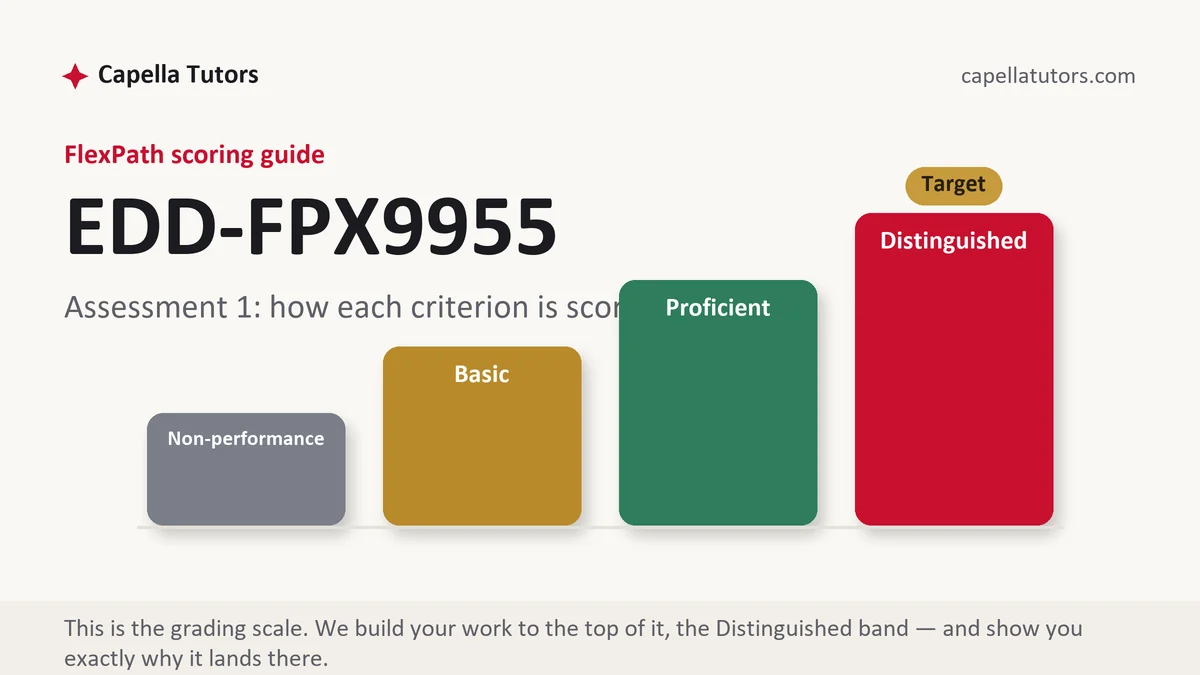
How EDD FPX 9955 Assessment 1 is scored
Each criterion resolves to one of four levels, and on an interpretation the top level pays for explanation rather than for agreement:
| Level | What it means on an interpretation of findings |
|---|---|
| Distinguished | Each finding is connected to the framework and to the field, disagreements are explained through a named difference in dose, window, population or setting, and the competing explanation is dealt with rather than ignored. |
| Proficient | Findings interpreted completely against the framework and the literature. Sound, and short of the row above wherever a discrepancy is noted and left unexplained. |
| Basic | Results restated with fresh adjectives and a citation added, so the section reports a second time instead of arguing once. |
| Non-performance | A required element is absent, most often the relationship to the framework, or the treatment of alternative explanations the criterion asked for. |
One approval reality shapes what this chapter may say. Your determination and your consent language fixed how the site and the participants could be described, so an interpretation that names the elementary school, its principal and its reading specialist re-identifies people who agreed to be aggregated. Describe the context richly and generically, by size, poverty rate, staffing pattern and prior performance, because that is what licenses transfer anyway. Where the argument genuinely requires a named site, that is a permission question for the district and your review body, asked before the sentence is written.
The handoff runs into recommendations, and it is tighter than it looks. Every recommendation the next deliverable makes has to trace back to an interpretation written here, so a claim you assert now without a mechanism behind it produces advice nobody can defend in a board room. Keep a running list of the mechanisms you settle on, since those sentences become the justification column when the recommendations get costed and scheduled later in the sequence.
The EDD FPX 9955 Assessment 1 method, step by step
-
Write one unexplained sentence per finding
List the findings in plain language with nothing attached, then line them up under the research questions. Two will collapse into one and one will be an observation you never tested. That page is your outline, and building it first is what stops the chapter from becoming a second results section.
-
Expand each finding in a fixed order
What it says, what the framework predicted, what the literature reports, what differs, what follows. Writing every finding through the same five moves keeps the section from wandering, and it makes the criterion easy for an evaluator to locate, which is worth more than variety at this stage.
-
Explain disagreement through a named difference
Where your result parts from the field, the answer is almost never that the field is wrong. It is a smaller dose, a shorter window, a different baseline, a population the original studies never included. Naming which one, and showing it in your own data, is the work a practitioner doctorate exists to do.
-
Give the framework an honest verdict
Say which constructs the data supported, which it did not, and where the model needs adjusting for a setting like yours. A framework that survives untouched through a real study usually means it was never put at risk, and a reviewer reading five chapters in order will notice that it stopped doing work after the literature review.
-
Kill the alternative explanation on the page
Name the rival account a skeptical reader would raise, maturation, a concurrent initiative, a cohort difference, differential attrition, then show what in your data speaks against it or concede what you cannot rule out. Conceding one rival explanation precisely is stronger than claiming to have excluded all of them.
-
Change the grammatical subject, then self-score
In results the subject is the data; here the subject should be the idea. If a paragraph still opens with a number, it belongs in the previous chapter. Then mark each criterion honestly, confirm no finding appears here that never appeared upstream, and submit early, allowing two business days for evaluation.
A structure that maps to the criteria
These are our planning targets for an interpretation chapter, not Capella rules. Give the per-question interpretation the bulk of the length and keep the framework verdict short and unhedged.
| Section | What it must do | Guide |
|---|---|---|
| Chapter opening | The purpose, the questions and what this chapter adds beyond the findings. | ~200 words |
| Interpretation by question | Each finding through the five moves, with the mechanism you propose stated plainly. | ~700 words |
| The framework revisited | Which constructs held, which did not, and what the model needs in a setting like yours. | ~250 words |
| Alternative explanations | The rival accounts named, and what in the data speaks for or against each. | ~250 words |
| Relation to the field | Whether your result extends, bounds or complicates the studies nearest to it. | ~250 words |
| Summary and references | The argument condensed, with primary sources checked and current APA both ways. | ~200 words |
Annotated sample excerpt
An original paragraph from our team at the register an interpretation criterion rewards. Learn the moves, then write them against your own findings.
The kindergarten and first grade cohorts gained 0.31 standard deviations on the phonological measure against the 0.55 reported in the two efficacy trials the program cites, and the framework predicted the smaller figure once fidelity is treated as a mediator rather than as a precondition.1 Teachers in this district delivered a median of 19 minutes of the intended 30 in the small-group block, and the trials that reported 0.55 ran in schools with a dedicated interventionist rather than with classroom teachers absorbing the block into an existing literacy hour.2 Read that way the result bounds the published finding rather than contradicting it: the program appears to work at partial dose, at roughly the proportion of the dose delivered, which is a more useful claim for a district choosing between buying the program and buying the staffing the program assumes.3
- 1Puts the local effect and the published effect in the same sentence, then credits the framework with predicting the gap. Comparison first, explanation second.
- 2Names the difference and evidences it with a delivery figure from the writer's own data, plus the staffing difference in the original trials.
- 3Chooses the word bounds over contradicts and defends the choice, then converts the interpretation into the decision a district is actually facing.
The full premium sample for your exact assessment, written fresh to your scoring guide and issue, is free to request. Study it, revise it into your own voice, and submit work you understand.
The five mistakes that cost Distinguished
- Findings repeated instead of interpreted. Restating results with new adjectives satisfies neither the findings criterion nor this one.
- Discrepancy noticed and dropped. A sentence conceding that your result differs from the literature, with no named difference behind it, forfeits the criterion.
- A framework that never took a hit. A model confirmed in every particular reads as a model that was never tested against the data.
- Rivals ignored rather than answered. The alternative explanation you skip is the first question a reader asks, and skipping it looks like not having seen it.
- Interpretation of things never measured. A claim about teacher belief in a study that measured only practice arrives from nowhere and cannot be traced upstream.
Pre-submission checklist
- Every finding stated once in plain language before any explanation was attached
- Each interpretation runs the same five moves, ending in what follows
- Every discrepancy with the literature explained through a difference named in your data
- The framework given a verdict, including the constructs the data declined to support
- At least one alternative explanation answered or explicitly conceded
- No finding interpreted here that did not appear in the findings chapter
Interpretation chapter due?
Send the guide, your findings and whatever framework you settled on. Eight people, including a research analyst and two QA reviewers, return a premium original sample in 24 to 48 hours with each finding argued through the framework, discrepancies explained and rivals answered, revised free until the guide is satisfied.