This manual is for EDD FPX 9954 Assessment 3, start to submission. Assessment 3 usually turns the analysis into a chapter, so the graded question is discipline: whether you can report what the data says and stop there. The deliverable is a findings section organized under each research question, carried by statistics or by quotations, with meaning held back for the stage that pays for it. Your scoring guide decides the deliverable and its organization. Below is our method, a criterion-mapped structure, and an annotated sample excerpt. Prefer to hand it off? A premium original sample comes back in 24 to 48 hours, revised free until it meets the guide. Capella's catalog lists the course as EDD-FPX9954, and some courserooms print EDD9954; both point to this same Assessment 3.
One honesty note before the manual: Capella revises courses and scoring guides over time, so always write to the exact scoring guide attached to your assessment in the courseroom. The course identity above is verified on capella.edu; the method and structure below are our tutors' approach to it, not Capella's official rubric text.
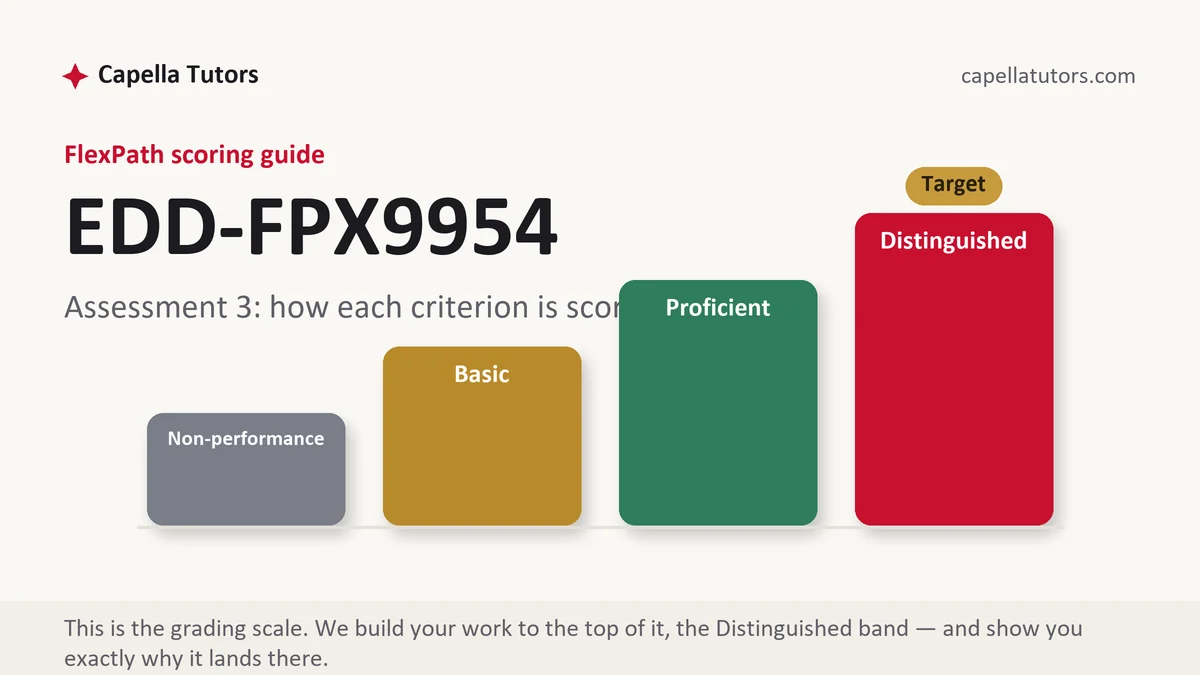
How EDD FPX 9954 Assessment 3 is scored
Each criterion resolves to one of four levels, and on a findings section the top level rewards restraint as much as completeness:
| Level | What it means on a findings section |
|---|---|
| Distinguished | Results sit under the question they answer, every figure arrives with its uncertainty and every quotation earns its length, the pattern that does not fit is reported alongside the one that does, and no sentence explains why. |
| Proficient | Findings reported completely and accurately under each question. Solid, and short of the row above wherever intervals are missing or the inconvenient case goes unmentioned. |
| Basic | A tour of the data organized by instrument rather than by question, with interpretation leaking into paragraphs that were supposed to report. |
| Non-performance | A required element is absent, most often a research question left unanswered, or the tables and figures the criterion asked for. |
Two disclosure realities govern what may appear on the page. Small cells identify people, so a subgroup of four students or one reading specialist is suppressed or aggregated even inside a document only your committee will read, and the rule holds for quotations as firmly as for tables. And the ethics account in this chapter has to match what was approved: where consent covered aggregate reporting, a table naming a building and a single teacher exceeds it, and reporting something the determination never contemplated is a modification request rather than a judgment call.
This chapter is the handoff, and the standard is stricter than being understandable to you. Everything the interpretation stage argues has to be visible here first, because a finding introduced later cannot be defended and a reader working through the document in order will see it arrive from nowhere. Write reflexive memos while the material is fresh, since the reflective account expected at the close of the sequence is easier to evidence from notes than reconstructed nine months afterward.
The EDD FPX 9954 Assessment 3 method, step by step
-
Make the questions the headings
Give every research question its own subsection with the question printed as the heading, in the wording it was asked. Organizing by instrument instead, one section for the survey and one for the interviews, is the structural error most commonly flagged at this stage, because it forces a reader to assemble your answer for you.
-
Write one plain sentence per finding first
Before any prose, write each finding as a single unexplained sentence and line the sentences up under the questions. Two of them will turn out to be the same finding and one will be an observation you never tested. Discovering that on a page costs ten minutes; discovering it in a committee meeting costs a session.
-
Report the size, not only the verdict
Give the estimate, its interval and its practical scale in units your reader thinks in. A 4.2 point shift on a 60 point measure across 214 students is a standardized difference near 0.28 with an interval running roughly 0.06 to 0.50, and translating that into students is what makes it usable to a cabinet.
-
Let quotations do work a paraphrase cannot
One extract per point, chosen because its wording carries something your summary would flatten, attributed to a participant identifier and a role, with enough context that a reader knows what was asked. Three long quotations making the same point signal a coding process that never reached a category.
-
Report the case that does not fit
Name the school moving the other way, the participant contradicting the theme, the subgroup where the effect disappears. A chapter in which every finding agrees with every other invites the suspicion that something was left out, and a reader who forms that suspicion applies it to everything they cannot check.
-
Strip the explanations, then self-score
Read the draft hunting the word because, and move every sentence answering why into a file for the next stage. Confirm each table stands alone, is called out before it appears, and agrees with the narrative to the last decimal. Then mark each criterion honestly and submit early, allowing two business days for evaluation.
A structure that maps to the criteria
Planning targets from our tutors for a findings chapter, not Capella requirements. The per-question sections carry most of the length, and the summary should be the shortest thing in it.
| Section | What it must do | Guide |
|---|---|---|
| Chapter opening | The purpose restated, the questions listed, and what the chapter will and will not do. | ~200 words |
| Sample as realized | Final participant and record counts, response rates, and who is actually in the data. | ~250 words |
| Findings by question | Each question answered under its own heading, with statistics or quotations carrying the claim. | ~800 words |
| Results that do not fit | The case running the other way, reported with the same care as the pattern that does. | ~200 words |
| Tables and figures | Numbered in order, called out before they appear, readable without the surrounding prose. | as needed |
| Summary and references | A short recap of the answers with no interpretation in it, current APA both ways. | ~200 words |
Annotated sample excerpt
An original paragraph from our team at the register a findings criterion rewards, reporting a result without explaining it. Learn the moves, then write your own.
Across the four pilot high schools, the share of ninth graders flagged chronically absent by the end of the first semester was 18.4 percent in the pilot cohort and 23.1 percent in the prior year's cohort, a difference of 4.7 percentage points with a 95 percent interval running from 1.2 to 8.2 points, which on an enrolled ninth grade of 1,046 students is roughly 49 students.1 The direction was not uniform: three schools declined between 3.9 and 7.6 points while School D rose 1.8 points, and School D was also the only site where the weekly flag list reached teachers after the Friday attendance conferences rather than before them.2 Coaches described the change in the language of routine rather than of insight, with one saying the list did not tell her anything she did not know but did tell her on Monday instead of in November.3
- 1Both rates, the difference, the interval and the same result expressed in students. A district reader thinks in students, and the translation costs one clause.
- 2Reports the site contradicting the pattern and pairs it with one factual difference in how the pilot ran there, with no explanation attached. The restraint is the criterion.
- 3A quotation kept because its phrasing carries something a paraphrase would lose. Timing rather than information is the participant's own distinction, not the writer's.
The full premium sample for your exact assessment, written fresh to your scoring guide and issue, is free to request. Study it, revise it into your own voice, and submit work you understand.
The five mistakes that cost Distinguished
- Interpretation smuggled in. A results paragraph explaining why spends the next stage's material early and earns credit in neither place.
- Organization by instrument. Survey findings followed by interview findings makes the reader answer your research questions on your behalf.
- Bare p values. Significance with no effect size and no interval says something happened and nothing about whether it matters.
- Quotations as decoration. Long extracts repeating a point already made read as padding and expose coding that stopped at description.
- Only the convenient pattern. A chapter with no anomaly in it reads as curated, and a reader who suspects curation discounts what cannot be verified.
Pre-submission checklist
- Every research question has its own heading in the wording it was asked
- Each finding stated as one plain sentence before any explanation was written
- Effect sizes and intervals reported, and translated into units a district thinks in
- One purposeful quotation per point, attributed and de-identified
- The disconfirming case or site reported without a defence attached to it
- Every table called out before it appears, readable alone, and agreeing with the narrative
Findings chapter due?
Send the guide, your coded transcripts or your output, and the questions in their approved wording. Eight people, including a research analyst and two QA reviewers, return a premium original sample in 24 to 48 hours organized by question, with intervals reported and interpretation held back, revised free until the guide is satisfied.