This manual is for EDD FPX 9954 Assessment 2, start to submission. Assessment 2 usually moves from what you hold to what you did with it, so the graded object is procedure rather than result. The deliverable is an analytic account: the coding cycles or statistical steps in the order they ran, the codebook or the condition checks behind them, and the evidence for whatever trustworthiness you claim. Your scoring guide decides the deliverable and its evidence. Below is our method, a criterion-mapped structure, and an annotated sample excerpt. Prefer to hand it off? A premium original sample comes back in 24 to 48 hours, revised free until it meets the guide. Capella's catalog lists the course as EDD-FPX9954, and some courserooms print EDD9954; both point to this same Assessment 2.
One honesty note before the manual: Capella revises courses and scoring guides over time, so always write to the exact scoring guide attached to your assessment in the courseroom. The course identity above is verified on capella.edu; the method and structure below are our tutors' approach to it, not Capella's official rubric text.
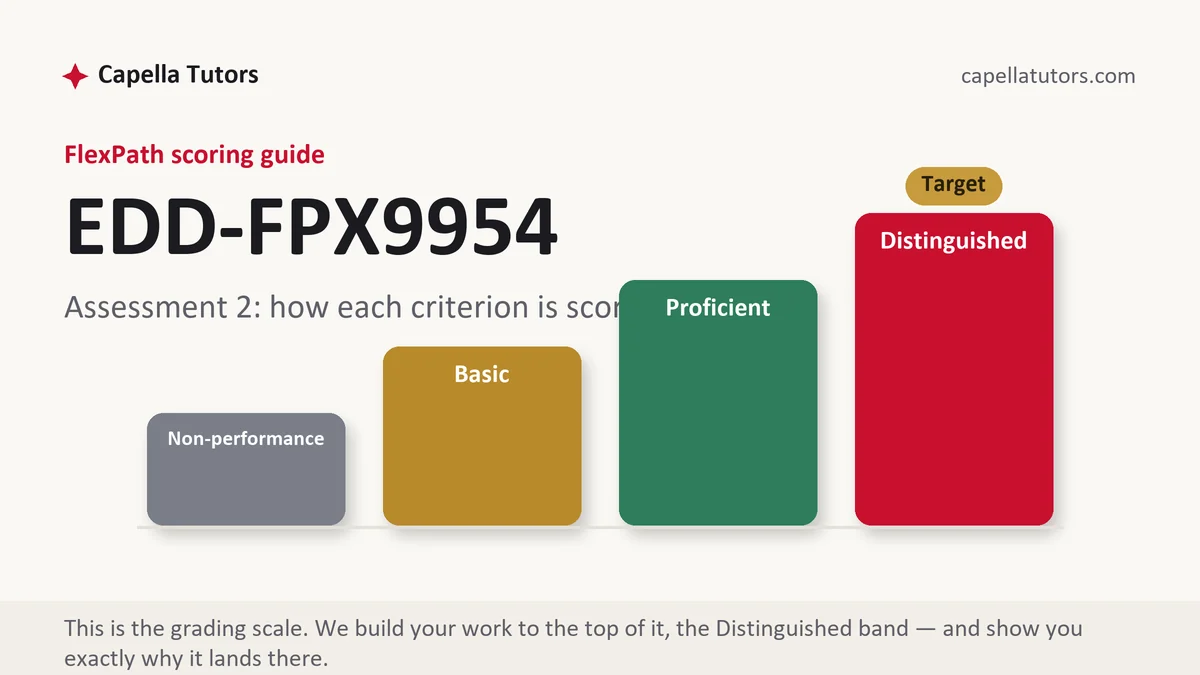
How EDD FPX 9954 Assessment 2 is scored
Each criterion resolves to one of four levels, and on an analytic account the top level buys repeatability rather than sophistication:
| Level | What it means on an analytic procedure |
|---|---|
| Distinguished | The procedure is written so another analyst could run it on the same material and land close to the same place, every trustworthiness claim is backed by an artifact, and the decisions that could have gone otherwise are named along with why they went this way. |
| Proficient | A clear and complete description of how the analysis was conducted. Solid, and short of the row above wherever a claim such as member checking is named rather than evidenced. |
| Basic | The approach announced by label, with codes listed and no definitions, or tests reported with no check that their conditions held. |
| Non-performance | A required element is absent, most often the codebook or the condition testing, or the agreement evidence the criterion asked for. |
Two ethics realities bite here rather than earlier. De-identification is an analytic task, because a quotation naming a grade level, a subject and a years-of-service band identifies one person in a building of forty, and your review determination assumed that person stays unidentifiable. And the moment a second coder touches your transcripts, somebody outside the approved protocol is handling human subjects material, which means naming them, training them, and binding them to the confidentiality terms you signed.
What the next stage needs from this one is an argument it can stand on. Findings organized by research question inherit whatever rigor the procedure established, so a category built without a rule cannot support a recommendation a district would act on. Write the codebook and the decision log as documents you hand forward rather than as scaffolding you discard, since the reconciliation waiting in EDD FPX 9956 will compare every construct name here against the framework that defined it.
The EDD FPX 9954 Assessment 2 method, step by step
-
Write the codebook before the second transcript
Each code gets a name, a one-sentence definition, an inclusion rule, an exclusion rule and a verbatim exemplar. Codes without exclusion rules expand until they mean nothing, which is how a corpus ends up with one theme covering half the data. Version the codebook and date each version, because the changes evidence a first cycle doing its job.
-
Keep the first cycle close to the language of the room
Code in the participants' words before you code in the framework's words. A coach saying she spends her mornings covering classes is a coverage code, not a role ambiguity code, and the promotion from one to the other is a decision you should be able to point at. Framework vocabulary applied first finds only what the framework predicted.
-
Promote codes to categories only with a stated rule
A category needs an assertion attached: this group of codes says coaching time is displaced by supervision duties. Write the assertion, list the codes under it, and record how many participants and excerpts support it. If you cannot state what the category claims, you have a folder rather than a finding, and folder names score Basic.
-
Evidence the trustworthiness you claim, and nothing more
Claim intercoder agreement and produce it: a second coder on a stated share of the corpus, an agreement figure, and an account of how disagreements were settled. Claim member checking and say who received what, for how long, and what changed. A named safeguard with no artifact behind it is worse than no claim at all.
-
Run the checks your statistics assume
Report missing data and the named method that handled it, test the conditions rather than asserting them, and give reliability for every scale. Then report the full result, test, degrees of freedom, statistic, exact p, effect size and interval, in that order. A verdict with no effect size answers whether and leaves a district asking how much.
-
Hunt the disconfirming case, then self-score
Work the material a second time looking only for what contradicts your emerging theme, quote the participant who does, and say what you did with them. Negative case analysis is the cheapest credibility available and the most visibly absent when skipped. Then mark each criterion honestly and submit early, allowing the two business days for evaluation.
A structure that maps to the criteria
These are our planning targets for an analytic account rather than Capella rules. Give the codebook and trustworthiness rows the most room, since they carry the criteria other sections only describe.
| Section | What it must do | Guide |
|---|---|---|
| Approach and rationale | The analytic tradition or test chosen, and why it fits the question you actually asked. | ~200 words |
| The codebook | Codes with definitions, inclusion and exclusion rules, exemplars, and a dated version history. | ~300 words |
| Cycles and decisions | How coding moved from first cycle to categories to themes, with the promotion rules stated. | ~300 words |
| Quantitative procedure | Missing data, condition checks, reliability, software and version, with full result reporting. | ~250 words |
| Trustworthiness evidence | Agreement figures, member checking records, audit trail entries and disconfirming cases. | ~250 words |
| Appendices and references | Codebook excerpt, agreement calculation and instrument, methodological sources in current APA. | ~200 words |
Annotated sample excerpt
An original excerpt from our team showing what a procedure paragraph looks like when it is evidenced rather than asserted. Study the moves, then write your own.
The code coverage displacement was applied to any passage in which a coach described instructional coaching time being reassigned to classroom coverage, substitute duty or supervision, and excluded passages describing coaching time lost to meetings, testing or absence, which were coded separately.1 It appeared in 9 of the 12 coach interviews and in 41 excerpts, and its exemplar is a first-year coach saying that three mornings out of five she is a substitute with a coaching title.2 A second coder, an assistant principal from a non-participating district trained on two transcripts and bound by the same confidentiality agreement, independently coded 20 percent of the corpus and produced a kappa of 0.81 on this code; the four disagreements all concerned meeting time, and they were resolved by tightening the exclusion rule and recoding the corpus under version 3 of the codebook.3
- 1Definition and exclusion rule in one sentence, with the neighboring code named. Exclusion is what makes a code testable, and its absence is the commonest reason agreement comes out low.
- 2Prevalence reported by participant and by excerpt, then one exemplar in the participant's own words. Counts stop a reader wondering whether a theme rests on one talkative person.
- 3Who the second coder was, what licensed them to read transcripts, the share coded, the figure, and what the disagreements changed. The recode under a new version proves the process was real.
The full premium sample for your exact assessment, written fresh to your scoring guide and issue, is free to request. Study it, revise it into your own voice, and submit work you understand.
The five mistakes that cost Distinguished
- Codes with no exclusion rule. A code that can absorb anything absorbs everything, and the theme built on it says nothing a district can use.
- Framework language in the first cycle. Coding straight into your constructs guarantees you find them, which a reviewer reads as confirmation rather than analysis.
- Themes that are only topics. Barriers to implementation is a folder label, and the criterion is asking what participants actually said.
- Trustworthiness named, not shown. Triangulation and member checking with no artifacts behind them read as vocabulary borrowed from a methods text.
- Conditions asserted rather than tested. A test reported without its assumptions checked leaves the whole result available to be discounted in one comment.
Pre-submission checklist
- Every code carries a definition, an inclusion rule, an exclusion rule and an exemplar
- Category promotions stated as assertions, with participant and excerpt counts
- Second coder named, trained, bound by confidentiality, with an agreement figure reported
- Missing data, condition checks and reliability reported for every quantitative claim
- At least one disconfirming case quoted, with what you did about it
- Quotations de-identified so no combination of details identifies a person in their building
Codebook or analysis due?
Send the guide, your filed protocol and your transcripts or dataset. Eight people, including a research analyst and two QA reviewers, return a premium original sample in 24 to 48 hours with the codebook built to rules, agreement calculated and every claim carrying its artifact, revised free until the guide is satisfied.