This manual is for EDD FPX 9954 Assessment 1, start to submission. Assessment 1 usually opens the collection stage, so what is graded is correspondence rather than interest: whether the material you now hold is the material your approved design promised. The deliverable is a data account, a record of what was gathered, from whom, on which dates, under which permission, and where the realized set parted company with the protocol. Your scoring guide decides the deliverable and its boundaries. Below is our method, a criterion-mapped structure, and an annotated sample excerpt. Prefer to hand it off? A premium original sample comes back in 24 to 48 hours, revised free until it meets the guide. Capella's catalog lists the course as EDD-FPX9954, and some courserooms print EDD9954; both point to this same Assessment 1.
One honesty note before the manual: Capella revises courses and scoring guides over time, so always write to the exact scoring guide attached to your assessment in the courseroom. The course identity above is verified on capella.edu; the method and structure below are our tutors' approach to it, not Capella's official rubric text.
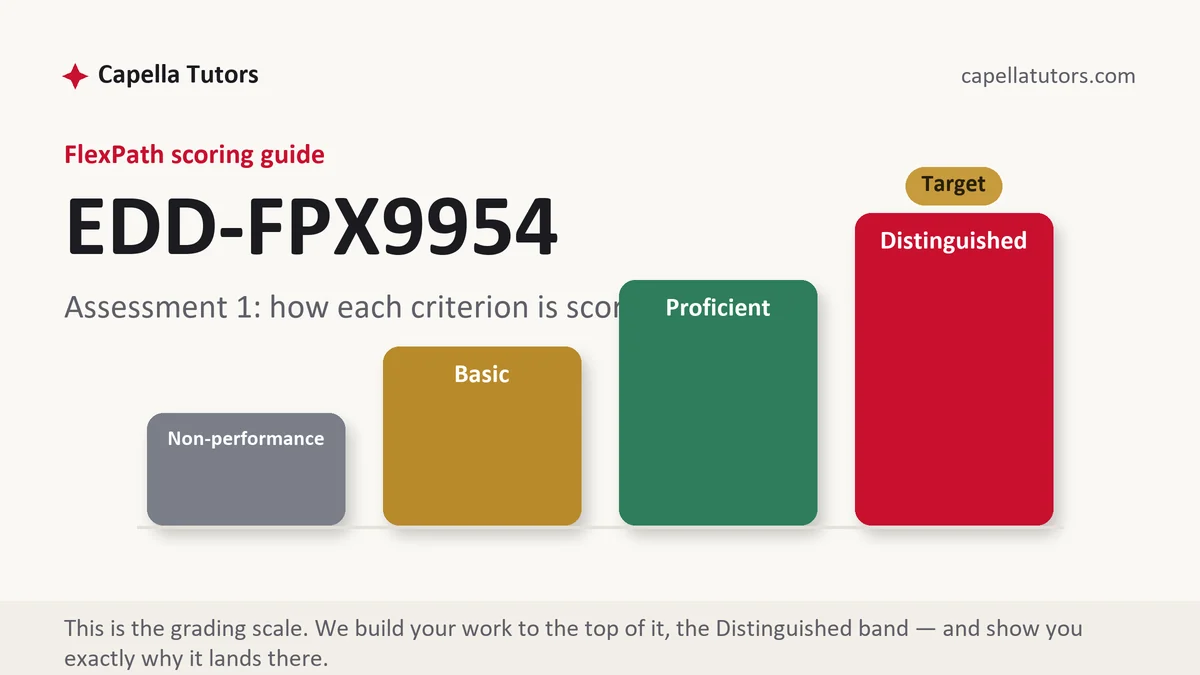
How EDD FPX 9954 Assessment 1 is scored
Each criterion resolves to one of four levels, and on a data account the top level pays for disclosure rather than for tidiness:
| Level | What it means on a data account |
|---|---|
| Distinguished | Every departure from the approved design is dated, explained and followed by its consequence for the analysis, the realized sample is described including the people missing from it, and each source sits under the permission that licensed collecting it. |
| Proficient | An accurate and complete record of what was collected and when. Sound work, and short of the row above wherever a deviation is logged without saying what it does to the analysis. |
| Basic | Collection narrated as though the plan had executed itself, with totals reported and nothing said about the distance between invited and completed. |
| Non-performance | A required element is absent, most often the participant accounting, or the approval and site permission record the criterion asked for. |
Approvals belong inside the account rather than in front of it. The determination your review body issued governs what you may now do with the material on your desk. A study built on de-identified extant records may have returned as exempt, and the same study with a teacher focus group added is a different activity needing a modification filed before the group meets rather than described afterward. Site permission is not institutional review, and neither is the agreement releasing student records to you.
The handoff is a corpus another analyst could work with without asking you a question. Coding, assumption checks and every table organized by research question run on the ledger built here, so a gap left undocumented becomes a claim you cannot defend later. Write the deviation record while the dates are still recoverable from a calendar, because the interpretation stage waiting in EDD FPX 9955 can only argue about findings whose origins are written down.
The EDD FPX 9954 Assessment 1 method, step by step
-
Turn the approved design back into a ledger
Open the protocol rather than the draft and convert every promise in it into a row: source, instrument, intended count, window, site, person responsible. Add three columns you fill as you go, actual count, actual dates, variance. Built during collection the sheet costs an hour; rebuilt afterward it costs a week.
-
Attach each source to the permission that licensed it
Write the chain once and in order: the determination your review body issued and its date, any modification since, the signed site permission, and the agreement under which student-level records reached you. Where a source arrived without one, say so now. A missing letter you find is an errand; a missing letter a reviewer finds is a finding about your conduct.
-
Log every deviation on the day it happens
A principal transfers in March, a testing window slides two weeks, an observation dies to a snow day, two consented teachers withdraw. Each is one line: date, what changed, why, and what it does to the analysis. Recorded live the entry takes ninety seconds; reconstructed in July it takes an afternoon and reads like an alibi.
-
Account for people rather than for returns
Report invited, started, completed and usable as four different figures, then describe who is absent from the final set in whatever legitimate terms you hold, by building, by assignment, by years of experience. Forty-one of 68 teachers completing a survey is a 60 percent rate, and the sentence earning the criterion says which 27 are missing.
-
Interrogate extant data before you trust it
District records arrive with definitions you did not choose. Establish how the denominator is built, whether the measure changed mid-year, and what the reporting rules do to small groups. A rate calculated on enrolled days behaves differently from one calculated on membership days, and a comparison across a definition change compares two things.
-
Write to the criterion, then self-score
Draft each section against the criterion it answers rather than in narrative order, then read the guide one criterion at a time and mark yourself honestly. Confirm every figure in the prose equals the figure in its table. Submit early in the week, since faculty have two business days and a Thursday attempt can idle until Monday.
A structure that maps to the criteria
The targets below are our planning numbers for a data account, not Capella requirements. Weight the deviation and sample rows, since those are where this deliverable is won.
| Section | What it must do | Guide |
|---|---|---|
| Collection ledger | Each source, instrument, window and site, with intended and actual counts side by side. | ~250 words |
| Approvals and permissions | The review determination, any modification, site permission and any data agreement, dated. | ~200 words |
| The realized sample | Who actually participated, the rates behind that, and who is absent from the final set. | ~250 words |
| Deviation record | Every departure from the design, dated, explained, and followed by its analytic consequence. | ~250 words |
| Data preparation | Transcription, cleaning, missing-value handling and de-identification, described repeatably. | ~250 words |
| Appendices and references | Instruments and permission language appended, tables readable alone, current APA both ways. | ~200 words |
Annotated sample excerpt
One original paragraph from our team at the register a fidelity criterion rewards. Learn the moves, then write them against your own ledger.
Classroom observations were collected in the two middle schools that moved from a seven-period day to a modified block in August, with 24 of the 30 planned observations completed between September 8 and November 21 and all six shortfalls falling in one building.1 The assistant principal who had agreed to schedule access at School B left the district on October 3, and entry stopped there for five weeks until the interim administrator reauthorized it; the deviation was logged on October 6 and reported to the review body as a change of timeline rather than of procedure, since neither the protocol nor the consent language moved.2 School B therefore contributes 9 observations against School A's 15, so the cross-site comparison is reported descriptively with both counts visible rather than as a pooled mean that would let the better-staffed building speak for both.3
- 1Realized count against planned count in the first clause, with the shortfall located in one building. A writer who leads with the gap is not managing an impression.
- 2Dates the cause, dates the log entry, and separates what was reported to the review body from what needed no report. Knowing which changes are procedural is the judgment being watched.
- 3States the analytic consequence and the decision taken because of it. Without this sentence a deviation is a confession; with it, evidence of design control.
The full premium sample for your exact assessment, written fresh to your scoring guide and issue, is free to request. Study it, revise it into your own voice, and submit work you understand.
The five mistakes that cost Distinguished
- Collection narrated in the past perfect. Data were collected as planned is almost never true, and it invites a search for whatever it covers.
- One number for participation. Invited, started, completed and usable are four figures, and reporting only the last hides the response problem.
- Deviations reconstructed at the end. An undated entry written months later cannot be checked, and it reads as narrative rather than as record.
- Extant data accepted at face value. A definition change inside a district file produces a finding belonging to the file rather than to anything you did.
- Approvals summarized instead of listed. Ethical approval was obtained answers no criterion, while the determination, its date and the site permission do.
Pre-submission checklist
- Every source in the ledger carries intended and actual counts, dates and site
- The review determination, any modification and the signed site permission listed with dates
- Invited, started, completed and usable reported as four separate figures
- Each deviation dated, explained, and followed by its consequence for the analysis
- Data preparation described precisely enough for another analyst to repeat it
- Self-scored against every criterion, with each narrative figure matching its table
Data account due?
Send the prompt, the guide, your approved protocol and whatever collection records you have, however untidy. Eight people, including a research analyst and two QA reviewers, return a premium original sample in 24 to 48 hours with the ledger built, deviations dated and the realized sample accounted for, revised free until the guide is satisfied.