This manual is for EDD FPX 9953 Assessment 2, start to submission. Assessment 2 of EDD FPX 9953, EdD Doctoral Project 3, is the instrument and the procedure: every item traced to the construct or question it serves, and a sequence a stranger could execute without calling you. The assessment usually asks you to present the instrument, account for where each item came from, and write the collection procedure in order with owners and dates attached. Below is our tutors' method, a structure derived from the criteria, and an annotated sample. Prefer to hand the drafting across? A premium original sample returns inside 24 to 48 hours, rewritten free until your guide is met. Capella's catalog lists the course as EDD-FPX9953, and some courserooms print EDD9953; both point to this same Assessment 2.
One honesty note before the manual: Capella revises courses and scoring guides over time, so always write to the exact scoring guide attached to your assessment in the courseroom. The course identity above is verified on capella.edu; the method and structure below are our tutors' approach to it, not Capella's official rubric text.
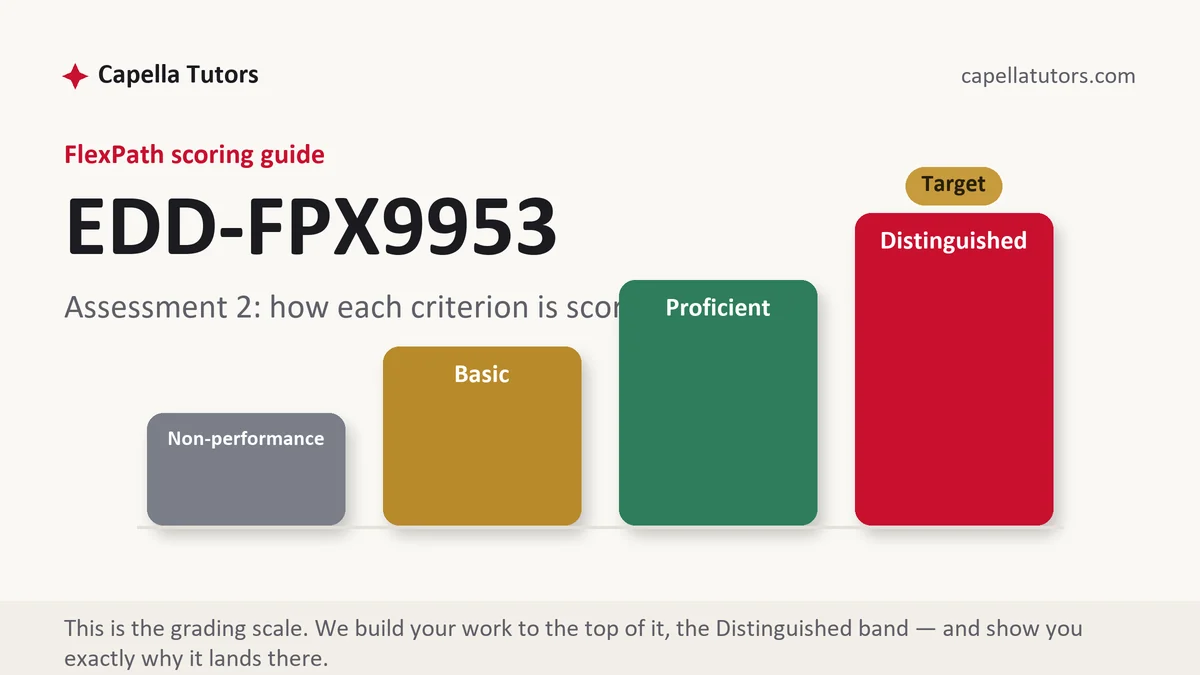
How EDD FPX 9953 Assessment 2 is scored
Every criterion on the guide is scored against four levels independently of the others. What the top level says is the specification for this deliverable:
| Level | What it means on an instrument and procedure deliverable |
|---|---|
| Distinguished | Every item traces to a construct or a question, the pilot or expert review actually happened and is reported with what it changed, and the procedure names dates, durations and owners. Reporting what the pilot broke is the move most drafts skip. |
| Proficient | Items are sourced and the procedure is complete. Executable as written, and one degree less tested than the level above. |
| Basic | A sensible question list with no provenance, and a procedure written in the future tense without owners or dates. |
| Non-performance | Items with no traceable origin, or a procedure so general that two people following it would collect different things. |
This is the document the next course carries into the field. EDD FPX 9954, EdD Doctoral Project 4, collects exactly what this instrument asks for and nothing else, so an item answering no question is a wasted question in every interview. It is also the document a reviewer edits: a request to raise the reading level of an assent form, or to drop a question about a named administrator, changes the instrument and everything downstream of it. Submit on grade and keep drafting during the two business days faculty have for an attempt.
The EDD FPX 9953 Assessment 2 method, step by step
-
Build the item map before the items
Two columns: construct or question on the left, item on the right. Write the left column first from the framework you already defended, then fill the right. Items written before the map are items you will have to justify backward, and the trace is the criterion.
-
Adapt a published instrument rather than inventing one, where one exists
A published survey brings its own evidence with it. Cite it, state exactly what you changed and why, and say whether permission was required and obtained. An adapted instrument credited only in an appendix reads as an instrument you hoped nobody would look up.
-
Write probes, not only questions
An interview protocol of bare questions produces thin transcripts. Under each question put the two follow-ups you will use when the first answer is one sentence, and mark which probes are optional so a second interviewer could match your depth without matching your wording.
-
Pilot it on somebody outside your study, then report what broke
Two or three practice runs will find the question everybody misreads and the one that takes eleven minutes to answer. Fix them, then say in the chapter what the pilot changed. A pilot reported as having gone well is a pilot a reviewer assumes did not happen.
-
Write the procedure as a sequence with owners and dates
Recruitment on a date, through a named channel, by a person who does not evaluate the participants. Consent collected in a stated form and stored somewhere specific. Sessions of a stated length, recorded with permission, transcribed inside a stated window, returned for correction if you intend to claim member checking. Vagueness here is not a style problem.
-
Give each criterion its level, then submit early in the session
Read the section against the guide criterion by criterion and mark it as a committee would, then repair what falls short. A revision requested on Wednesday can still be back before the week closes.
A structure that maps to the criteria
Word targets our tutors plan against for an instrument and procedure section of ordinary length, not Capella rules; expand wherever your guide asks for more.
| Section | What it must do | Guide |
|---|---|---|
| The item map | Every construct or question beside the items that serve it, with nothing unmatched in either column. | ~200 words |
| Instrument provenance | Where each item came from, what you adapted, what you changed, and whose permission you hold. | ~250 words |
| The instrument itself | The questions or items in final order, with probes attached and optional follow-ups marked. | ~275 words |
| Pilot or expert review | Who reviewed it, what they found, and what you changed as a result. | ~200 words |
| Procedure in sequence | Recruitment, consent, collection, recording, transcription and storage, with owners and durations. | ~275 words |
| Fidelity and references | How a second person would run this identically, then seventh edition APA in both directions. | ~150 words |
Annotated sample excerpt
An original passage from our team at the level the top column asks for. Read it for the trace on every item.
Items 1 through 4 come from a placement-decision inventory published in 2021, are used unchanged with the author's written permission, and carry the construct this project calls decision authority, meaning who a family believes made the placement.1 Items 5 through 9 are ours, written from the second synthesis theme, and each names a specific document a family may or may not have seen, because the pilot showed that asking whether communication was clear returned agreement from everyone and information from nobody.2 Item 10 was cut after the pilot: it asked parents to rate the fairness of the placement, which two of the three reviewers read as a question about the teacher rather than about the process.3
- 1Adapted items are credited in the text with permission stated, and the construct they serve is named in the same sentence.
- 2Original items are traced to a synthesis theme rather than to intuition, and the pilot supplies the reason for the wording.
- 3Reports a cut item and the misreading that caused it. A pilot that changed something is a pilot the criterion can credit.
The full premium sample for your exact assessment, written fresh to your scoring guide and issue, is free to request. Study it, revise it into your own voice, and submit work you understand.
The five mistakes that cost Distinguished
- Items invented and mapped afterward. A question list written first will always leave one construct unserved and one item serving nothing.
- An adapted survey credited only in the appendix. The text is where a reader looks for provenance, and the omission reads as ownership of somebody else's work.
- A protocol with no probes. Bare questions produce one-sentence answers, and thin transcripts are a data problem no analysis plan repairs.
- A pilot reported as successful. If nothing changed, either the pilot found nothing or it never happened, and neither earns the criterion.
- A procedure in the passive future. Participants will be recruited names nobody, dates nothing, and leaves two readers holding two different studies.
Pre-submission checklist
- An item map with nothing unmatched in either column
- Adapted items cited in the text, with changes and permission stated
- Probes written under each question, optional follow-ups marked
- Pilot or expert review reported together with what it changed
- Procedure written in order with named owners, dates and durations
- Reference entries and in-text citations checked against each other, seventh edition APA
Instrument and procedure due?
Send the guide and the framework you defended. Items arrive with a provenance note on each one, protocols arrive with probes, and the procedure arrives in order with owners and durations attached. Nothing to pay for the first one.