This manual is for EDD FPX 9953 Assessment 1, start to submission. Assessment 1 of EDD FPX 9953, EdD Doctoral Project 3, is the design and the sample: the tradition you are working in, the specific design inside it, and a selection logic that answers your questions rather than a number chosen for convenience. The assessment usually asks you to justify the design against the alternative you rejected and to state the limits of the sample you can actually reach. Below is the method our tutors run, a structure the criteria can follow, and an annotated sample. Rather this arrived already built? A premium original sample arrives in 24 to 48 hours and is revised at no cost until the guide is satisfied. Capella's catalog lists the course as EDD-FPX9953, and some courserooms print EDD9953; both point to this same Assessment 1.
One honesty note before the manual: Capella revises courses and scoring guides over time, so always write to the exact scoring guide attached to your assessment in the courseroom. The course identity above is verified on capella.edu; the method and structure below are our tutors' approach to it, not Capella's official rubric text.
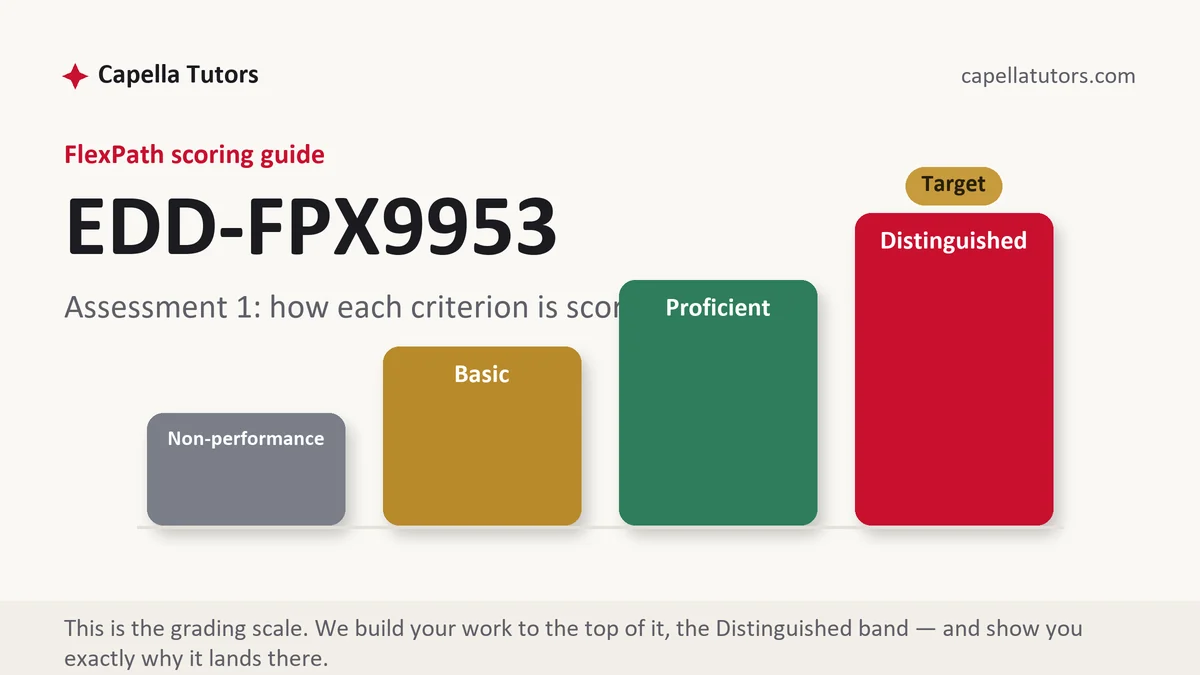
How EDD FPX 9953 Assessment 1 is scored
Four levels per criterion, no aggregate grade, nothing rounded. The gap between the top two is where most doctoral drafts sit, and the guide tells you what closes it:
| Level | What it means on a design and sampling deliverable |
|---|---|
| Distinguished | The design is defended in one paragraph against the alternative it beat, the selection criteria were set before recruitment, and the limits of the resulting sample are named by the author rather than discovered by the reader. Naming your own ceiling is the move this column pays for. |
| Proficient | Design and sample are appropriate and justified. Defensible in full, and one degree less self-aware than the level above. |
| Basic | A design named and described, with the sample given as a number and its logic supplied afterward. |
| Non-performance | A sample with no selection criteria at all, or a design that could not produce an answer in the shape the question asked for. |
Everything after this course executes what this document says. EDD FPX 9954, EdD Doctoral Project 4, spends its weeks doing exactly that, and every later departure from the plan has to be written against this text, so precision now buys explanation you will never have to write. Submit on grade, and let the evaluation window run while the next section gets drafted.
The EDD FPX 9953 Assessment 1 method, step by step
-
Write the alignment table before you write prose
Questions in the left column in their final wording, then fill each row rightward: data source, the specific items or records that answer it, the analysis, the construct it traces to. A row with a blank in it is a design problem you can still fix in a paragraph. Faculty who grade many of these read the table first.
-
Name the design you rejected and why
One paragraph saying which alternative you considered and what different question it would have answered does more for this criterion than three pages of definitions. A design defended only in the positive reads as a design that was chosen before the questions existed.
-
Justify a qualitative sample by coverage, not by count
Fourteen interviews is a number; fourteen interviews covering both buildings, every pathway, two tenure brackets and at least one person likely to disagree with your premise is a sample. Say how you will know whether the coverage was enough, and what you will do if it was not.
-
Run the power arithmetic and print it even when it fails
Detecting a standardized difference of 0.30 at conventional power needs something on the order of 175 per group, and a district with 240 pathway students across two schools will not get there. That is an argument for a descriptive or mixed design, and printing the calculation that ruled the other one out is worth more than hiding it.
-
Confirm the sampling frame exists before you commit to it
A frame is a real list held by a real person. Check that the roster you plan to sample from exists in the form you need, that somebody has authority to release it, and that the people on it are reachable during the months you will be collecting. A frame discovered to be imaginary in the following course costs a session.
-
Score every criterion yourself, then submit early in the week
Give each criterion the level you would defend to a committee, then repair whatever falls short. A Friday attempt buys nothing that a Monday attempt does not.
A structure that maps to the criteria
Planning targets our tutors use for a design and sampling section of ordinary length, not Capella rules; expand whichever criterion your guide weights hardest.
| Section | What it must do | Guide |
|---|---|---|
| The alignment table | Every question with its source, its instrument or records, its analysis and its framework construct. | ~200 words |
| Tradition and design | The tradition your questions sit in and the specific design inside it, attributed to a primary methodological source. | ~250 words |
| The design you rejected | The alternative, the different question it would have answered, and the reason you let it go. | ~200 words |
| Population, frame and selection | Who the study is about, the actual list you will sample from, and the criteria set in advance. | ~275 words |
| Size and its justification | Coverage logic or the power calculation, printed, with the conclusion you drew from it. | ~250 words |
| Limits and references | What this sample cannot support, stated by you, then seventh edition APA in both directions. | ~175 words |
Annotated sample excerpt
An original passage from our team at the register the top column rewards. Read it for what the author admits.
The 240 students who entered a career and technical pathway at either high school in 2023 form the population, and the 61 who left a pathway before completing its second course form the group this project is about.1 Interviews will be sought from 16 of those 61, selected to cover both campuses, all four pathways, students who left in the first semester and students who left in the third, with the registrar's withdrawal file as the frame and the pathway coordinator, who grades none of them, making first contact.2 Sixteen interviews cannot establish how often any reason occurs across the district, and this project does not claim that they can; the enrollment file carries the frequencies and the interviews carry only the reasoning.3
- 1Separates the population from the group of interest with a count for each, so a reader knows exactly who is being studied and how many exist.
- 2Selection is stated as coverage across named dimensions, the frame is a real file, and the recruiter is somebody with no grade authority over the students.
- 3The author draws the ceiling personally and then says which source carries the claim the interviews cannot. Volunteering the limit is the top-column move.
The full premium sample for your exact assessment, written fresh to your scoring guide and issue, is free to request. Study it, revise it into your own voice, and submit work you understand.
The five mistakes that cost Distinguished
- A sample size defended after it was chosen. A number picked for convenience and justified in the next paragraph is visible on a first reading.
- A design named but never compared. Where no alternative is mentioned, a reader assumes the design arrived before the questions did.
- Power arithmetic omitted because the answer was inconvenient. The calculation that rules out a design is an argument for the design you chose, and hiding it forfeits the argument.
- A frame that turns out not to exist. A roster nobody actually holds, or holds in a form you cannot use, stalls the course after this one.
- Saturation asserted in advance. Promising that new participants will stop producing new ideas is a prediction, and the criterion wants a plan instead.
Pre-submission checklist
- An alignment table with no blank cells, questions in final wording
- Design attributed to a primary methodological source, not a textbook summary
- The rejected alternative named with the different question it answers
- Selection criteria set before recruitment, coverage stated across named dimensions
- Power or coverage arithmetic printed, including where it ruled a design out
- Every in-text citation traced to its entry and back, seventh edition APA
Design and sampling section due?
Send the guide, your questions in their current wording, and what your site will actually release. We build the alignment table first, then the design defended against the one it beat, and a reviewer tries answering each question using only the sources you named. No charge for the first premium sample.