This manual is for EDD FPX 9953 Assessment 3, start to submission. Assessment 3 of EDD FPX 9953, EdD Doctoral Project 3, is the ethics account and the analysis plan: consent and assent, protected records, dual-role safeguards, de-identification, the review pathways under way, and the coding steps or tests chosen before any data exists. The assessment usually asks you to pair every risk with a control and to specify an analysis a second person could run. Below is the order our tutors work in, a criterion-mapped structure, and an annotated sample. Want somebody else to draft it? A premium original sample comes back in 24 to 48 hours and is revised free until the guide is satisfied. Capella's catalog lists the course as EDD-FPX9953, and some courserooms print EDD9953; both point to this same Assessment 3.
One honesty note before the manual: Capella revises courses and scoring guides over time, so always write to the exact scoring guide attached to your assessment in the courseroom. The course identity above is verified on capella.edu; the method and structure below are our tutors' approach to it, not Capella's official rubric text.
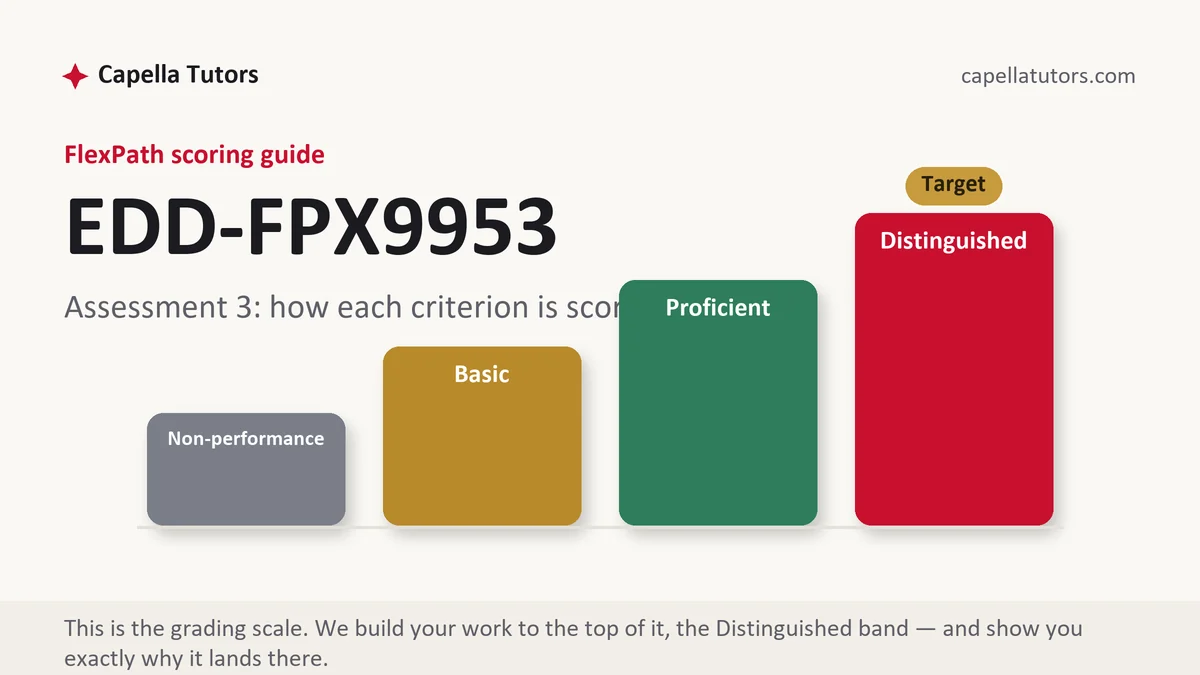
How EDD FPX 9953 Assessment 3 is scored
A FlexPath evaluation returns a level on each criterion and nothing else. Four exist, and the difference between the upper two is a move rather than a quantity:
| Level | What it means on an ethics, permissions and analysis plan |
|---|---|
| Distinguished | Every risk carries a control with somebody's job attached, the review pathways are described as the separate queues they are, and the analysis is specified closely enough that a second person could run it and reach your numbers. Specificity is the whole difference between the upper two columns here. |
| Proficient | Protections are appropriate and the analysis is named. Complete, and one step short of executable by a stranger. |
| Basic | A paragraph on confidentiality, a sentence about approval, and an analysis named by its family rather than by its steps. |
| Non-performance | A required protection is missing, most often assent from minors or the separation between the researcher and the people they evaluate. |
Approvals run on their own calendar and the following course cannot start without them. EDD FPX 9954, EdD Doctoral Project 4, needs a decision in hand before a single interview happens, so build the schedule backward from the last date collection could begin and still leave time to analyze anything. A learner holding a flat 12-week session open while a queue moves is using it correctly, provided the wait is spent writing the codebook.
The EDD FPX 9953 Assessment 3 method, step by step
-
List the risks before you list the protections
Write down every way this study could cost somebody something: a teacher identified by their department, a student whose grades sit in your file, a colleague who cannot comfortably refuse you, a school whose name plus its size identifies it. That list is the section, and the controls are answers to it.
-
Handle minors as two documents, not one
Parental consent and student assent are separate, and the reading level of the assent form is part of what gets reviewed. Say who hands them out, where signed forms live, how long they are kept, and what happens when a parent consents and the student declines, because that case occurs and a plan with no answer for it comes back.
-
Draw the line between records you may see and records you may analyze
Grade files you open in your job are not study data until somebody with authority releases them for that purpose, and student records carry protections that do not lift because you have a login. Name the person who releases, name what they are releasing, and say whether you receive identifiable records or aggregates.
-
Move recruitment away from your own authority
If you evaluate the teachers whose practice you are studying, you cannot be the one who asks them. Hand first contact to somebody with no evaluative relationship, state plainly in the consent language that declining costs nothing, and keep the record of who declined away from anybody who writes evaluations.
-
Ask which review pathway applies, then plan for both queues
Whether your plan is exempt, expedited or fully reviewed is a reviewer's determination and not yours to make, and your district may run its own research request process with its own committee and meeting schedule. Get the requirement in writing from your faculty, file early, and expect a reviewer to change something.
-
Specify the analysis, then score yourself and submit
Name whose coding steps you are following or which test you will run, with the software, the assumption or trustworthiness checks, and what you will do if a check fails. Then mark each criterion at the level you would defend and file the attempt early in the week, since evaluations take up to two business days.
A structure that maps to the criteria
Section targets our tutors plan to for an ethics and analysis section of ordinary length, not Capella rules; lengthen whichever criterion your guide weights hardest.
| Section | What it must do | Guide |
|---|---|---|
| Risks, named | Every way the study could cost a participant, a colleague or the organization something, listed separately. | ~200 words |
| Consent and assent | Who asks, what the documents say, at what reading level, where they live and for how long. | ~250 words |
| Records and release | What data you need, who holds authority to release it, and whether you receive identifiers or aggregates. | ~225 words |
| Dual role and recruitment | Your evaluative relationships, who makes first contact instead, and who never sees the refusals. | ~225 words |
| Approvals in progress | The review pathway you asked about, the district process if one exists, and the date each was filed. | ~200 words |
| Analysis specified and references | Whose steps or which tests, the software, the checks, and the response if a check fails, in seventh edition APA. | ~275 words |
Annotated sample excerpt
An original passage from our team, at the register the top descriptor describes. Every risk in it is answered in the same sentence that raises it.
Because I evaluate the eleven teachers whose retake practices this project examines, none of them will be recruited by me: the district assessment coordinator, who conducts no evaluations, will make first contact and will hold the record of who declined, which I will not see before the following school year.1 The gradebook extract will arrive from the student information systems office as counts of retakes by course and marking period with no student identifiers, so no student record enters the study even though my role gives me access to all of them.2 Two of the eleven are the only staff members teaching their course, so their courses will be reported inside a subject grouping rather than by name, and the district will be described by size and region rather than named.3
- 1Names the dual role, the substitute recruiter and their lack of evaluative authority, then adds a timing rule for the refusal record. Three controls, one risk, one sentence.
- 2Distinguishes access from permission and specifies the form the data arrives in, which is the sentence a reviewer looks for first.
- 3Handles re-identification with a rule that follows from a count, rather than promising confidentiality in general terms.
The full premium sample for your exact assessment, written fresh to your scoring guide and issue, is free to request. Study it, revise it into your own voice, and submit work you understand.
The five mistakes that cost Distinguished
- Confidentiality promised in general terms. Data will be kept confidential names no risk and no control, and the criterion pays only for pairs.
- Assent folded into consent. One form signed by a parent does not cover a minor's own agreement, and the omission is the fastest route to a returned plan.
- Access mistaken for authority. Holding the password to a student information system is not permission to analyze what is inside it.
- A review pathway asserted by the researcher. Declaring your own study exempt is a determination you do not get to make, and reviewers notice the presumption.
- An analysis named by its family. Thematic analysis and regression are categories; the criterion wants whose steps, which software, and what happens when a check fails.
Pre-submission checklist
- Every risk written on its own line with a control beside it
- Consent and assent handled as separate documents, with a plan for a declining student
- Record holders named, and the form of the data you receive stated
- Recruitment moved away from anyone holding evaluative authority
- Both review queues asked about in writing, with the date each was filed
- Analysis specified to steps, software and checks, seventh edition APA throughout
Ethics and analysis section due?
Send the guide, your design, and an honest account of who reports to you. We write the risk table with a control on every line, keep access and permission apart, and specify the analysis closely enough that a second reader could run it. The first premium sample is yours without charge.