This manual is for EDD FPX 9952 Assessment 1, start to submission. Assessment 1 of EDD FPX 9952, EdD Doctoral Project 2, is the search made reproducible: databases named, limits justified, strings printed as they were typed, and a count at every stage between everything retrieved and everything kept. The assessment usually asks you to report that method, then appraise what survived it by design rather than by publication year. Below is the method our tutors work through, a structure that maps onto the criteria, and an annotated sample. Rather we handled the whole thing? A premium original sample returns in 24 to 48 hours, rewritten at no cost until your guide is satisfied. Capella's catalog lists the course as EDD-FPX9952, and some courserooms print EDD9952; both point to this same Assessment 1.
One honesty note before the manual: Capella revises courses and scoring guides over time, so always write to the exact scoring guide attached to your assessment in the courseroom. The course identity above is verified on capella.edu; the method and structure below are our tutors' approach to it, not Capella's official rubric text.
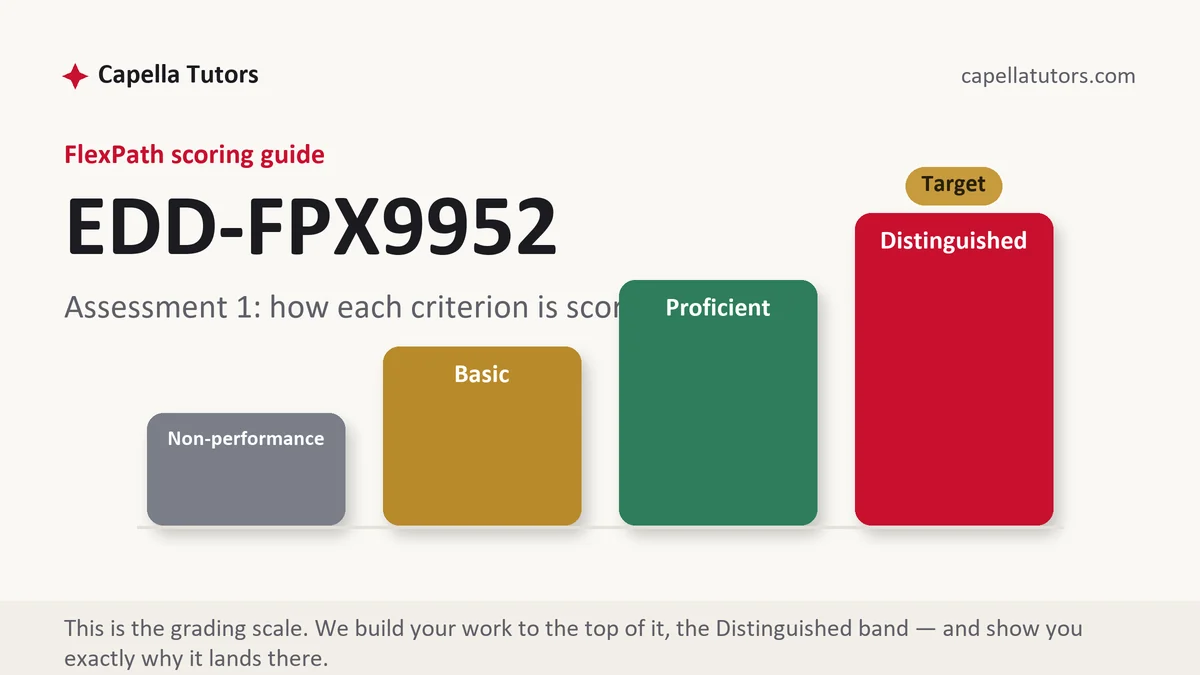
How EDD FPX 9952 Assessment 1 is scored
Levels, not points, decide a FlexPath attempt. Every criterion on the guide arrives at one of four, and the distance between two of them is usually one specific move:
| Level | What it means on a documented search and appraisal |
|---|---|
| Distinguished | A second person could repeat the search from the page and finish holding your retained set, every rating rests on a named appraisal standard, and the weak studies are marked and kept rather than quietly dropped. The traceability is the criterion, not the size of the pile. |
| Proficient | The search is documented and the appraisal is consistent. Repeatable in principle, and one degree less traceable than the level above. |
| Basic | Two database names, a date range with no reason attached, and a set of studies rated by how useful each one was to the argument. |
| Non-performance | No stage counts anywhere, or an appraisal with no standard behind the ratings, which leaves a reader unable to check anything. |
The two courses after this one lean on the method more than on its conclusions. EDD FPX 9953, EdD Doctoral Project 3, justifies a design by pointing at what the evidence does and does not establish, and an undocumented search cannot support the pointing. Print the strings in an appendix, submit early in the session, and spend the two business days faculty have for evaluation building the appraisal table.
The EDD FPX 9952 Assessment 1 method, step by step
-
Write the question you are searching before you search
A search needs a target it can be wrong about. Convert your research question into the concepts a database indexes, then decide which concept you will not compromise on, because that is the term you must never drop when the result count disappoints you.
-
Build the string in the thesaurus, not in the search box
ERIC and Education Source both carry controlled vocabulary, and the descriptor for your concept is rarely the phrase practitioners use. Pull the descriptors, combine them with free-text variants using OR, join the concepts with AND, and record the string exactly as typed so it can be run again.
-
Set every limit and attach a reason to each one
Peer review, language, date range and publication type all narrow the pile, and each narrowing is a claim you have to defend. A five-year window is defensible on empirical work in a policy-sensitive field and indefensible on the theory your framework rests on, so state the two rules separately.
-
Count at every stage and keep the rejections
Records retrieved, records removed at title and abstract, full texts read, studies retained, with the excluded grouped by the reason they were excluded. A reader who can see 1,146 become 27 and why can certify what you concluded; a reader who cannot has to take your word for it.
-
Appraise on design and sample before you read a conclusion
A conclusion is a claim and the design is what licenses it, so read the method first every time. Give each retained study a row carrying design, setting, grade band, sample size, dose, outcome and the strength you assigned, and name the standard you used to assign it.
-
Self-score each criterion, then submit on grade
Mark every criterion at the level you would defend, then repair whatever sits below the top column. An evaluation can take two business days, so a Monday attempt and a Wednesday revision still fit inside one week.
A structure that maps to the criteria
Planning targets our tutors use for a search and appraisal section of ordinary length, not Capella rules; expand whichever part your guide weights hardest.
| Section | What it must do | Guide |
|---|---|---|
| The search question and concepts | The question restated as searchable concepts, with the one concept that never gets dropped identified. | ~175 words |
| Databases and limits | Every database and every limit, each limit carrying the reason it was applied. | ~200 words |
| Strings as typed | The descriptor and free-text terms with their Boolean operators, reproduced exactly, appendix referenced. | ~200 words |
| Screening with counts | The number at each stage and the reasons the excluded were excluded, grouped rather than listed. | ~250 words |
| The appraisal table | Every retained study by design, setting, sample, dose, outcome and assigned strength, with the standard named. | ~325 words |
| What the set can support | One paragraph on what this body of evidence licenses and what it does not, then seventh edition APA. | ~175 words |
Annotated sample excerpt
An original passage from our team at the level the top descriptor asks for. Watch what it makes checkable.
The three searches returned 1,146 records, of which 998 were removed at title and abstract against criteria set before screening began, leaving 148 read in full and 27 retained.1 Of the 121 excluded at full text, 63 studied programs for students in their first year of language instruction rather than students awaiting reclassification, 41 reported no time to reclassification in any form, and 17 were program descriptions with no comparison group.2 Nine of the 27 retained are single-district studies of fewer than 200 students, and they are kept and marked as such, because dropping them would leave the elementary grades represented by two papers.3
- 1Four numbers in one sentence, and the criteria are stated as having existed before screening rather than after it. A reader can now audit the funnel.
- 2Groups the rejections by reason with counts, which turns a discard pile into a finding about the literature.
- 3Marks weak studies and keeps them, then gives the consequence of the alternative. That clause is the appraisal judgment the top column is looking for.
The full premium sample for your exact assessment, written fresh to your scoring guide and issue, is free to request. Study it, revise it into your own voice, and submit work you understand.
The five mistakes that cost Distinguished
- A search reported as a sentence. Naming two databases and a date range gives a reader nothing to repeat and nothing to check.
- Limits without reasons. A five-year window applied to every source type at once quietly excludes the theory your framework rests on.
- Counts only at the ends. Retrieved and retained, with nothing in between, hides the screening decisions that shaped the whole chapter.
- Strength ratings with no standard behind them. Strong and weak mean whatever the writer wanted them to mean until the appraisal tool is named.
- Weak studies deleted rather than marked. A tidy table built by quiet removal is the failure a reviewer finds by counting your grade bands.
Pre-submission checklist
- Databases, limits and the reason for each limit all printed
- Search strings reproduced exactly as typed, appendix referenced in the text
- A count at every screening stage, with exclusions grouped by reason
- Every retained study entered by design, setting, sample, dose and outcome
- The appraisal standard behind your strength ratings named
- Every citation matched to an entry and every entry to a citation, seventh edition APA
Search and appraisal due?
Send the guide and your research questions. We build the strings, run the counts, and hand back a finished appraisal table with a named standard behind every rating, so the synthesis can cite a row instead of waving at a body of work. We do not charge for the first premium sample.