This manual is for EDD FPX 9952 Assessment 2, start to submission. Assessment 2 of EDD FPX 9952, EdD Doctoral Project 2, is the synthesis: the studies you kept, arguing with each other on your page, organized by mechanism and never by author. The assessment usually asks you to state what a body of evidence supports, handle the places where it contradicts itself, and say what it still cannot tell a leader who has to decide something. Below is the sequence our tutors follow, a structure the criteria can locate, and an annotated sample. Prefer to put it in somebody else's hands? A premium original sample comes back in 24 to 48 hours and is revised free until the guide is met. Capella's catalog lists the course as EDD-FPX9952, and some courserooms print EDD9952; both point to this same Assessment 2.
One honesty note before the manual: Capella revises courses and scoring guides over time, so always write to the exact scoring guide attached to your assessment in the courseroom. The course identity above is verified on capella.edu; the method and structure below are our tutors' approach to it, not Capella's official rubric text.
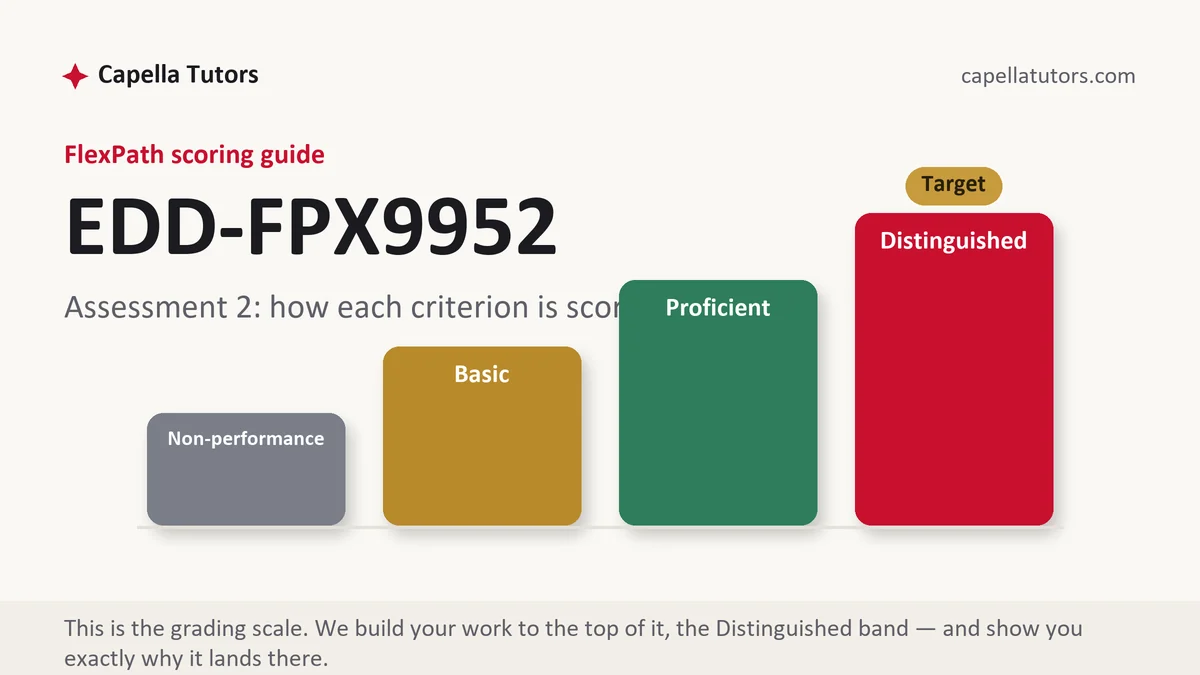
How EDD FPX 9952 Assessment 2 is scored
Your attempt comes back as a set of levels rather than a score. Four are available on each criterion, and the wording of the top one is where the draft should be aimed:
| Level | What it means on a written synthesis |
|---|---|
| Distinguished | Each theme opens with a claim the collected studies support, every contradiction is resolved with a stated reason for preferring one body of evidence, and effect sizes are converted into something a practitioner could weigh. The conversion is usually what separates the top two columns. |
| Proficient | Themes are genuine and the evidence is handled accurately throughout. Nothing to correct, and nothing a reader has to think about. |
| Basic | A synthesis heading sitting on top of an annotated bibliography: one study per paragraph, in sequence, no claim anywhere above them. |
| Non-performance | Sources summarized with no organizing claim at all, or findings attributed to studies that do not report them. |
What this section settles is what the rest of the project may assume. EDD FPX 9953, EdD Doctoral Project 3, defends a design against the alternative it rejected, and the reason for that rejection comes out of these paragraphs. Write the themes first and the connective prose afterward, submit on grade, and use the two business days faculty have for an attempt to keep drafting.
The EDD FPX 9952 Assessment 2 method, step by step
-
Group by mechanism and never by author
Sort your retained studies by what they claim makes the difference rather than by who wrote them. Studies explaining the condition sit in one cluster, studies that tried to move it in a second, studies reporting why attempts failed in a third, and the clusters become your headings.
-
Open every theme with the claim, then bring the evidence
The first sentence under a heading says what the collected studies support. Citations arrive afterward, doing named jobs inside the argument. If a paragraph can be deleted without weakening the claim above it, it was a summary, and summaries cost a level.
-
Report design and sample before the finding, every time
A result from one school of 1,900 is not evidence about eleven small buildings, and saying so is the appraisal showing its work. Observational school data rarely licenses a causal claim, so match your verb to the design and let the weaker studies be weak in public.
-
Treat every contradiction as a finding
Where two studies of the same program disagree, look for what differed: dose, duration, grade band, baseline performance, staffing, how long the program had been running. Name the difference, then state which body of evidence you weight more heavily and why. A conflict left open reads as a conflict you did not notice.
-
Turn effect sizes into something a leader can weigh
Suppose your retained set runs from 0.08 to 0.55 in standardized units and the two largest studies sit near the bottom of it. The honest sentence says the approach works at roughly a tenth of a standard deviation once delivered at scale, which is worth having and is not a transformation. Then restate it in the units your district actually reports.
-
Score yourself against each criterion, then file early in the week
Read the synthesis one criterion at a time, mark the level you would defend to a committee, and lift anything short of the top column. An attempt submitted late in the week can sit until the next one opens.
A structure that maps to the criteria
Length targets our tutors plan against for a synthesis of ordinary scope, not Capella rules; expand whichever theme your questions lean on hardest.
| Section | What it must do | Guide |
|---|---|---|
| What the evidence base is | The retained set in two or three sentences: how many studies, which designs, which settings, which grade bands. | ~175 words |
| Theme one, the mechanism | The claim the studies support about how the condition operates, carried by the evidence that supports it. | ~300 words |
| Theme two, the attempts | What has been tried, at what dose, with what measured result, each reported with its design attached. | ~300 words |
| Contradictions resolved | Each disagreement, the difference that explains it, and which side you weight, with the reason. | ~250 words |
| Magnitude in practitioner units | Effect sizes stated, then converted into the measure your organization already reports. | ~200 words |
| What it cannot settle | The question this literature leaves open for a leader, then seventh edition APA both ways. | ~175 words |
Annotated sample excerpt
An original paragraph from our team, at the register the top column describes. Read it for how the disagreement gets used.
Across the 27 studies retained, schools that replaced out-of-school suspension with a structured in-school alternative reduced repeat referrals, and the four studies reporting no reduction share a feature the others do not: the alternative room was staffed by whoever was available that period.1 That makes the disagreement one about staffing rather than about the approach, which matters here because this district has budgeted the room and not the position.2 Weighting the eleven studies with a dedicated staff member over the four without one is defensible on design as well as on dose, since three of the four are single-year descriptive reports with no comparison school.3
- 1The claim comes first and the conflicting studies are introduced as a group with a shared feature, which is what converts a contradiction into a mechanism.
- 2Connects the resolved conflict straight back to a decision the site is actually facing. A synthesis that lands on a budget line is a practitioner synthesis.
- 3States the weighting and gives two independent reasons for it, one about dose and one about design, so the judgment is checkable rather than asserted.
The full premium sample for your exact assessment, written fresh to your scoring guide and issue, is free to request. Study it, revise it into your own voice, and submit work you understand.
The five mistakes that cost Distinguished
- Paragraphs in citation order. One study each, marching down the page, is an annotated bibliography with a synthesis heading on top of it.
- Conclusions quoted without their designs. A finding reported free of its method invites a reviewer to look the study up, and they will.
- Contradictions smoothed over. Writing that results are mixed and moving on forfeits the criterion that pays for resolving them.
- Effects described in adjectives. Substantial improvement is unscoreable next to a number in a unit a superintendent recognizes.
- A theme that is really a topic. Headings named after subjects rather than mechanisms produce paragraphs that cannot argue with each other.
Pre-submission checklist
- Themes named for mechanisms, not for subjects or authors
- Every theme opening with the claim its studies support
- Design and sample reported ahead of each finding
- Each contradiction resolved with a stated reason for the weighting
- Effect sizes given and converted into units your organization reports
- Each entry matched to a citation and each citation to an entry, seventh edition APA
Synthesis section in the queue?
Send the guide and the studies you have already kept. We organize by mechanism, resolve the conflicts in writing, convert every effect into a number a cabinet would recognize, and check each figure against the paper it came from. The opening sample is free.