This manual is for EDD FPX 9952 Assessment 3, start to submission. Assessment 3 of EDD FPX 9952, EdD Doctoral Project 2, is the framework and the gap: the constructs you claim are operating on your problem, the relationships you claim hold between them, each traced to whoever published it, and then the two gaps your project sits between. The assessment usually asks you to define the constructs, show them doing work, and state separately what the literature has not settled and what your organization is not doing. Below is our tutors' approach, a structure laid over the criteria, and an annotated sample. Want this one drafted before you touch it? A premium original sample returns inside 24 to 48 hours, revised free until the criteria are met. Capella's catalog lists the course as EDD-FPX9952, and some courserooms print EDD9952; both point to this same Assessment 3.
One honesty note before the manual: Capella revises courses and scoring guides over time, so always write to the exact scoring guide attached to your assessment in the courseroom. The course identity above is verified on capella.edu; the method and structure below are our tutors' approach to it, not Capella's official rubric text.
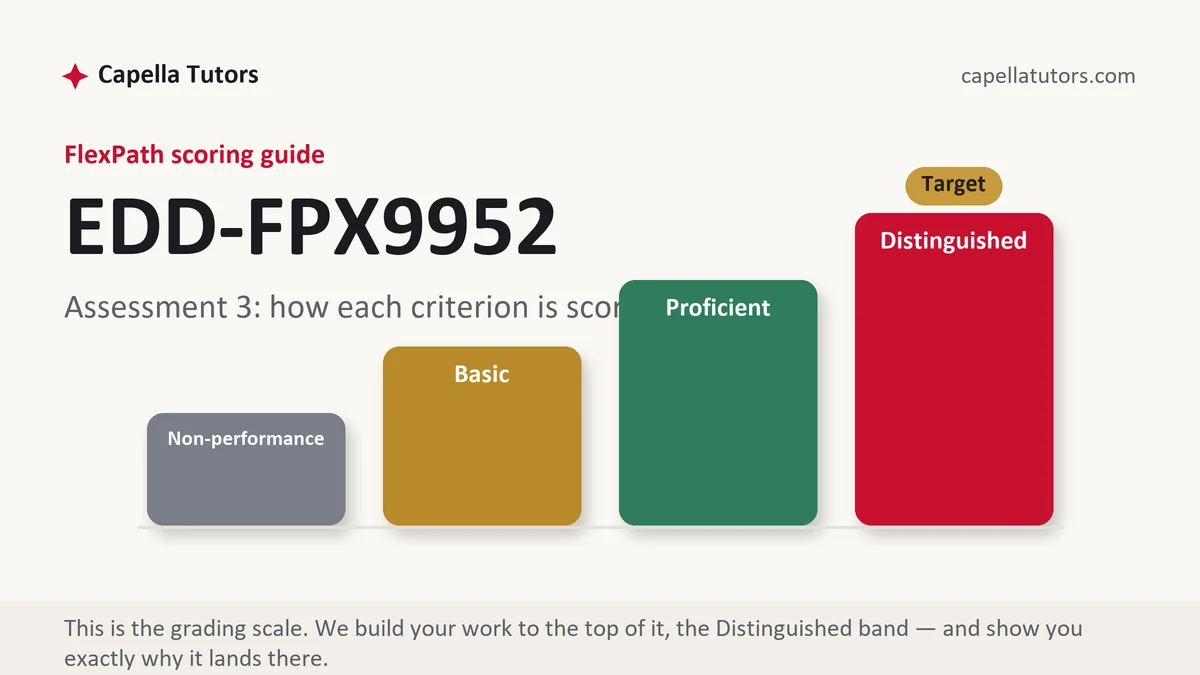
How EDD FPX 9952 Assessment 3 is scored
FlexPath scores criteria one at a time against four levels. Read the top level of each before you write, because that is the only place the required move is stated:
| Level | What it means on a conceptual framework and gap statement |
|---|---|
| Distinguished | Each construct is defined once, cited to its origin, and then visibly reused where the questions are set, and the two gaps are stated separately with the project placed in the overlap. A framework that generates something is the whole of the top column. |
| Proficient | Constructs are defined and sourced and the gap is clear. Correct, and one move short of doing work. |
| Basic | A framework named in a heading, a diagram, and no construct that reappears anywhere below it. |
| Non-performance | A required element is missing, most often the gap in practice, or a framework attributed to the textbook that summarized it. |
The next course is where a loose framework turns expensive. EDD FPX 9953, EdD Doctoral Project 3, is graded on whether instrument items trace back to a construct, so a framework that stopped at the diagram means a course spent inventing questions and then failing to justify them. Tighten it now, submit on grade, and the two business days an evaluation can take are better spent writing than watching.
The EDD FPX 9952 Assessment 3 method, step by step
-
Take the constructs out of your own synthesis
The framework is not a new reading assignment. Look at the themes you just wrote, name the two or three things you claim actually operate on this problem, then find the source that introduced each. A construct arriving from nowhere is the sign that a framework was chosen rather than built.
-
Define each construct once, in your own words, with the citation attached
One definition, in the first place the construct appears, phrased so a practitioner would recognize it in a hallway. Cite whoever published the idea rather than the methods text that paraphrased it, because a faculty reader can tell those two apart from a single reference entry.
-
State the relationship you are claiming, not only the parts
A framework is constructs plus the arrows. Say which construct you claim moves which, in what direction, under what condition, and be willing to be wrong about it. A list of defined terms with no claimed relationship is a glossary, and glossaries generate no questions.
-
Make the constructs do visible work
Take each construct and point at the question it produced. If a construct produces nothing, either it is not operating on your problem or your questions were not derived from your framework, and both are cheaper to fix in this course than in the next one. Draw a figure only where the figure carries what the sentences cannot.
-
Write the two gaps in separate sentences
The gap in the literature is what nobody has studied. The gap in practice is what your organization is not doing. They are rarely the same absence, almost never one sentence, and your project belongs where they overlap. Name both, then say which piece of the overlap one practitioner could close.
-
Level yourself on each criterion, then submit early in the session
Mark each criterion at the level you would defend, and repair anything below the top column while it is still cheap. Evaluations take up to two business days, so early submissions leave room for a second attempt.
A structure that maps to the criteria
Section targets our tutors plan to for a framework and gap section of ordinary length, not Capella rules; stretch wherever your guide puts the weight.
| Section | What it must do | Guide |
|---|---|---|
| Where the constructs came from | The move from your synthesis themes to the constructs you claim operate, with the reasoning shown. | ~200 words |
| The constructs defined | Each construct once, in practitioner language, cited to the publication that introduced it. | ~275 words |
| The relationships claimed | Which construct acts on which, in what direction, under what condition, and how you could be wrong. | ~250 words |
| The framework at work | Each construct pointed at the question it generates, with any figure carrying what prose cannot. | ~250 words |
| The gap in the literature | What has not been studied in settings like yours, stated as an absence rather than as a complaint. | ~200 words |
| The gap in practice and references | What your organization is not doing, its overlap with the literature gap, then seventh edition APA. | ~175 words |
Annotated sample excerpt
An original passage from our team at the level the top descriptor describes. Note that the two gaps never share a sentence.
The retained studies test writing curricula in schools that funded release time for collaborative planning, and none of the 27 reports what happens to a curriculum adopted without it, which is the absence in the literature.1 The absence in this district is different and more specific: the curriculum has been board-adopted for three years, sits in every classroom, appears in 4 of the 61 lesson plans sampled last spring, and no planning time has been added to the contract day since 2019.2 A single practitioner cannot supply release time, so this project sits in the narrow overlap and asks what the curriculum's own materials are doing for teachers who use them inside the day they already have.3
- 1The literature gap is stated as a specific missing condition rather than as a call for more research, so a reader can verify it against the retained set.
- 2The practice gap arrives with counts and a date, which is what stops it from being a complaint about the district.
- 3Names what one practitioner cannot do, then places the project inside the remainder. Scoping honestly is what the top column reads as control.
The full premium sample for your exact assessment, written fresh to your scoring guide and issue, is free to request. Study it, revise it into your own voice, and submit work you understand.
The five mistakes that cost Distinguished
- A framework picked for its reputation. Adopting a well-known theory because it is well known produces constructs that never touch your problem, and a reader sees it at the first question.
- A construct defined twice, differently. Two definitions in one chapter means neither is being used, and the criterion that pays for use goes unpaid.
- Arrows with no claim behind them. A diagram of boxes joined by lines nobody explains is decoration, and it is scored as decoration.
- Theory cited to its summarizer. A methods textbook standing where the original publication belongs tells a faculty reader how you met the idea.
- The two gaps folded into one sentence. Combining them hides whichever is weaker, and the weaker one is always what a reviewer asks about.
Pre-submission checklist
- Constructs derived from your own synthesis themes, not imported whole
- Each construct defined once, in practitioner language, cited to its origin
- The claimed relationship between constructs stated with a direction
- Every construct pointed at a question it generates
- Literature gap and practice gap written as separate sentences
- Citations and entries checked against each other in both directions, seventh edition APA
Framework section due?
Send the guide and the synthesis you already have. We build constructs out of your own themes, cite each to the publication that introduced it, and make certain every one reappears where the questions get written. First sample free, rewrites included.