This manual is for EDD FPX 9951 Assessment 1, start to submission. Assessment 1 of EDD FPX 9951, EdD Doctoral Project 1, is where a concern you carried into the doctorate becomes a problem of practice: one condition, inside one named organization, sized with that organization's own published figures. The assessment usually asks you to state the condition, establish its magnitude against a comparison a reader can check, and name the person who owns the decision behind it. Below is our tutors' method, a structure the criteria can find, and an annotated sample. Prefer to hand it off? A premium original sample returns in 24 to 48 hours and is revised free until the guide is satisfied. Capella's catalog lists the course as EDD-FPX9951, and some courserooms print EDD9951; both point to this same Assessment 1.
One honesty note before the manual: Capella revises courses and scoring guides over time, so always write to the exact scoring guide attached to your assessment in the courseroom. The course identity above is verified on capella.edu; the method and structure below are our tutors' approach to it, not Capella's official rubric text.
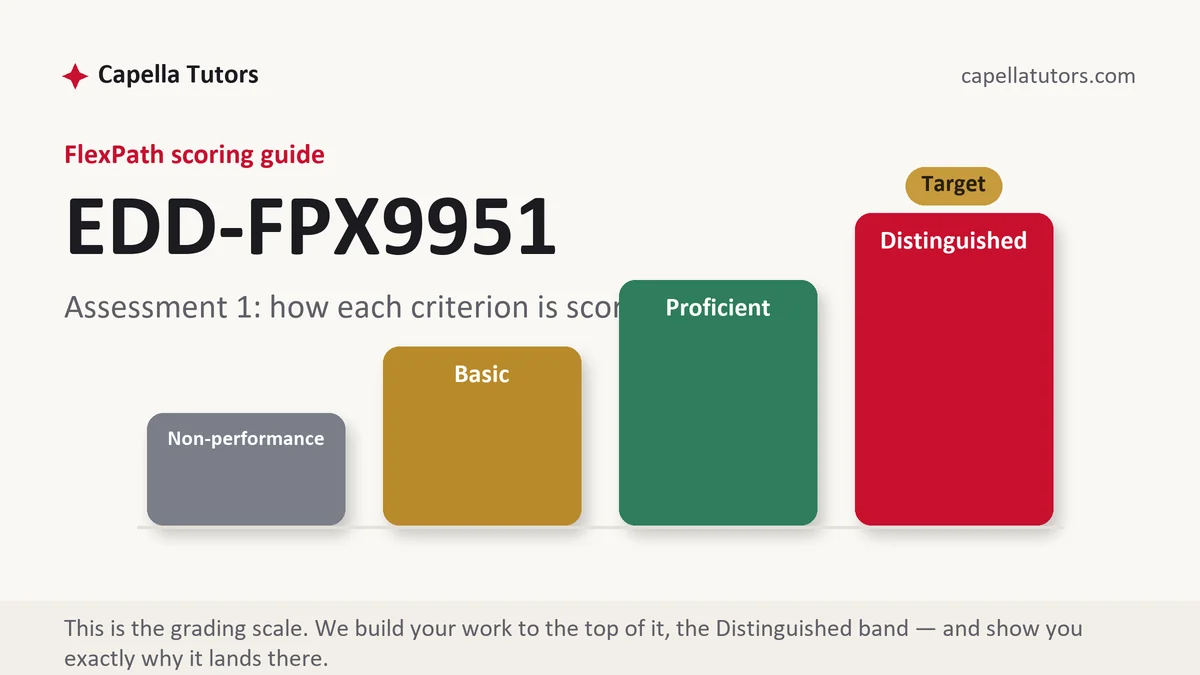
How EDD FPX 9951 Assessment 1 is scored
There are no letter grades in a FlexPath session. Each criterion on your guide is placed at one of four levels, and the wording at each level is the instruction set for the draft:
| Level | What it means on a problem-of-practice statement |
|---|---|
| Distinguished | The condition arrives as the difference between two figures a reader could open, the decision it implicates is named with its owner, and the author says what those figures cannot yet establish. The top column asks one move past complete, and its wording tells you which move. |
| Proficient | The condition is stated and evidenced from start to finish. Complete work, one deliberate move below the column above it. |
| Basic | A fluent account of something worth worrying about, with magnitude asserted instead of sourced. Most first attempts at a doctoral problem statement land here. |
| Non-performance | A required element is missing rather than thin, most often the site's own numbers or the person who could decide otherwise. |
This is the sentence five later courses get built on, so the cost of a soft one compounds. EDD FPX 9952, EdD Doctoral Project 2, has to show that your problem is a known kind of problem, which it cannot do while the problem itself is still a topic. Faculty take up to two business days on an attempt, so an honest submission early in the week buys a second cycle inside the same session.
The EDD FPX 9951 Assessment 1 method, step by step
-
Turn the guide into the outline before you write a word
Every criterion becomes a heading and its top descriptor sits underneath while you draft. Anything you cannot file under a heading is not part of this deliverable, however true it is. Doctoral guides usually score scholarly writing on a row of its own, so a sound observation made loosely still drops a level.
-
Say the condition out loud to somebody who works there
Read your draft sentence to a principal, a coordinator or a department chair at the site and watch what happens. If they name the month it gets worst, you have a problem of practice. If they ask what you mean, you still have an interest, and the repair is one more conversation rather than one more source.
-
Give the condition a numerator, a denominator and a window
Rates persuade committees and adjectives do not. Serious turnover means nothing; 19 of the 34 teachers hired since 2021 gone before their fourth year is a fact somebody can dispute, and only disputable facts earn credit. Put the year range beside the count every time.
-
Find the comparison that turns a rate into a gap
One figure standing alone is a description. Set it against the state average, against the district three years earlier, or against the buildings inside your own system that do not have the problem, and it becomes a gap with a size. Choose the comparison you can source today rather than the one that flatters the argument.
-
Ask now what review the eventual study will need
Whether your later collection requires full review, expedited review or a determination that it is exempt depends on what you plan to gather and from whom, and that determination belongs to a reviewer rather than to you. Ask your faculty in writing which pathway applies and whether your district runs its own research request process, because both queues move on their own calendar.
-
Award yourself a level on every criterion, then submit early in the week
Read the draft one criterion at a time, write down the level you would honestly give it, and repair everything short of the top column while it is still yours to repair. An attempt filed on a Thursday can sit through the weekend.
A structure that maps to the criteria
Planning targets our tutors use for a problem statement of ordinary length, not Capella rules; stretch whichever section your own guide weights hardest.
| Section | What it must do | Guide |
|---|---|---|
| Opening and the condition | Name the organization, its size, and the condition in one sentence a person who works there would recognize. | ~150 words |
| Magnitude in the site's own figures | The rate with its numerator, denominator and school year, each figure attributed to a document a reader can open. | ~275 words |
| The gap against a comparison | The same measure beside a state figure, a prior year or an internal unit without the problem, with the difference stated in numbers. | ~275 words |
| Why a practice doctorate belongs here | What changes for identifiable people if this improves, and what it would still not settle for the field. | ~225 words |
| Access, permission and review | The records and people a later design needs, who releases them, and which review pathway you have asked about. | ~200 words |
| Purpose forward and references | One sentence naming what the project will find out, then seventh edition APA in both directions. | ~150 words |
Annotated sample excerpt
One original opening from our team, written at the register the top column describes. Read it for the moves rather than for the subject.
This district hired 34 teachers between 2021 and 2024, and 19 of them had left before the start of their fourth year, a departure rate of 56 percent against a statewide figure of 24 percent across the same period.1 Two of the six buildings account for 13 of the 19 departures, and both are the schools filled last each August, after the internal transfer window closes.2 I direct induction for all six, which makes the assignment sequence a practice I can describe in detail and cannot change, so this project treats the August order as a condition and asks what induction can carry inside it.3
- 1A count, a denominator, a window and an external comparison in the first sentence, so the problem arrives as evidence rather than as concern. Nothing about why teacher retention matters.
- 2Locates the gap inside the system instead of across it, and points at a practice rather than at people. A committee can argue with a transfer window.
- 3Discloses role, authority and the limit of that authority in one sentence, then scopes the project to what the author could actually move.
The full premium sample for your exact assessment, written fresh to your scoring guide and issue, is free to request. Study it, revise it into your own voice, and submit work you understand.
The five mistakes that cost Distinguished
- A theme where a problem belongs. Teacher retention is a subject with a literature; a 56 percent four-year departure rate in six named schools is a problem with an owner.
- Magnitude asserted and never sourced. High turnover, significant attrition and widespread concern are all unscoreable until a rate, a denominator and a year appear.
- A comparison chosen for effect. Setting your figure against the most flattering benchmark available is visible immediately, and it costs more than the point it wins.
- Role and stake left out. Studying the organization that pays you is ordinary in this degree; not saying so reads as an oversight rather than a decision.
- A first sentence that would fit any district. If the opening survives having your site swapped out of it, the criterion has nothing specific to reward.
Pre-submission checklist
- Every criterion in your guide owns a labeled section
- The condition reads as one sentence somebody at the site would recognize
- The rate carries a numerator, a denominator and a school year
- A named comparison converts the rate into a gap of stated size
- Your role, your authority and what you cannot change all disclosed
- Citations reconciled against the reference list both ways, seventh edition APA
Problem statement in the queue?
Send the scoring guide, your state report card and whatever your district publishes about itself. Eight readers, one of them checking every figure against the document it came from, return a premium original sample written to the top descriptor in 24 to 48 hours, revised free until it gets there.