This manual is for EDD FPX 9951 Assessment 2, start to submission. Assessment 2 of EDD FPX 9951, EdD Doctoral Project 1, is the alignment deliverable: a purpose sentence and a small set of questions describing the same object as your problem at three levels of resolution. The assessment usually asks you to write the purpose, derive the questions from it, and show that each question could be answered with a source you can name today. Below is the method our tutors use, a structure built out of the criteria, and an annotated sample. Would rather this were written for you? A premium original sample comes back within 24 to 48 hours, rewritten free until your guide is met. Capella's catalog lists the course as EDD-FPX9951, and some courserooms print EDD9951; both point to this same Assessment 2.
One honesty note before the manual: Capella revises courses and scoring guides over time, so always write to the exact scoring guide attached to your assessment in the courseroom. The course identity above is verified on capella.edu; the method and structure below are our tutors' approach to it, not Capella's official rubric text.
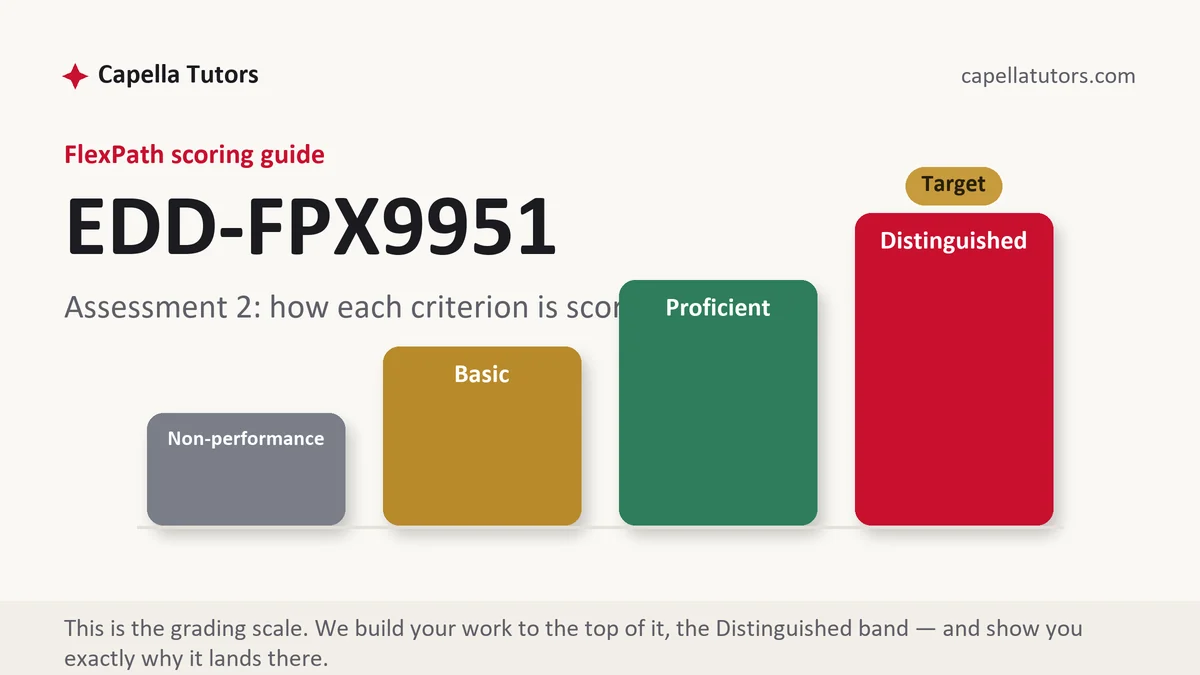
How EDD FPX 9951 Assessment 2 is scored
A FlexPath transcript records levels rather than percentages. Your guide sorts every criterion into one of four, and the top descriptor is the sentence you are actually writing toward:
| Level | What it means on a purpose and questions deliverable |
|---|---|
| Distinguished | Purpose and questions could not be lifted onto a different problem without breaking, every question names the source that would answer it, and the author states which part of the problem the set deliberately leaves alone. That last admission is usually what the column is paying for. |
| Proficient | Purpose and questions are aligned and answerable throughout. Nothing is wrong with it, and nothing in it is surprising. |
| Basic | A reasonable purpose followed by questions that drift a little wider than it does. Drift of one degree is the most common finding on this deliverable. |
| Non-performance | A question asks about something the site does not record, or the purpose describes a different object from the problem statement above it. |
Alignment is graded harder in the opening course than anywhere later, because nothing downstream repairs it cheaply. EDD FPX 9952, EdD Doctoral Project 2, searches the literature against the questions you write here, and a question that shifts afterward invalidates the search that answered it. Submit on grade rather than on schedule, and use the two business days faculty have for evaluation to draft the next section.
The EDD FPX 9951 Assessment 2 method, step by step
-
Write the purpose sentence before anything else, and keep it to one
One sentence, in the form of what this project will find out or change, at the scale your site can support. If it takes two sentences you are holding two projects, and the second is the one to cut. Every question underneath it is then derived rather than invented.
-
Test the purpose by substitution
Swap your problem out of the purpose sentence and put a neighboring problem in. If the sentence still reads correctly, it is generic and the criterion cannot reward it. A purpose that breaks under substitution is a purpose that belongs to your project alone.
-
Derive two to four questions and then stop
Each question inherits the purpose and divides it, so a set of three usually covers a practitioner project and a set of seven means the purpose was never narrowed. Write them as questions rather than as aims, and keep the verb honest: describe, compare and explain are three different commitments and only one of them is yours.
-
Put the data source beside each question in writing
For every question, name the record, the roster, the transcript file or the group of people whose answers would settle it, then confirm that the thing exists and that somebody would release it. A question with a blank in that column is a question your fourth course cannot answer.
-
Say what the set will not answer
Name the nearby question you are declining and give the reason in one clause. A committee reading a bounded set trusts the boundary; a committee reading an unbounded set starts drawing one for you, and theirs is never the boundary you wanted.
-
Score yourself criterion by criterion, then file the attempt early
Mark each criterion at the level you would defend out loud, then fix everything below the top level before it leaves your hands. Evaluations take up to two business days, so an attempt sent Monday leaves room for a revision inside the same week.
A structure that maps to the criteria
Word targets our tutors plan against for an alignment section of ordinary length, not Capella requirements; expand wherever your guide puts its weight.
| Section | What it must do | Guide |
|---|---|---|
| Problem restated in brief | Two or three sentences carrying the condition and its magnitude forward from the problem statement. | ~125 words |
| Purpose | One sentence naming what the project will find out or change, sized to what the site can support. | ~150 words |
| Derivation of the questions | How the purpose divides, and why it divides along these lines rather than others. | ~250 words |
| The questions with their sources | Two to four questions, each paired with the specific record or group whose answer settles it. | ~325 words |
| Boundaries | The nearby question you are not asking, the reason, and what the set therefore cannot claim. | ~200 words |
| Forward link and references | What the next stage of the project owes this set, in seventh edition APA throughout. | ~150 words |
Annotated sample excerpt
An original passage from our team at the level the top descriptor describes. Study the joints, not the subject.
The purpose of this project is to explain why 96 of the 412 students who entered ninth grade at this school last year finished it short of the six credits the district requires for on-time promotion, when the same cohort left eighth grade with a 91 percent course pass rate.1 The purpose divides along the two things the school can act on, scheduling and adult contact, which is why the questions ask about course placement patterns and about who noticed a failing student first rather than about student motivation.2 Both divisions are answerable from records the school already keeps, transcripts and the referral log, and neither requires a claim about what a fourteen year old was thinking.3
- 1The purpose carries the count, the denominator and the contrast forward, so a reader never has to reach back to the problem statement to size it.
- 2States the principle behind the division before the questions arrive, which is the difference between derived questions and assembled ones.
- 3Names the data sources inside the purpose section and rules out a question the site could not answer, in the same breath.
The full premium sample for your exact assessment, written fresh to your scoring guide and issue, is free to request. Study it, revise it into your own voice, and submit work you understand.
The five mistakes that cost Distinguished
- A purpose that fits the whole field. Exploring factors affecting student success is a sentence any school in the country could file, and there is nowhere on a guide to reward it.
- Questions wider than the purpose that spawned them. Each question should be a slice of the purpose; a question reaching past it has quietly changed the project.
- A verb the design cannot deliver. Asking why when the only available data records whether is a mismatch a reviewer sees in one pass.
- Seven questions where three would do. A long list is usually a narrow purpose that was never written, and every extra question is another source you owe.
- No stated boundary. A set with no declared edge invites the committee to test it at the edge they choose.
Pre-submission checklist
- Purpose written as one sentence that breaks if the problem is swapped out
- Two to four questions, each a slice of that purpose
- A named data source printed beside every question
- Verbs matched to what the available records can support
- One nearby question declined, with the reason given
- In-text citations and reference list reconciled both ways, seventh edition APA
Purpose and questions due this week?
Send the guide and the problem statement you already filed. We build the purpose, derive the questions from it, and print the data source beside each one before you commit five more courses to the set. The first premium sample carries no charge.