This manual is for EDD FPX 9951 Assessment 3, start to submission. Assessment 3 of EDD FPX 9951, EdD Doctoral Project 1, is the account of where the work will happen and who you are inside it: the organization in figures, your role and the access it grants, the risks that role creates, and the permission you hold in writing. The assessment usually asks you to describe the setting well enough that a stranger could tell why the problem survives there, then handle your own position as a design constraint rather than as a closing disclosure. Below is our tutors' method, a criterion-mapped structure, and an annotated sample. Rather it landed on your desk finished? A premium original sample arrives inside 24 to 48 hours and is revised at no charge until the criteria are satisfied. Capella's catalog lists the course as EDD-FPX9951, and some courserooms print EDD9951; both point to this same Assessment 3.
One honesty note before the manual: Capella revises courses and scoring guides over time, so always write to the exact scoring guide attached to your assessment in the courseroom. The course identity above is verified on capella.edu; the method and structure below are our tutors' approach to it, not Capella's official rubric text.
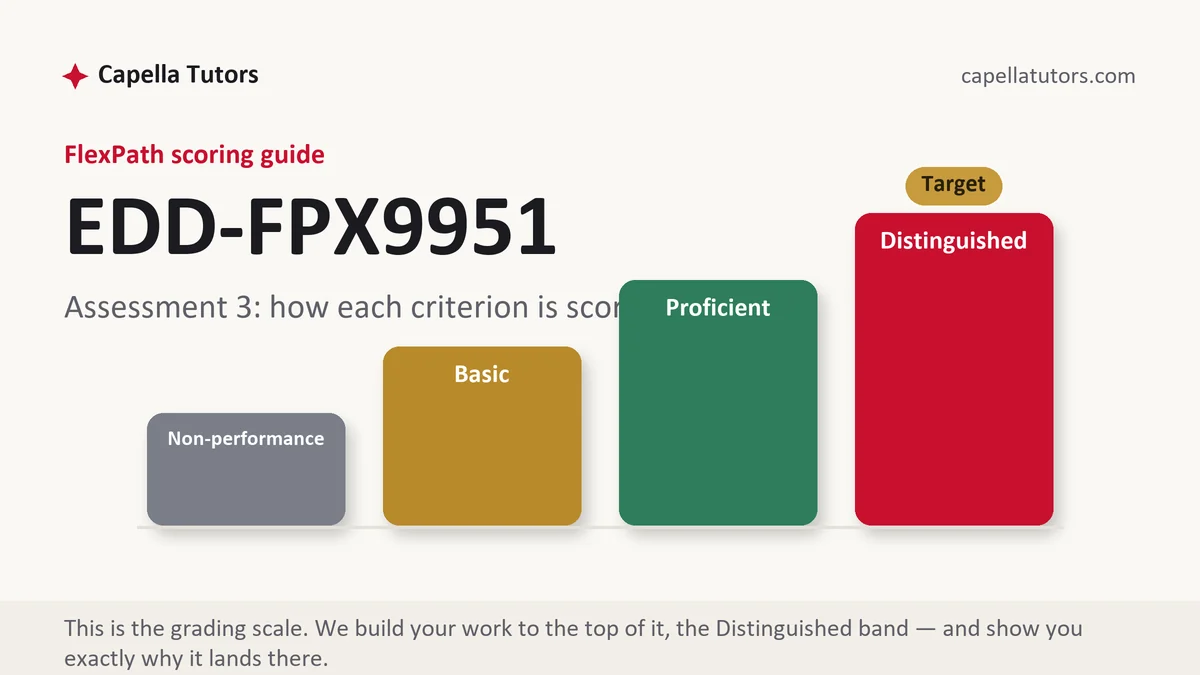
How EDD FPX 9951 Assessment 3 is scored
Nothing here is averaged into a grade. Each criterion is judged on its own and lands at one of four levels, so read all four before you draft anything:
| Level | What it means on a site, positionality and access account |
|---|---|
| Distinguished | The setting explains why this problem survives here rather than describing a district generically, every risk your role creates is paired with a control, and the approval pathways are described as the separate queues they are. |
| Proficient | Setting, role and permissions are all present and accurate. A reader finishes it informed and unsurprised. |
| Basic | A competent profile of a district, with positionality handled as a disclosure paragraph rather than as a constraint on the design. |
| Non-performance | Something required is absent, most often the access position: no named holder of the records, or no acknowledgement that the researcher evaluates the participants. |
This section quietly decides whether the project can be executed at all. EDD FPX 9953, EdD Doctoral Project 3, has to convert what you claim here into a procedure with dates on it, and a permission assumed in the first course becomes a stalled queue in the third. Write to the criterion, submit early in the session, and treat the two business days faculty have for evaluation as drafting time rather than waiting time.
The EDD FPX 9951 Assessment 3 method, step by step
-
Describe the site in numbers a reader could verify
Enrollment, building count, staffing levels, the performance figures your problem touches, and the demographic profile, each attributed to a published source. A paragraph of adjectives about a caring community tells a reader nothing and forfeits the criterion that pays for context.
-
Explain why the problem persists at this site specifically
Context earns credit where it answers a question rather than filling space. What has the organization already tried, when, and what happened? A problem that survived two prior attempts is a different problem from one nobody has touched, and saying which you have is the point of the section.
-
State your role, your reporting line and your influence
Give the title, the number of people it covers, and the decisions you can actually make. Then say who reports to you among the people you might recruit, because a reader forced to guess at your authority reads everything after it more carefully than you would like.
-
Pair every risk your position creates with a control
Colleagues you evaluate cannot comfortably decline, so recruitment moves to somebody who does not evaluate them. A district of a few thousand is a small place, so a school name plus a grade band plus a subject can identify a person after the name is gone. Write the risk, then the control beside it, and the section reads as judgment instead of boilerplate.
-
Separate what you may see from what you may analyze
Records you hold in your job are not automatically records you may use in a study, and student records in particular sit under protections that do not lift because you have a password. Name who releases them, then ask your faculty which review pathway your plan needs, since a determination that a project is exempt is a reviewer's call and never your own.
-
Give yourself a level on each criterion, then submit on grade
Read the section against the guide one criterion at a time and mark it honestly, then repair anything under the top level. Filing early in the week means an evaluation returns inside the same week rather than after it.
A structure that maps to the criteria
Section targets our tutors work to for a setting and positionality account of ordinary length, not Capella rules; lengthen whichever part your guide weights.
| Section | What it must do | Guide |
|---|---|---|
| The organization in figures | Enrollment, buildings, staffing and the performance measures your problem touches, each sourced. | ~250 words |
| Why the problem persists here | Prior attempts with dates and outcomes, plus the local conditions that let the condition survive them. | ~275 words |
| Role, authority and reporting line | Your title, its scope, the decisions it carries, and who among your potential participants reports to you. | ~200 words |
| Risks and controls | Each risk your position creates, on its own line, with the safeguard that answers it. | ~250 words |
| Records, release and review | What data the project needs, who holds authority to release it, and which review pathway you have asked about. | ~225 words |
| Standing forward and references | What this position permits the next stage to attempt, in seventh edition APA both ways. | ~150 words |
Annotated sample excerpt
An original passage from our team at the register the top column rewards. Read it for the way each risk gets answered.
I coordinate family engagement for the four elementary schools that feed this middle school, which gives me the sign-in records for every family event held since 2022 and no authority over the principals who schedule them.1 Because I approve the stipends the parent liaisons are paid from, no liaison will be recruited by me; the middle school counselor, who approves nothing, will make first contact and will hold the consent forms.2 Sign-in records name families, so the analysis will use counts by school and grade band only, and the two schools with fewer than 40 participating families will be reported together to keep any single family from being reconstructed.3
- 1Discloses the access and the limit of the authority in one sentence, so a reader knows exactly what this researcher can and cannot make happen.
- 2Names the dual-role problem and the person who solves it. A control with somebody's job attached is worth three paragraphs about confidentiality.
- 3Handles re-identification with a stated rule and a threshold, which is what a reviewer looks for and what most drafts leave as an intention.
The full premium sample for your exact assessment, written fresh to your scoring guide and issue, is free to request. Study it, revise it into your own voice, and submit work you understand.
The five mistakes that cost Distinguished
- A district profile with no argument in it. Enrollment and demographics matter only where they explain why this problem survives at this site, and the criterion is written to check that they do.
- Positionality as a confession. Naming your bias and moving on scores under naming the specific risk your job creates and the control that answers it.
- Permission described as a friendly yes. A supportive principal is not an approval, and neither is a conversation nobody wrote down.
- Access to records treated as authority over them. Being able to open a file is not permission to analyze it, and the two are usually held by different people.
- Review left for later. Whether a plan is exempt, expedited or fully reviewed is a reviewer's determination, and learners who guess spend the following course waiting.
Pre-submission checklist
- Every figure about the site attributed to a document a reader can open
- Prior attempts at the problem named with dates and outcomes
- Your title, its scope and your reporting line all stated
- Each risk from your position paired with a named control
- Record holders identified and the review pathway asked about in writing
- Reference list and citations reconciled both ways, seventh edition APA
Site and positionality section due?
Send the guide, what your district publishes about itself, and an honest sentence about your job. We build the context that argues, a risk table with a control on every line, and an access account a reviewer can follow. The first premium sample comes at no cost to you.