This manual is for EDD FPX 8528 Assessment 1, start to submission. Assessment 1 usually asks you to appraise a measure rather than admire it. The deliverable is an argument about a specific interpretation and a specific use: what the instrument was built for, what a score can carry, which decision it is being asked to support, and whether that decision is one the score can bear. Format and audience come from the guide attached to your own assessment. Below is the method, the section plan it produces, and an annotated excerpt from one of our models. Prefer to hand it off? A premium original sample built on your instrument comes back inside 24 to 48 hours, revised free until the guide is met. Capella's catalog lists the course as EDD-FPX8528, and some courserooms print EDD8528; both point to this same Assessment 1.
One honesty note before the manual: Capella revises courses and scoring guides over time, so always write to the exact scoring guide attached to your assessment in the courseroom. The course identity above is verified on capella.edu; the method and structure below are our tutors' approach to it, not Capella's official rubric text.
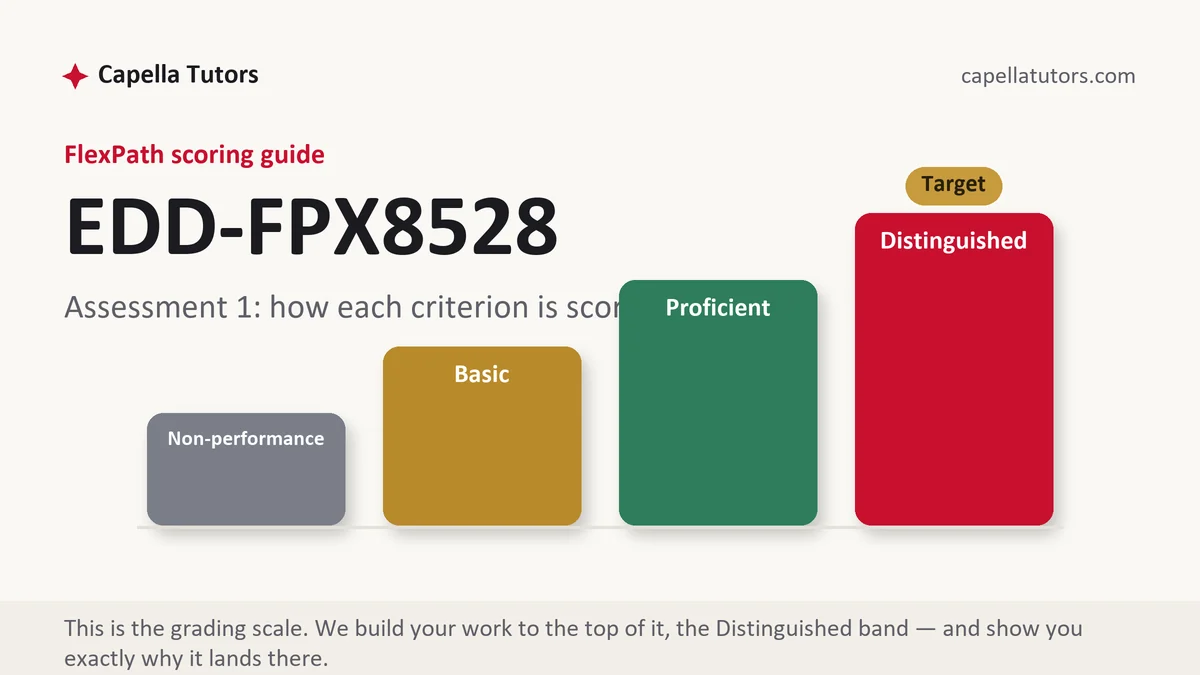
How EDD FPX 8528 Assessment 1 is scored
There is no aggregate grade. Each criterion resolves to one of four levels, and the top level always asks for one move beyond completeness:
| Level | What it means on an instrument appraisal |
|---|---|
| Distinguished | Validity is argued for the named use rather than claimed for the test, the technical documentation is used rather than cited, and at least one inappropriate use is named and ruled out. |
| Proficient | The instrument described accurately with its purpose identified. Complete, and one move short wherever validity is discussed in general rather than against the decision at hand. |
| Basic | A description of a test with its reliability figure quoted. No decision named, and no argument connecting the score to what somebody wants to do with it. |
| Non-performance | A required element is absent, most often the intended use, or the technical evidence the criterion asked you to appraise. |
One principle settles most arguments in this deliverable: validity is a property of an interpretation and a use, not of an instrument. The professional testing standards issued jointly by the educational research, psychological and measurement associations state it outright, and working from that document rather than from a textbook summary of it is what a doctoral reader notices first.
The EDD FPX 8528 Assessment 1 method, step by step
-
Name the decision before the instrument
Write at the top of the page what somebody wants to do with the score: place a student, group for instruction, exit an intervention, evaluate a program, rate an adult. Every later judgment depends on that sentence, since the same reading inventory can be a defensible basis for grouping next week and an indefensible basis for a personnel decision.
-
Read the technical documentation
Find the manual and use it. It carries the purpose the instrument was designed for, the population it was normed on, its reliability estimates, and the standard error of measurement, which is the figure that matters most and gets quoted least. A claim about one student's score that ignores the error band is unsupported by the documentation itself.
-
Convert the error band into students
Turn the technical figure into something a principal can see. If the standard error is 4 scale points and the placement cut is 212, a student at 209 and a student at 215 are not reliably different, and the count of students inside that band tells you how many placements are effectively decided by measurement noise.
-
Check whether purpose and use match
Formative, interim and summative describe purposes and consequences rather than products. A tool marketed as formative turns summative the moment its score feeds a placement, and your appraisal has to name that. Where intended purpose and actual use diverge, name the divergence, since the criterion is grading that judgment.
-
Rule out one use explicitly
Say what this measure should not be used for and why, in one clear paragraph. Ranking teachers, exiting a student from services on a single administration, comparing this year's cohort to last year's as though they were the same children: pick the misuse most likely in your setting and close the door on it.
-
Check the fairness question, then self-score
Ask whether every group had comparable opportunity to learn what the instrument measures, and whether accommodations, language of administration or testing conditions differed in ways the score cannot see. Then disaggregate with small cells suppressed, mark each criterion honestly, and submit once every technical figure traces to the manual.
A structure that maps to the criteria
The word targets below are our planning numbers for an appraisal deliverable rather than Capella requirements. Give the validity argument the most room, since that is where the criteria concentrate.
| Section | What it must do | Guide |
|---|---|---|
| The decision at stake | Who makes it, when, and what evidence they currently rely on. | ~180 words |
| The instrument as documented | Purpose, norming population, administration conditions, scoring, reliability and standard error. | ~300 words |
| The intended interpretation | What the score is being read to mean in your setting, stated as a claim. | ~250 words |
| The validity argument | Whether that interpretation supports that use, with the technical evidence doing the work. | ~300 words |
| Uses ruled out | At least one misuse named, with the reasoning that closes it. | ~200 words |
| Fairness, limits, references | Opportunity to learn, conditions, disaggregation and suppression, current APA both ways. | ~200 words |
Annotated sample excerpt
One original paragraph from our team at the standard a validity criterion rewards. Take the reasoning, then run it on your own instrument's manual.
The publisher reports a standard error of measurement of 4 scale points at the seventh grade winter window, and the district uses 212 as the cut for placement into the accelerated sequence.1 Of the 288 students tested, 41 scored between 208 and 216, which means roughly one student in seven sits inside a band where the instrument cannot reliably separate above the cut from below it, and 41 placements are therefore decided by something the score does not know.2 The manual describes the instrument's purpose as monitoring growth within a year and says nothing about course placement, so the interpretation the district relies on is one the publisher does not claim to support.3
- 1The technical figure and the local cut, side by side. Neither means anything alone, and the criterion is grading whether the writer joins them.
- 2The error band converted into a count of affected children. This is the sentence that makes a measurement argument land with a superintendent.
- 3Names the purpose from the documentation and the gap between it and the local use. Validity is argued against a decision, which is what the top row asks for.
The full premium sample for your exact assessment, written fresh to your scoring guide and issue, is free to request. Study it, revise it into your own voice, and submit work you understand.
The five mistakes that cost Distinguished
- Validity claimed for the instrument itself. What matters is whether one particular reading of a score supports one particular decision, and that verdict moves when the decision does.
- A reliability figure quoted with no error band. The coefficient reassures; the standard error tells you which individual decisions are unsafe.
- Purpose taken from marketing. A label does not determine function, since a score used in a placement decision is operating summatively whatever the brochure says.
- No use ruled out. An appraisal finding an instrument generally useful and closing no door has not made the judgment the criterion asked for.
- Opportunity to learn ignored. A score cannot separate what a student cannot do from what a student was never taught, and the fairness row surfaces that.
Pre-submission checklist
- The decision at stake stated before the instrument is described
- Purpose, norming population, reliability and standard error taken from the manual
- The error band converted into a count of the students it affects
- The intended interpretation written as a claim, then argued for or against
- At least one use explicitly ruled out, with reasoning
- Small cells suppressed, and every technical figure traced to its source
Instrument appraisal due?
Send the prompt, the guide, the instrument you are appraising and the decision it is being used for. Eight people, including a research analyst and two QA reviewers, return a premium original sample in 24 to 48 hours with every technical figure traced to the manual, revised free until the guide is met.