This manual is for EDD FPX 8528 Assessment 3, start to submission. Assessment 3 usually moves from measurement to leadership, so the question is no longer what the numbers say but who receives them and what they are permitted to do. The deliverable is a reporting and use plan: an audience at a time, a decision each audience can make, the stakes attached, and the distortion the indicator will produce once people know it is watched. The document's shape and its reader are set by the guide in your courseroom. Below are our working method, the sections the criteria call for, and an annotated excerpt. Prefer to pass it over? A premium original sample arrives inside 24 to 48 hours and keeps being revised at no charge until the guide is met. Capella's catalog lists the course as EDD-FPX8528, and some courserooms print EDD8528; both point to this same Assessment 3.
One honesty note before the manual: Capella revises courses and scoring guides over time, so always write to the exact scoring guide attached to your assessment in the courseroom. The course identity above is verified on capella.edu; the method and structure below are our tutors' approach to it, not Capella's official rubric text.
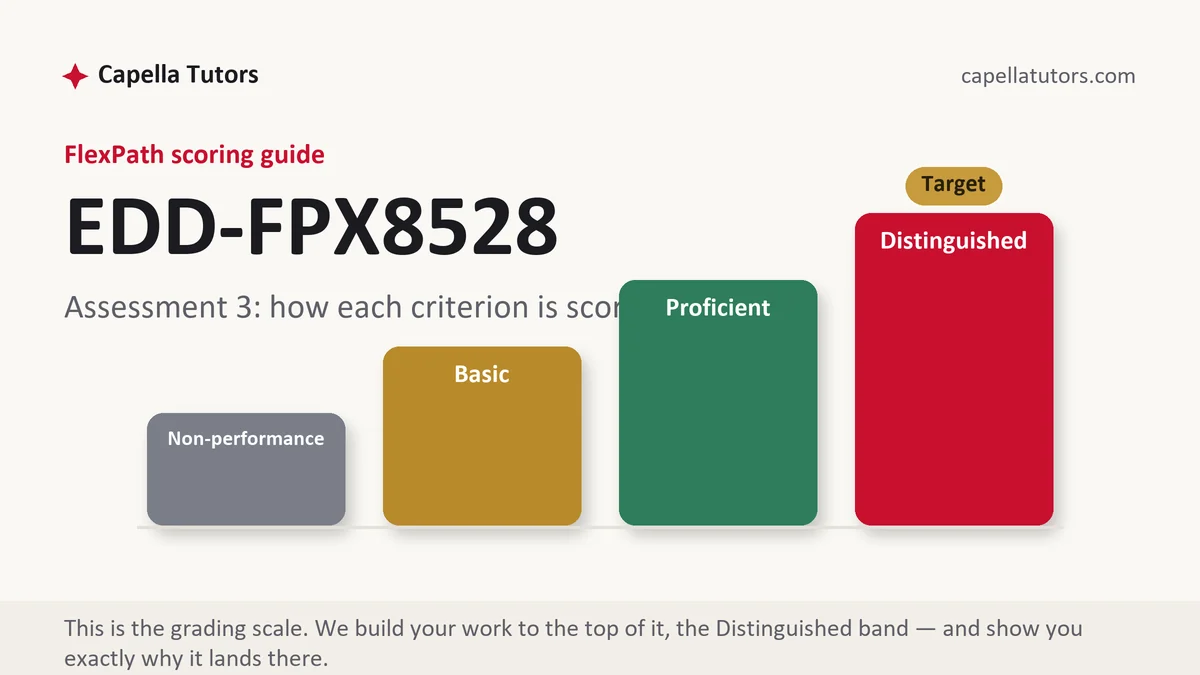
How EDD FPX 8528 Assessment 3 is scored
Each criterion resolves to one of four levels, and in this deliverable the top level is almost always about anticipation rather than accuracy:
| Level | What it means on a reporting and use plan |
|---|---|
| Distinguished | Each audience receives only what it can act on, decision rights and stakes are stated, the predictable gaming of the indicator is anticipated, and suppression rules protect small groups. |
| Proficient | A clear reporting plan with audiences distinguished. Complete, and short of the row above wherever stakes go unstated or distortion is not anticipated. |
| Basic | One report distributed to everybody, with a note about using data for improvement. No decision rights, no suppression, no account of what the measure will do to behavior. |
| Non-performance | A required element is absent, most often the ethical analysis, or the audience-specific reporting the criterion asked for. |
Every indicator with consequences attached changes behavior toward the indicator, and the pattern is documented well enough that ignoring it reads as naivety. Attendance definitions drift, referral thresholds move, and attention crowds toward whichever students sit closest to a threshold. Naming the distortion you expect, and how you will watch for it, is the doctoral version of this work.
The EDD FPX 8528 Assessment 3 method, step by step
-
Write the decision each audience can make
Take the audiences one at a time and finish the sentence: with this report, this person may decide something. A teacher may change a schedule for a named student, a counselor may open a case, a principal may reassign adult time, a board may allocate money. Where an audience has no decision, the report is a courtesy, and courtesies leak.
-
Match the grain of the report to the decision
Student-level detail belongs where somebody can act on an individual and nowhere else. A board needs a trend and a denominator, not a roster. Getting the grain wrong is both a privacy problem and a usability problem, since a table too detailed for its reader gets ignored and one too coarse gets misused.
-
State the stakes plainly
Say what follows from the numbers for each party: nothing, a conversation, a resource allocation, an evaluation entry. People behave according to consequences they infer, so an indicator whose stakes are unstated is treated as though the stakes were maximal. Writing them down is the cheapest way to keep a measure informative.
-
Predict the distortion, name the tell
For each indicator, write how a reasonable person under pressure would improve the number without improving the thing, then name the signal that would reveal it. Referrals falling while incidents hold steady, attendance improving only in the coded categories a school controls, a pass rate rising while the next course's failure rate rises too: each is a tell.
-
Set suppression and access rules
Fix a minimum cell size and apply it everywhere, including internally, since a table of four students in a subgroup identifies them to anybody who works in the building. Say who has access to which layer, how long each report is retained, and what happens to the file when a student transfers out.
-
Add the equity check, then self-score
Disaggregate by the groups your setting requires, ask whether every group had comparable opportunity to learn what the indicator reflects, and report uncertainty alongside every figure rather than in a footnote. Then mark each criterion honestly, confirm every number in the narrative matches its table, and submit once the suppression rules hold throughout.
A structure that maps to the criteria
The targets below are our planning numbers for a reporting and use deliverable, not Capella requirements. Weight the use and ethics sections, since those rows separate this course from a statistics exercise.
| Section | What it must do | Guide |
|---|---|---|
| The indicator set | What is being reported, how each figure is defined, and where the data comes from. | ~250 words |
| Audiences and decisions | Each audience, the decision it can make, and the grain of report that supports it. | ~300 words |
| Stakes and decision rights | What follows from the numbers for each party, and who may act on what. | ~250 words |
| Distortion analysis | How each indicator would be gamed, and the tell that would reveal it. | ~250 words |
| Access, suppression, retention | Minimum cell sizes, access layers, retention periods, and transfer handling. | ~200 words |
| Equity checks and references | Disaggregation, opportunity to learn, uncertainty reporting, current APA both ways. | ~200 words |
Annotated sample excerpt
One original paragraph from our team at the register a use-and-ethics criterion rewards. Learn the moves, then write them for your own indicator set.
The ninth grade counselor receives the student-level view weekly because she is the only person in this plan authorized to open a case, and her report shows four flags by name: a course failure, absence above 8 percent, two or more office referrals, and a credit deficit at the quarter.1 The principal receives counts and rates by flag with denominators and no names, because the decision available at that level is where to move adult time; the board receives the same rates quarterly with cells under 10 suppressed.2 The distortion I expect is on the referral flag, since referrals are an adult decision and the cheapest way to improve the number is to stop writing them, so the plan pairs referral counts with incident logs and treats a divergence between the two as a warning about the measure rather than as progress.3
- 1Names the audience, the authority and the grain in one sentence, with the flag definitions attached. Student-level detail is justified by a decision rather than by convenience.
- 2Two more audiences, each receiving only what its decision needs, with a suppression threshold stated. The board tier is deliberately coarser than the counselor tier.
- 3Predicts the gaming, names the mechanism, and pairs the indicator with a second measure that would reveal it. This is the paragraph the ethics criterion is looking for.
The full premium sample for your exact assessment, written fresh to your scoring guide and issue, is free to request. Study it, revise it into your own voice, and submit work you understand.
The five mistakes that cost Distinguished
- One report for everybody. A single table sent to a teacher, a principal and a board serves three different decisions badly and creates a privacy problem on the way.
- Names where no decision exists. Student-level detail delivered to an audience that cannot act on an individual is exposure with no purpose.
- Stakes left implicit. Where consequences are unstated, people assume the worst and behave accordingly, and the measure stops being informative.
- No distortion analysis. Every watched indicator moves toward being watched, and a plan ignoring this will be corrected in the comments.
- Suppression applied only externally. A subgroup of four identifies its members to colleagues, so the minimum cell rule has to hold inside the building too.
Pre-submission checklist
- Each audience paired with the one decision it is authorized to make
- Report grain matched to that decision, with names only where an individual can be acted on
- Stakes stated for every party receiving a figure
- A predicted distortion and its tell written for each indicator
- A minimum cell size applied internally as well as publicly, with retention stated
- Disaggregation reported with uncertainty, and every narrative figure matching its table
Reporting and use plan due?
Send the prompt, the guide, your indicator definitions and whichever reports you can share. Eight people, including a research analyst and two QA reviewers, return a premium original sample in 24 to 48 hours with audiences separated, stakes stated and suppression applied throughout, revised free until the guide is satisfied.