This manual is for EDD FPX 8528 Assessment 2, start to submission. Assessment 2 usually asks for an evaluation design you could defend to somebody who wants a different answer. That means evaluation questions before methods, a comparison you can actually construct, an implementation measure, and language proportional to the design you have rather than the one you wish you had. Your own guide settles the shape of the document and the reader it has to satisfy. What follows is our method, a set of sections matched to the criteria, and one annotated excerpt. Rather hand it over? A premium original sample is returned to you within 24 to 48 hours, with revisions free until every criterion clears. Capella's catalog lists the course as EDD-FPX8528, and some courserooms print EDD8528; both point to this same Assessment 2.
One honesty note before the manual: Capella revises courses and scoring guides over time, so always write to the exact scoring guide attached to your assessment in the courseroom. The course identity above is verified on capella.edu; the method and structure below are our tutors' approach to it, not Capella's official rubric text.
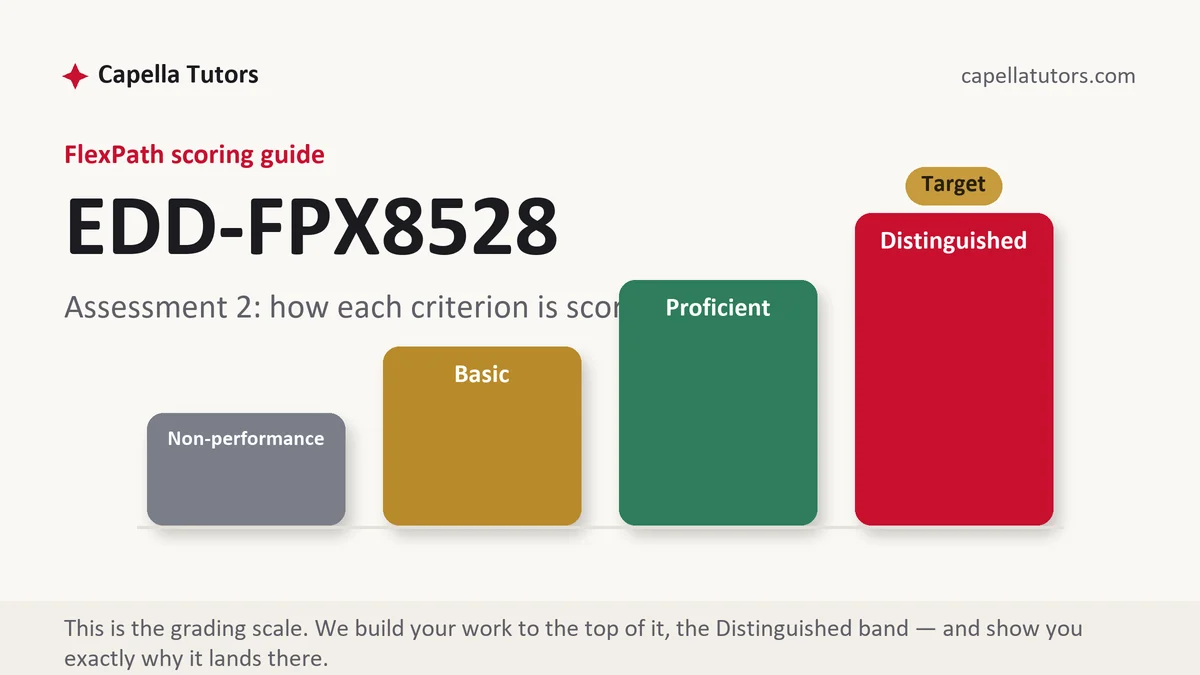
How EDD FPX 8528 Assessment 2 is scored
Levels rather than points, four of them per criterion, returned within two business days of the attempt you submit:
| Level | What it means on an evaluation design |
|---|---|
| Distinguished | The design is named accurately, the alternative explanations it leaves open are listed by the writer, implementation is measured before outcome, and the language never exceeds what the comparison supports. |
| Proficient | A workable design with measures attached. Complete, and short of the row above wherever the counterfactual is unnamed or the verbs promise more than the structure delivers. |
| Basic | Before and after figures with a conclusion attached. No comparison, no implementation measure, and causal verbs doing work the design cannot carry. |
| Non-performance | A required element is absent, most often the evaluation questions, or the design the criterion asked you to specify. |
Most school evaluations have no randomization and no clean comparison, and that is workable if you say so. The rows separating the top two levels are about honesty rather than sophistication: name the design, list what it cannot rule out, and write consistent with rather than caused by.
The EDD FPX 8528 Assessment 2 method, step by step
-
Write the questions before the methods
The question decides whether you need a comparison group, an implementation measure or a description. Whether the program was delivered as intended, whether attendance differed by group, whether participants outperformed similar non-participants: three questions needing three designs. Order them by what the decision in front of you requires first.
-
Build a logic model and find the weak arrow
Inputs, activities, outputs and outcomes, drawn once, with the arrow you least believe marked. In a tutoring program the doubtful arrow is rarely the tutoring itself; it is usually whether the students who most needed it attended enough sessions to receive anything. Aim your first measure at that arrow.
-
Measure implementation before outcome
Report the dose figures first and always: sessions offered, sessions attended, the distribution of attendance rather than the mean, and the share of enrolled students attending fewer than a stated minimum. A program never received cannot be shown to have failed, and reporting implementation first is the habit faculty most reliably reward.
-
Choose the strongest comparison available and name it
An interrupted series, meaning enough measurement points on both sides of the start date to see a shift in level or slope, is the strongest structure most schools can assemble. A matched comparison carries less weight and needs its matching variables named in the text. A dose comparison inside the program is usable with the caution that dose is rarely random. Say which you have and what it leaves open.
-
Report rates against denominators
Every figure arrives with its numerator, its denominator and its window. A gain reported as a percentage of a group whose size is never stated cannot be interpreted, and in small programs the movement of three or four students produces headline numbers ordinary variation would produce anyway.
-
Match the verbs to the design, then self-score
Read the findings section once looking only at verbs. Consistent with, associated with and no different from are defensible in most school evaluations; caused, drove and produced almost never are. Then check that every total in the narrative matches the tables and submit once the arithmetic has survived a second reader.
A structure that maps to the criteria
These are our planning numbers for an evaluation design deliverable, not Capella requirements. Give the design and limits section room, since that is where the criteria concentrate.
| Section | What it must do | Guide |
|---|---|---|
| Decision and evaluation questions | The decision the evaluation informs, and the questions ordered by what it needs first. | ~200 words |
| Program logic | Inputs, activities, outputs, outcomes, and the arrow the writer least believes. | ~250 words |
| Implementation measurement | Dose offered against dose received, the attendance distribution, and who received nothing. | ~300 words |
| Design and comparison | The structure available, the matching or series specification, and what it leaves open. | ~300 words |
| Analysis and reporting rules | Denominators, windows, suppression, and how practical significance will be described. | ~250 words |
| Limits and references | The alternative explanations that survive, and current APA in text and list. | ~200 words |
Annotated sample excerpt
A model paragraph from our writers at the standard an evaluation criterion rewards. Study how the dose figures come first, then write your own.
The program offered 62 sessions across the year and enrolled 78 students, of whom 71 attended at least once; median attendance was 19 sessions, but the distribution is bimodal, with 24 students attending fewer than 8 and 29 attending more than 30.1 Of the 31 students the referral criteria identified as highest need, 18 fall in the low-attendance group, which means the students the program was designed for are largely the students who did not receive it.2 No outcome comparison appears before that figure, because a difference between participants and non-participants here would mostly describe who could stay after school rather than what the tutoring did.3
- 1Offered, enrolled, attended, and the distribution rather than the mean. The bimodal shape is the finding, and an average would have hidden it completely.
- 2Cross-tabulates dose against referral need. Naming that the intended population did not receive the program is the most useful sentence in most first-year evaluations.
- 3Refuses the comparison a reader expects and says why. Declining to report a number you cannot defend is what the limits criterion is grading.
The full premium sample for your exact assessment, written fresh to your scoring guide and issue, is free to request. Study it, revise it into your own voice, and submit work you understand.
The five mistakes that cost Distinguished
- A rate with its base missing. A percentage reported without the population it was computed on cannot be interpreted by anybody, including its author six months later.
- Outcome before implementation. Where dose is not reported first, a null result cannot be told apart from a program nobody attended.
- A mean standing in for a distribution. One median across a bimodal attendance pattern describes a program that does not exist.
- Self-selection ignored. Comparing volunteers with non-volunteers measures who could stay late, and saying so is what keeps the design honest.
- Verbs the design cannot carry. Caused and drove require a counterfactual no after-school evaluation of this kind usually has.
Pre-submission checklist
- Evaluation questions written before any method is chosen
- A logic model with the least believable arrow marked
- Dose offered, dose received, and the distribution rather than the mean
- The design named accurately, with what it leaves open listed by you
- Every rate carrying a numerator, a denominator and a window
- Every verb in the findings section checked against the strength of the design
Evaluation design due?
Send the prompt, the guide, the program description and whichever extracts you can share. Eight people take it from the data pull to the final proofread and return a premium original sample in 24 to 48 hours with every rate shown against its denominator, revised free until every criterion is met.