This manual is for EDD FPX 8526 Assessment 2, start to submission. Assessment 2 usually asks for the theory and the test: an if and then chain naming the mechanism you believe operates, and a first cycle small enough to run without anybody's permission. The instinct at this level is to propose something building-wide starting in August, and that instinct is what the criteria are built to catch. Your scoring guide decides the format and how much of the design has to be documented. Below is the sequence we work in, the sections it yields, and an annotated excerpt. Rather hand it over? Our team drafts a premium original sample and returns it inside 24 to 48 hours, revising free until the guide is met. Capella's catalog lists the course as EDD-FPX8526, and some courserooms print EDD8526; both point to this same Assessment 2.
One honesty note before the manual: Capella revises courses and scoring guides over time, so always write to the exact scoring guide attached to your assessment in the courseroom. The course identity above is verified on capella.edu; the method and structure below are our tutors' approach to it, not Capella's official rubric text.
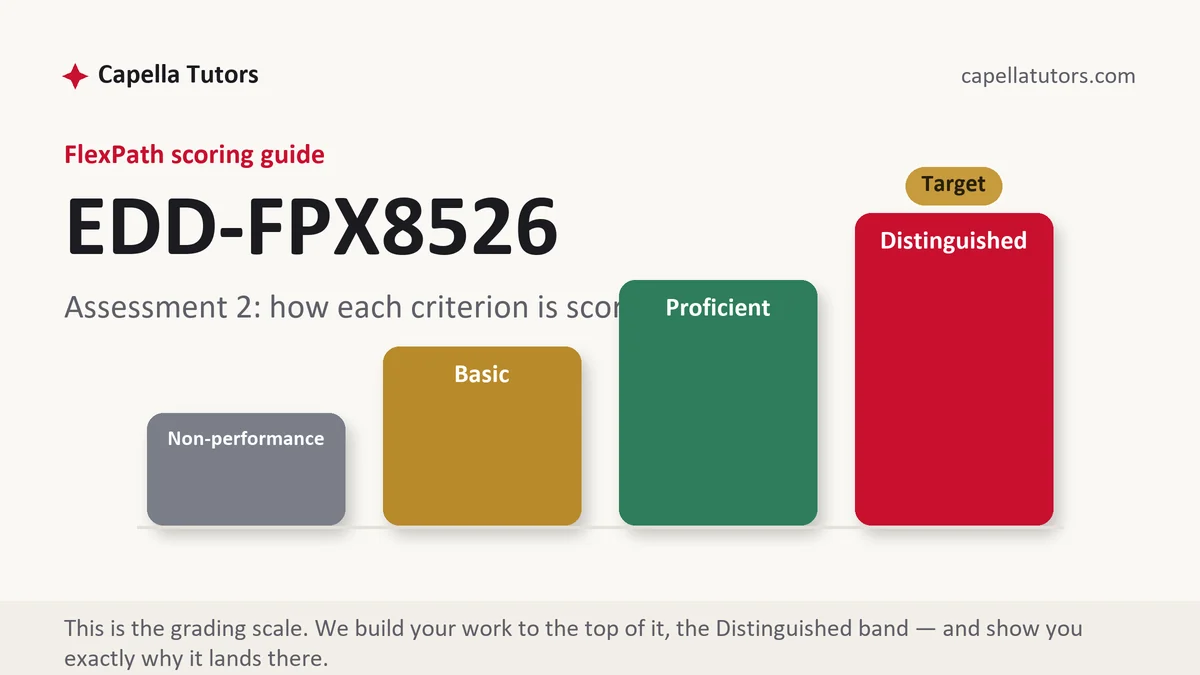
How EDD FPX 8526 Assessment 2 is scored
Each criterion lands on one of four levels rather than contributing to a score, and the top level always names an extra move:
| Level | What it means on a theory of improvement and first test |
|---|---|
| Distinguished | The chain is falsifiable link by link, the weakest link is chosen for the first cycle, the test is small enough to run next month, and the decision rules are written before any result arrives. |
| Proficient | A coherent theory with a pilot attached. Complete, and short of the row above wherever the prediction is missing or the test is larger than it needs to be. |
| Basic | A rollout described as a plan. No prediction, no cycle, and no rule for what happens if the result disappoints. |
| Non-performance | A named element is absent, most often the measures, or the theory the criterion asked you to state. |
One habit distinguishes this deliverable from a project proposal. Write the prediction down before the cycle runs, in a sentence with a number in it, then say what you will do if the prediction fails. A framework can supply sequencing and language; only a written prediction makes the work testable.
The EDD FPX 8526 Assessment 2 method, step by step
-
State the chain and name the mechanism
Write it as if and then, one link at a time, and say why each link should hold. If the most recent evidence replaces the average, then a student who improves late is graded on what they can now do, then reassessment stops being pointless, then late-term effort rises. Four links, four claims, each separately right or wrong.
-
Attribute the framework and say what it is
Attribute precisely: Senge for the five disciplines, Argyris and Schon for the difference between fixing an error and interrogating the assumption that produced it, Kotter for the eight-step sequence that came out of consulting rather than research, Hall and Hord for the empirical work on how individuals take up a practice. Then say which one you used and why it fits this problem.
-
Attack the weakest link first
Mark the link you trust least and aim the first cycle at it. If the doubtful step is whether students will reattempt anything at all, test that and nothing else. A cycle designed to confirm the link you already believe wastes the only cheap information the term is going to give you.
-
Size the test so it needs no permission
Two teachers, one course, three weeks, one rubric, twelve pieces of student work is a cycle. A department in August is a launch. Say who runs it, what changes for them, what they do differently on the first Monday, then write the prediction: how many reattempts, by what date, with what score movement.
-
Separate process from outcome measures
Process measures read weekly and say whether the test happened: assessments offered for reattempt, reattempts taken, entries changed in the gradebook. Outcome measures need longer and a baseline. Report the process figures first, since a cycle nobody ran cannot have failed, and mistaking absence for failure is the costliest error here.
-
Write the decision rules, then self-score
Before the cycle opens, say what result expands it, what revises it, and what stops it, each with a number. Then settle fidelity in advance: which elements a second teacher may adapt, and which are the mechanism and cannot change. Then mark each criterion honestly and submit once the rules are on the page.
A structure that maps to the criteria
These are our planning numbers for a theory and test deliverable, not Capella requirements. The cycle design usually deserves more space than the framework discussion.
| Section | What it must do | Guide |
|---|---|---|
| Problem restated and aim | The problem carried forward, plus an aim with a number and a date attached. | ~180 words |
| Theory of improvement | The if and then chain, the mechanism behind each link, and the literature behind the links you can support. | ~300 words |
| Framework applied and attributed | One named model doing work on a specific local difficulty, cited to its author. | ~250 words |
| The first cycle | Who, what course, how long, what changes, and the written prediction with a number in it. | ~300 words |
| Measures | Process measures reading weekly, outcome measures with a baseline and a window, kept separate. | ~250 words |
| Decision rules, fidelity, references | Expand, revise or stop thresholds, what may be adapted, current APA both ways. | ~200 words |
Annotated sample excerpt
One original paragraph from our writers at the level of specification a cycle criterion rewards. Learn the structure, then write the prediction for your own test.
The first cycle is two chemistry teachers, one section each, three weeks, covering a single unit, in which the gradebook records the most recent demonstration on each standard instead of the mean of all attempts.1 Everything else holds: same unit, same tasks, the reassessment window that already exists in the handbook, and no announcement beyond the two sections involved.2 The prediction, written before the cycle opens, is that at least 14 of the 46 students scoring below proficient on the first attempt will reattempt inside the window, against 3 of 51 in the same unit last year, and that the median entry for reattempting students rises by at least one performance level.3
- 1Two teachers, three weeks, one change. A cycle this size can start next month without a board, a budget or a vote, which is what the criterion is looking for.
- 2Holds everything else constant and says so. Naming what does not change is how a reader knows which link the test is actually attacking.
- 3A numbered prediction with a prior-year comparison, recorded before results exist. This sentence is the difference between a test and an announcement.
The full premium sample for your exact assessment, written fresh to your scoring guide and issue, is free to request. Study it, revise it into your own voice, and submit work you understand.
The five mistakes that cost Distinguished
- A launch instead of a cycle. Building-wide implementation with no small test first gives a reader no way to judge whether the theory holds.
- A framework used as a heading list. Eight borrowed headings is formatting, while the criterion asked the model to explain something local.
- No prediction on the page. A cycle whose expected result was never written down can be reinterpreted afterward, which is why it is asked for in advance.
- Process and outcome measures mixed. Combining whether the test ran with whether it worked makes a flat result unreadable.
- Fidelity left undecided. Where nobody has said which elements are the mechanism, a second teacher's adaptation quietly removes the thing being tested.
Pre-submission checklist
- The chain written as if and then, with each link separately falsifiable
- The framework attributed to its author, with its origin stated honestly
- The first cycle small enough to run without any approval
- A prediction with a number and a date, recorded before the cycle opens
- Process measures reading weekly, kept separate from outcome measures
- Expand, revise and stop thresholds written down, plus what may be adapted
Change plan due for review?
Send the prompt, the guide, the practice you want changed, and the number of adults it involves. Eight people take it from the literature pull to the final proofread and return a premium original sample in 24 to 48 hours with the aim numbered and the first cycle sized, revised free until every criterion is met.