This manual is for EDD FPX 8526 Assessment 1, start to submission. Assessment 1 usually asks for the front half of an improvement argument: a problem of practice narrow enough to test, and an analysis of the system that keeps producing it. The deliverable is diagnostic rather than prescriptive, and the criteria are unusually strict about precision, since every later section inherits whatever sentence you write first. Your scoring guide decides the format and how much local evidence has to be documented. Our tutors' method follows, with the sections it produces and an annotated excerpt from a model draft. Prefer to hand it off? A premium original sample is drafted to your guide and delivered within 24 to 48 hours, revised free thereafter. Capella's catalog lists the course as EDD-FPX8526, and some courserooms print EDD8526; both point to this same Assessment 1.
One honesty note before the manual: Capella revises courses and scoring guides over time, so always write to the exact scoring guide attached to your assessment in the courseroom. The course identity above is verified on capella.edu; the method and structure below are our tutors' approach to it, not Capella's official rubric text.
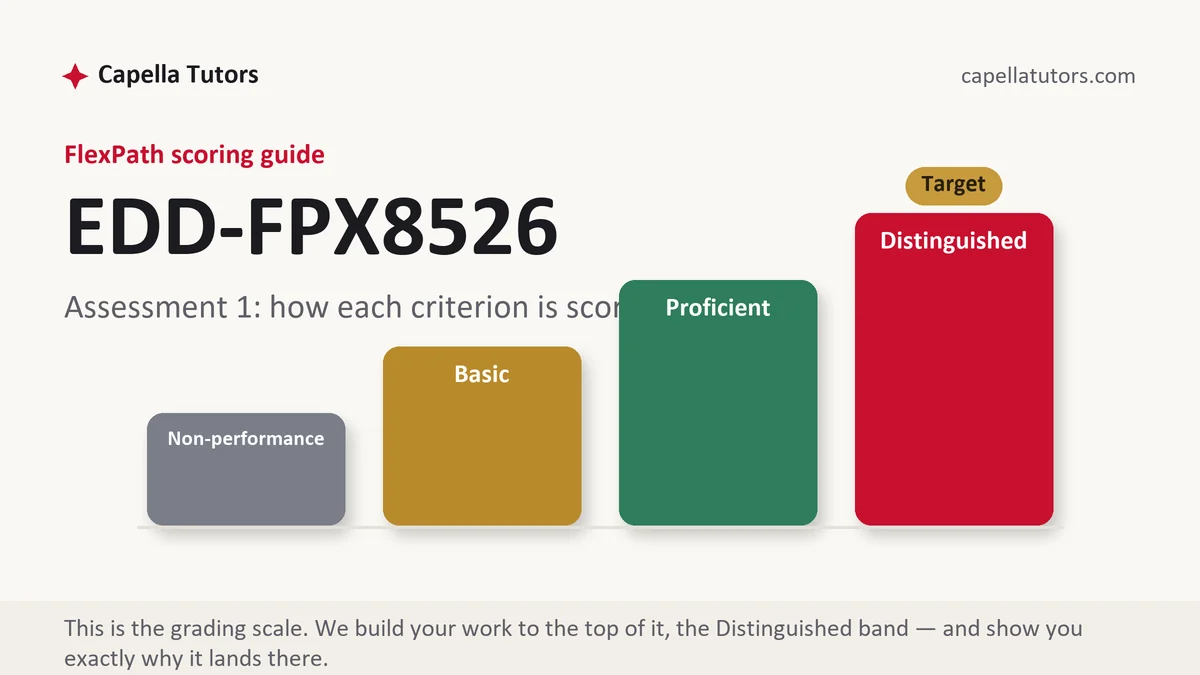
How EDD FPX 8526 Assessment 1 is scored
Nothing is averaged into a grade. Each criterion on your guide resolves to one of four levels, and those descriptions are the brief:
| Level | What it means on a problem of practice and system analysis |
|---|---|
| Distinguished | The problem names a population, a behavior, a frequency and a boundary with a baseline attached, and the analysis shows why the present result is a rational product of current conditions. |
| Proficient | A well-defined problem with plausible causes identified. Complete, and one move short wherever the causes are listed rather than traced into a system. |
| Basic | A topic with concern attached and a bulleted list of reasons. Nothing measurable, and nothing explaining why competent adults produce the current result. |
| Non-performance | A required element is absent, most often the baseline evidence or the analysis the criterion asked for. |
The move that lifts this deliverable is counterintuitive: stop looking for what is wrong with people and show why the current behavior is a sensible response to the conditions they work in. A system analysis making the present result look rational is the one that finds drivers a change could actually attack.
The EDD FPX 8526 Assessment 1 method, step by step
-
Write the problem three times
A problem of practice is not a topic, and the difference is countable. Curriculum alignment is a topic. Fewer than a third of the tasks in use last spring matched the units written the previous June is a problem, because it names a population, a behavior, a proportion and a window. Narrow first, since every later section inherits that sentence.
-
Find the baseline that already exists
Look for evidence the district generates without being asked: submitted unit plans, task samples collected for another purpose, the count of teachers who opened a shared folder, purchase orders for supplementary materials. One number with a denominator and a date beats three impressions, and it fixes the point any later change is measured from.
-
Work backward from the behavior
Ask what makes the current behavior rational rather than what makes it wrong. A teacher ignoring a summer-written unit may be answering a pacing calendar that does not fit it, an assessment window occupying four weeks, a roster the unit never anticipated, or the plain fact that nobody ever asked whether it was used. Each of those is a driver.
-
Separate drivers from symptoms
Sort what you found into conditions that produce the behavior and consequences of it. Low use of a unit is a symptom; the absence of any routine in which use is examined is a driver. Only drivers are attackable, and a criterion asking for analysis is grading whether you can tell the two apart in your own building.
-
Include the drivers you helped create
Doctoral readers notice when an analysis exempts its author. If the pacing calendar that broke the units is one you approved, or the folder nobody opens is one you built, name it. That admission costs nothing in score, buys credibility across every later criterion, and usually points at the driver easiest to change.
-
Mark the link you trust least, then self-score
Close by naming which part of your own explanation is weakest, because that is where a first test should later aim. Then score each criterion honestly, check that every figure carries a denominator and a date, and submit once the problem sentence would survive a stranger reading it cold.
A structure that maps to the criteria
The word targets here are our own planning numbers for a diagnostic deliverable, not requirements from Capella. Give the system analysis room, since it is usually the heaviest criterion in the guide.
| Section | What it must do | Guide |
|---|---|---|
| Setting and scope | The building or district, the population involved, and the boundary of the problem. | ~200 words |
| The problem of practice | Population, behavior, frequency, boundary, and the baseline figure with its window. | ~250 words |
| Evidence behind the baseline | Where each number came from, how it was counted, and what it cannot show. | ~250 words |
| System analysis | Why the present result is the rational product of current conditions, traced condition by condition. | ~350 words |
| Drivers and symptoms separated | Which conditions produce the behavior, which merely accompany it, and which you helped create. | ~250 words |
| The weakest link and references | The part of your explanation least supported, and current APA in text and list. | ~150 words |
Annotated sample excerpt
A model paragraph from our team at the precision a problem-of-practice criterion rewards. Take the structure, then write your own with your own counts.
Of the 27 unit plans written and paid for last June, 8 were in use in any recognizable form by the following March, judged by comparing the assessment tasks teachers submitted to the shared drive against the tasks the units specified.1 That is 30 percent, across 19 teachers in two grade bands, measured in one window and by one rater, who is me.2 The behavior is not refusal: the pacing calendar I approved in August compresses the third quarter by eleven instructional days against what the units assume, so a teacher following the calendar cannot follow the unit, and no routine in the school year asks anybody which one they chose.3
- 1A count, a comparison method and a window in the first sentence. The criterion asking for a measurable problem is satisfied before the paragraph turns.
- 2Reports the denominator and the limits of the measurement, including that a single rater judged it. Naming your own measurement weakness protects the whole analysis.
- 3Makes the current behavior rational and names the author's own contribution to the condition. This is the sentence that turns a complaint into a system analysis.
The full premium sample for your exact assessment, written fresh to your scoring guide and issue, is free to request. Study it, revise it into your own voice, and submit work you understand.
The five mistakes that cost Distinguished
- A topic where a problem belonged. Without a population, a frequency and a baseline, nothing later in the document can be measured against anything.
- Causes bulleted rather than traced. A list of reasons skips the step where you show why the present behavior is a sensible response to current conditions.
- Symptoms treated as drivers. Low use of a resource is a result; the absence of any routine that examines use is the thing a change can attack.
- An analysis that exempts its author. Where the writer approved the calendar or built the folder, omitting that is visible to anyone who has led a building.
- A baseline with no method. A number arrives with how it was counted, by whom, and across what window, or a later comparison means nothing.
Pre-submission checklist
- The problem sentence names a population, a behavior, a frequency and a boundary
- A baseline figure with its denominator, its window and its counting method
- The system analysis explains why current behavior is rational, not why it is wrong
- Drivers separated from symptoms, with only drivers carried forward
- The writer's own contribution to at least one condition named plainly
- The weakest link in your own explanation identified before you submit
Problem of practice due?
Send the prompt, the guide, and whatever the building already counts, including what has been tried before and abandoned. Eight people, including a research analyst and two QA reviewers, return a premium original sample in 24 to 48 hours with the problem narrowed to a testable sentence, revised free until the guide is met.