This manual is for EDD FPX 8526 Assessment 3, start to submission. Assessment 3 usually asks the question a change plan is weakest on: what survives. That means who owns the routine once you leave the role, where it lives in the schedule and the improvement plan, what stops so the hours exist, and how you would know a year later whether the practice deepened or merely persisted. The guide in your courseroom fixes the format and names the reader. The method is below, then a section plan the criteria imply, then an annotated excerpt. Want it handed across instead? A premium original sample arrives in 24 to 48 hours and is revised at no cost until the criteria are satisfied. Capella's catalog lists the course as EDD-FPX8526, and some courserooms print EDD8526; both point to this same Assessment 3.
One honesty note before the manual: Capella revises courses and scoring guides over time, so always write to the exact scoring guide attached to your assessment in the courseroom. The course identity above is verified on capella.edu; the method and structure below are our tutors' approach to it, not Capella's official rubric text.
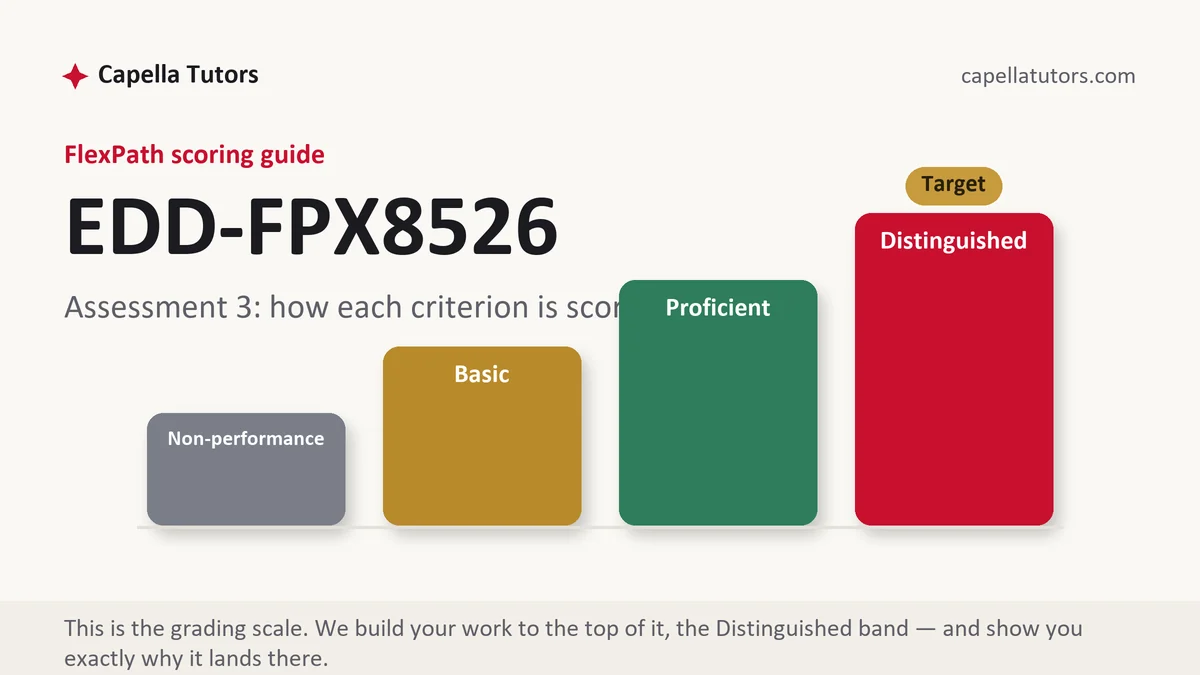
How EDD FPX 8526 Assessment 3 is scored
Four levels per criterion, evaluated within two business days of the attempt you choose to submit, and the level wording is the writing brief:
| Level | What it means on a sustainment and scale plan |
|---|---|
| Distinguished | Ownership transfers to a named role rather than a person, the removal is costed in hours, depth is distinguished from spread, and the two likeliest failure modes each carry a planned response. |
| Proficient | A credible plan for continuation with an owner named. Complete, and short of the row above wherever the removal is absent or persistence is treated as success. |
| Basic | A promise to embed the work in school culture. No owner, no hours, and no distinction between a practice used well and one merely still on the calendar. |
| Non-performance | A required element is missing, commonly the resource accounting or the sustainment analysis the criterion asked for. |
The dimensions of scale set out by Coburn, depth, spread, sustainability and a shift of ownership toward the people doing the work, are the usual frame for this section, and the last of the four is what decides it. A result held for one year under one champion demonstrates capability rather than change.
The EDD FPX 8526 Assessment 3 method, step by step
-
Count the initiatives and cost them
List everything currently running with the adult hours it consumes each month, and total it. The total is usually the finding, since a faculty with two hours of shared time a week cannot actually hold six priorities, so it holds two of them and performs the other four. That arithmetic is the strongest argument in the deliverable.
-
Name the removal, not the replacement
Say which initiative ends, which meeting shortens, which report retires, and who has authority to make that call. Naming an addition is easy and every draft does it. Naming a removal, with the hours it frees and the person who loses something, is what a superintendent needs and what the resource criterion rewards.
-
Transfer ownership to a role
A routine owned by you ends when you move. Assign it to a position, write what that position does with it in the annual cycle, and put the routine into documents that outlive individuals: the improvement plan, the master schedule, the handbook, the induction file for whoever holds the role next. Then name who would notice if it stopped.
-
Distinguish depth from spread
A practice adopted shallowly by twenty teachers is not better than one used well by six, and the criteria treat those as different achievements. Say which you are pursuing first and why. Then write what deep use looks like concretely enough to be observed, since a definition nobody can check will be satisfied by anybody who claims it.
-
Design the check a year out
Pick two indicators readable next year by somebody who did not run this: whether the routine appears in the published calendar, and whether its artifact exists for a stated share of scheduled occasions. Both are countable by an outsider, which matters, since the person checking will not be you and will not remember what was intended.
-
Write the two failure modes, then self-score
Name the two likeliest reasons this dies, with the counter planned for each: the champion leaves and nobody convenes it, or a new district priority takes the time back. Then say who loses access if the practice ends and what you would watch afterward, mark each criterion honestly, and submit once both failure modes carry a response.
A structure that maps to the criteria
The targets below are our planning numbers for a sustainment deliverable rather than Capella requirements. Weight the removal and ownership sections, since they are where most drafts thin out.
| Section | What it must do | Guide |
|---|---|---|
| What is being sustained | The practice itself in one paragraph, with its current state and who runs it now. | ~180 words |
| Initiative inventory and hours | Everything already running, its monthly adult cost, and the total against available time. | ~250 words |
| The removal | What ends, the hours it frees, who decides, and what the transition owes the students affected. | ~250 words |
| Ownership transfer | The role that inherits the routine, what it does in the annual cycle, and the documents it lives in. | ~250 words |
| Depth against spread | Which is pursued first, what deep use looks like observably, and how spread would be paced. | ~250 words |
| Failure modes, checks, references | Two likely failures with responses, two outsider-readable indicators, current APA both ways. | ~200 words |
Annotated sample excerpt
A model paragraph from our team at the standard a sustainment criterion rewards. Study the arithmetic, then run it against your own building's calendar.
Six initiatives currently draw on the 90 minutes of collaborative time the contract protects each week, which is 6 hours a month per teacher and, across 41 teachers, 246 adult hours a month.1 The writing conference routine needs 40 minutes twice a month from each of the 18 primary teachers, or 24 hours, so I propose that the monthly building committee report, which consumes roughly 30 hours across the same staff and has produced no decision in two years, ends in January, and that the assistant principal's role description carries the conference calendar from that point rather than mine.2 Whoever holds that position next inherits it through the induction file, and the intermediate grades are deliberately left out this year, which is spread I am not pursuing until depth in the primary grades is observable.3
- 1Total adult hours computed from the contract rather than estimated. A reader can check every figure, and the total is the argument.
- 2The removal is named with its hours, its date and the person who loses something, and ownership moves to a position rather than to the writer.
- 3Succession runs through a document that outlives individuals, and spread is deliberately deferred. Choosing depth first and saying so is what the scale criterion rewards.
The full premium sample for your exact assessment, written fresh to your scoring guide and issue, is free to request. Study it, revise it into your own voice, and submit work you understand.
The five mistakes that cost Distinguished
- Embedding promised with no mechanism. A routine embedded in culture but absent from the schedule, the handbook and any role description is embedded nowhere.
- Ownership assigned to a person. Where the champion is the owner, the plan ends with a transfer or a resignation, the most documented failure in this literature.
- An addition with no removal. A plan requesting hours the week does not contain is a request for unpaid work, and the arithmetic makes that visible.
- Persistence reported as success. A routine still on the calendar and used shallowly by everybody has spread without depth, and the criteria score those separately.
- No account of stopping. Ending a practice creates its own duties, starting with a decision about who continues to be served.
Pre-submission checklist
- Every current initiative listed with the adult hours it consumes monthly
- A named removal with its hours, its date and the person who decides
- Ownership assigned to a role, and written into documents that outlive individuals
- Depth defined observably, and spread deliberately paced rather than assumed
- Two indicators an outsider could read a year from now
- Two failure modes, each with a planned response, plus who keeps being served if it ends
Sustainment section holding you up?
Send the prompt, the guide, the routine you are trying to keep alive, and the initiatives already competing for the same hours. Eight people, including a research analyst and two QA reviewers, return a premium original sample in 24 to 48 hours with the removal costed and ownership transferred, revised free until the guide is satisfied.