This manual is for EDD FPX 8522 Assessment 3, start to submission. Assessment 3 usually asks for the leader's own moves and the leader's own account of them: what you will do publicly and repeatedly to build trust, what you will stop doing, and where your own past practice contradicts what you now propose. Doctoral criteria in this course tend to carry a reflective row, and the writing that clears it is neither confessional nor self-congratulatory. Length, format and audience are all settled by the guide in your courseroom. What follows is the method, the sections it produces, and an annotated excerpt from a model draft. Prefer to pass it across? A premium original sample comes back inside two days, with free revisions until the guide is satisfied. Capella's catalog lists the course as EDD-FPX8522, and some courserooms print EDD8522; both point to this same Assessment 3.
One honesty note before the manual: Capella revises courses and scoring guides over time, so always write to the exact scoring guide attached to your assessment in the courseroom. The course identity above is verified on capella.edu; the method and structure below are our tutors' approach to it, not Capella's official rubric text.
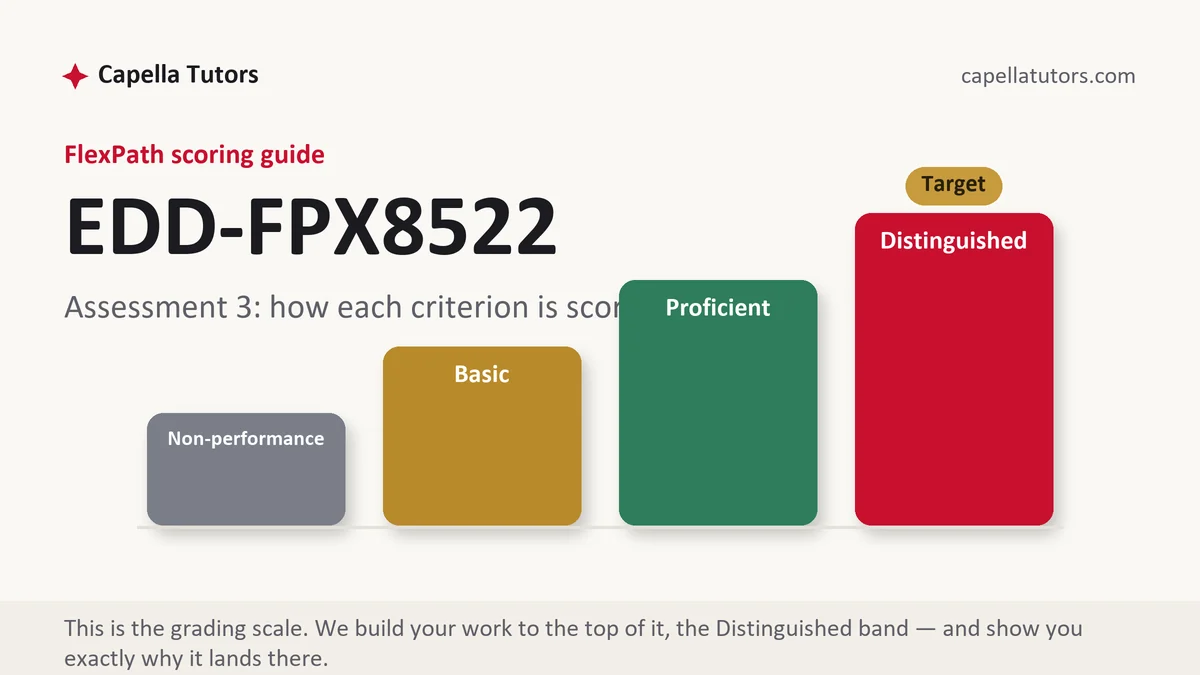
How EDD FPX 8522 Assessment 3 is scored
Four levels per criterion, no aggregate score, and the level language is where the writing brief actually lives:
| Level | What it means on a trust and reflective leadership deliverable |
|---|---|
| Distinguished | Trust is decomposed into observable behavior on a schedule, the writer names something they will give up, and the reflection identifies a specific occasion rather than a tendency. |
| Proficient | Credible moves with a rationale behind them. Complete, and short of the row above wherever the commitments are attitudes rather than behaviors somebody could witness. |
| Basic | A statement of values with a promise to communicate more openly. Nothing a colleague could observe, and nothing the writer surrenders. |
| Non-performance | A required element is missing, commonly the reflective component or the link between the leader's behavior and the conditions described earlier. |
The relational trust literature helps here precisely because it breaks the construct into parts somebody could watch a leader perform or neglect. Respect, competence, personal regard and integrity, in the Chicago formulation associated with Bryk and Schneider, each translate into behavior on a calendar, and behavior on a calendar is what a criterion can grade.
The EDD FPX 8522 Assessment 3 method, step by step
-
Decompose trust before you promise it
Trust as a single word cannot be designed. Split it the way the evidence does and take one component at a time: whether people are heard before decisions, whether the leader is competent at the job they hold, whether regard extends past role, whether stated commitments and actual behavior match. Then write one observable action per component.
-
Convert every commitment into something witnessable
An open door is not a behavior; standing in the seventh grade hallway between 7:40 and 8:00 every Tuesday and Thursday is. Write each move with a place, a frequency and a duration, so a colleague could confirm whether it happened. Reviewers score attitudes at the second row and observable behavior at the first.
-
Name what you will stop
Every new visible commitment consumes hours that currently belong to something else, so say what ends: a weekly report retired, a meeting shortened by fifteen minutes, a committee you leave. A leader who adds five public routines and gives up nothing has written a schedule that collapses by October, and the resource criterion prices that collapse.
-
Design for the newest staff specifically
Where a large share of the faculty is in its first two years, general communication reaches the wrong people. Say who is paired with whom, what the pairing does on which day, what a new teacher is never asked to do alone in the first semester, and what the mentor is released from in exchange. Nine early-career teachers among thirty-four is a structural fact.
-
Write the occasion, not the tendency
The reflective row rewards specificity. Name one meeting, one decision or one message where you enforced the norm you now propose to change, say what you did, and say what it cost somebody. Then say what you would trade to undo it. A paragraph confessing a general habit of moving too quickly earns like ornament.
-
Attach an indicator, then self-score
Give even the trust work something countable: the share of your calendar spent in classrooms rather than the office, the number of decisions where staff input was solicited before rather than after, retention among the newest cohort. Set the baseline, name the review date, then mark each criterion honestly and revise anything under the top level.
A structure that maps to the criteria
The targets below are our own planning numbers for a reflective leadership deliverable, not Capella requirements. Give the reflective section real room where your guide devotes a criterion to it.
| Section | What it must do | Guide |
|---|---|---|
| What the conditions require of a leader | The pattern from your earlier analysis, restated as a demand on your own behavior. | ~200 words |
| Trust, component by component | Each component of relational trust attributed and translated into one observable action. | ~300 words |
| Communication moves on a calendar | What you do, where, how often, for how long, and who could confirm it happened. | ~250 words |
| Support designed for early-career staff | Pairings, protected tasks, mentor release, and what the newest teachers never do alone. | ~250 words |
| The reflective account | One named occasion, what you did, what it cost, and what you would trade to undo it. | ~250 words |
| Indicators, review, references | Baseline, indicators readable within a term, review date, current APA both ways. | ~150 words |
Annotated sample excerpt
A model paragraph from our team at the register a reflective criterion rewards. Learn the structure, then write your own occasion rather than borrowing this one.
In February of my first year as dean I ended a grade-level meeting eleven minutes early because the agenda was finished, and in doing so I cancelled the only twenty minutes that month in which two first-year teachers had planned to bring a task they were unsure about.1 They did not raise it, I did not ask, and the following week I described the meeting to my principal as efficient.2 The norm I now propose to change, that adult time is released whenever nothing formal remains on the agenda, is a norm I enforced in that room, and what I would trade to undo it is the fifteen minutes of my own reporting time that funds the protected slot below.3
- 1A single dated occasion with a named consequence. The reflective row pays for this, not for a tendency described in the abstract.
- 2Includes the part that reflects badly, including the writer's own account to a supervisor. Candor about a small self-serving description makes the rest credible.
- 3Connects the reflection to the design and names the trade in hours. A reflection changing nothing later in the document is decoration.
The full premium sample for your exact assessment, written fresh to your scoring guide and issue, is free to request. Study it, revise it into your own voice, and submit work you understand.
The five mistakes that cost Distinguished
- Trust promised as a single quality. Undecomposed, it produces sentences nobody can act on or observe, and the criterion has nothing to score.
- Attitudes offered as behavior. Being approachable is not a commitment; standing in a named hallway at a named time twice a week is.
- New routines with nothing retired. A leader's calendar is finite, and a design adding five public commitments without removing any has not been costed.
- General communication where the staff is not general. A faculty a quarter of whom are new needs a structure aimed at them, not a newsletter aimed at everyone.
- A confession with no cost. Naming a tendency, apologizing for it, and changing nothing in the design is the reflective row's most common Basic pattern.
Pre-submission checklist
- Each component of trust attributed to its source and paired with one observable action
- Every commitment carries a place, a frequency and a duration
- Something you currently do is named as ending, with the hours it frees
- A structure aimed at the newest staff, with mentor release stated
- One dated occasion in the reflection, with what it cost and what you would trade
- An indicator with a baseline and a review date, and every row self-scored
Reflective leadership deliverable due?
Send the prompt, the guide, your role, and the staffing pattern you are writing about. Eight people, including a research analyst and two QA reviewers, return a premium original sample in 24 to 48 hours with trust decomposed and every commitment written as observable behavior, revised free until the guide is satisfied.