This manual is for EDD FPX 8522 Assessment 2, start to submission. Assessment 2 usually asks you to design the adult learning rather than describe it. The deliverable is a routine: who learns what, in what format, on whose released time, using which protocol, producing which decision, reviewed on which date. Naming a professional learning community earns nothing by itself, since the phrase has covered everything from lesson study to a shared lunch. How long it runs and who reads it are settled by the guide attached to your assessment, not by this page. The method our tutors use follows, with a section plan drawn from the criteria and one annotated excerpt. Rather hand it over? Our writers return a premium original sample in 24 to 48 hours and revise it at no cost until the criteria clear. Capella's catalog lists the course as EDD-FPX8522, and some courserooms print EDD8522; both point to this same Assessment 2.
One honesty note before the manual: Capella revises courses and scoring guides over time, so always write to the exact scoring guide attached to your assessment in the courseroom. The course identity above is verified on capella.edu; the method and structure below are our tutors' approach to it, not Capella's official rubric text.
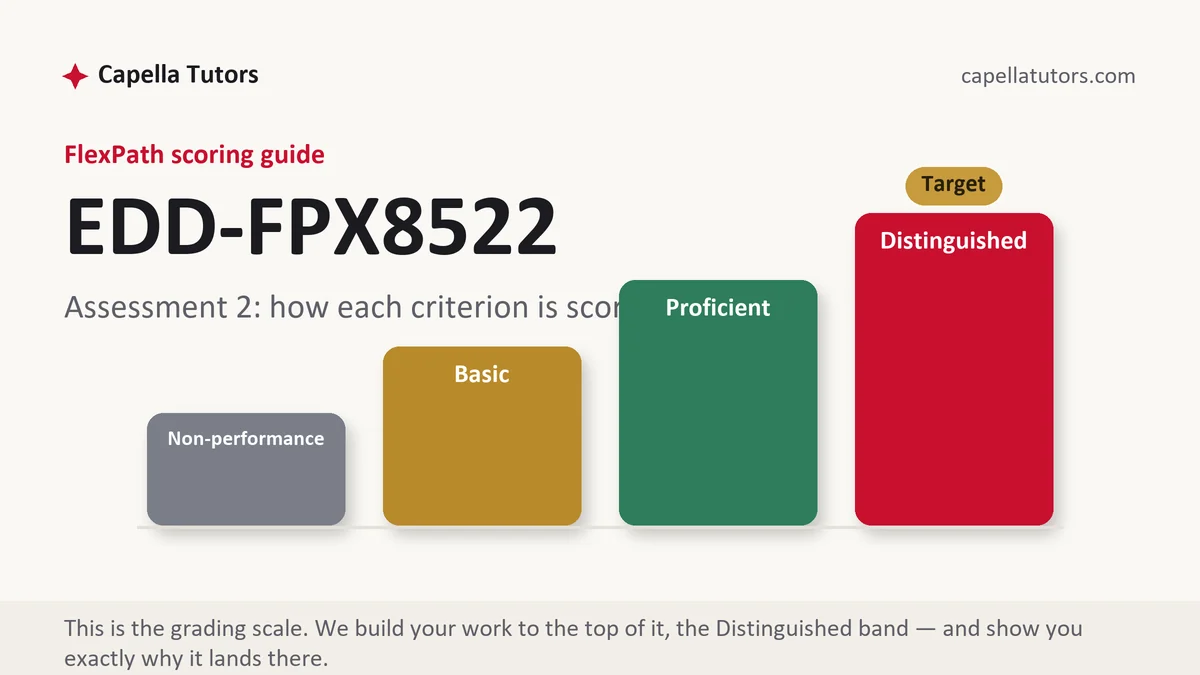
How EDD FPX 8522 Assessment 2 is scored
Each criterion in your guide lands on one of four levels rather than on a score, and the level wording is the brief:
| Level | What it means on a professional learning design |
|---|---|
| Distinguished | Participants, protocol, released time, artifact and decision are all specified, the follow-through between meetings is designed, and a measure that reads inside a term arrives with a review date. |
| Proficient | A complete plan with a format and a cadence. Solid, and short of the row above wherever the protocol is unnamed or the learning is assumed to transfer with nothing carrying it. |
| Basic | Time in a room called professional learning. Collaboration proposed with no structure to fill it, which is the most common Basic pattern in this course. |
| Non-performance | A required element is absent outright, most often the measure, or the release that makes the time exist at all. |
Adult learning is graded on design rather than on hours logged. The criteria are asking what happens between the sessions, since that is where a change in practice either occurs or does not, and a plan whose only mechanism is a meeting has nothing to report at the end of a term.
The EDD FPX 8522 Assessment 2 method, step by step
-
Choose the artifact before the agenda
A learning routine is organized around the thing the adults examine. Student work from a common task, an item analysis from a shared assessment, a recording of a lesson, a set of student explanations: each produces a different conversation. Name the artifact, say who brings it and how many pieces, and the agenda follows from that decision.
-
Name the protocol and cite it
Structured protocols exist, they have authors, and using one by name is worth more than inventing steps. Say how long each phase runs, who speaks when, where description has to precede judgment, and at what point the group must reach a decision. A protocol paraphrased with its source cited is the difference between a designed conversation and an invitation to talk.
-
Find the time the schedule already contains
Released time is the constraint that kills most designs at this level. Locate the minutes in the master schedule before writing the routine: a common planning period, an early-release Wednesday, a duty period two teachers share. Then state total adult hours per term, because a staff with ninety minutes of shared time a week cannot carry a seventh priority.
-
Design the week between meetings
The learning sits in the change of practice rather than in the conversation, so the routine needs a step carrying the decision into a classroom. Say what each teacher does before the next session, what evidence they bring back that it happened, and who notices if it did not. A design without that step can only report satisfaction.
-
Attach a measure that reads inside a term
Pick something countable and short-horizon: the share of meetings ending with a documented instructional decision, the number of decisions visible in the next common task, the proportion of teachers bringing the agreed artifact. Set a baseline now and name the review date, keeping the student outcome question separate and later.
-
Read it as the participant, then self-score
Hand the design to the imagined sixth grade teacher and ask what they would resent. Unpaid time, a protocol producing no decision, an artifact that exposes them without protecting them: each is a reason the routine empties by November. Fix what you find, mark every criterion honestly, and submit once the design is whole.
A structure that maps to the criteria
These are our planning targets for a design deliverable, not Capella requirements. Weight the routine section heavily, since that is where the implementable-detail criterion lives.
| Section | What it must do | Guide |
|---|---|---|
| The learning problem | What the adults need to be able to do reliably and cannot yet, with the evidence behind it. | ~200 words |
| Participants and time | Who is in the group, why those people, and where the released minutes come from. | ~250 words |
| The routine | Cadence, artifact, protocol with its source, timed phases, and the decision the meeting must produce. | ~350 words |
| Between-meeting follow-through | What changes in a classroom before the next session, and the evidence that it did. | ~250 words |
| Measures and review | Baseline, indicators readable within a term, the review date, and who attends it. | ~250 words |
| Cost, removal, references | Total adult hours, what stops in order to fund them, current APA both ways. | ~150 words |
Annotated sample excerpt
One original paragraph from our team, at the specification level a professional learning criterion rewards. Take the structure, then write it for your own team.
The sixth grade data team is four mathematics teachers and the instructional coach, meeting forty minutes every second Thursday inside the common planning period the schedule already holds for that grade.1 Each teacher brings the item analysis from the most recent shared unit task and three student explanations from the item their class answered worst, and the protocol runs in four timed phases: eight minutes describing what students did without interpreting it, ten minutes proposing explanations, twelve minutes choosing one instructional response, ten minutes writing it down.2 The meeting closes with a decision record naming the response, the class period it will be tried in, and the artifact each teacher brings back on the sixteenth.3
- 1Participants, duration, cadence and the existing schedule slot, stated before anything else. The time is located rather than requested, which is what makes the design runnable.
- 2The protocol is timed and phased, and description is separated from judgment. Naming the artifact and the number of pieces removes the ambiguity that empties these meetings.
- 3The decision has a classroom, a date and a return artifact. That closing sentence is the between-meeting step most designs omit, and where practice actually changes.
The full premium sample for your exact assessment, written fresh to your scoring guide and issue, is free to request. Study it, revise it into your own voice, and submit work you understand.
The five mistakes that cost Distinguished
- A name in place of a structure. Calling the group a learning community identifies nothing, since the label has covered lesson study and a shared lunch alike.
- Time requested rather than located. A routine needing minutes the master schedule does not contain is a proposal for unpaid work, and reviewers read it that way.
- A conversation with no decision. Meetings ending in discussion produce no artifact, so nothing exists for the measurement criterion to read.
- Nothing between sessions. Where no step carries the decision into a classroom, the plan can only ever report attendance.
- Satisfaction used as evidence. An exit survey measures reaction, the cheapest layer and the one least connected to what students eventually do.
Pre-submission checklist
- The artifact examined is named, with how many pieces and who brings them
- The protocol is phased, timed, and attributed to a source
- Released minutes located in the existing master schedule, with total hours stated
- A between-meeting step names what changes in a classroom and the evidence it did
- One indicator that reads inside a term, with a baseline and a review date
- What stops, so the hours the routine needs actually exist
Professional learning design due?
Send the prompt, the guide, the team you have in mind, and the schedule you are working inside. Eight people take it from the literature pull to the final proofread and return a premium original sample in 24 to 48 hours with the protocol phased and the hours costed, revised free until every criterion is met.