This manual is for EDD FPX 8522 Assessment 1, start to submission. Assessment 1 usually asks for a defensible account of the conditions the adults in your building actually work under. The deliverable is an analysis rather than a plan: what your evidence reaches, how it was gathered, what it cannot see, and which layer of the organization it describes. Your scoring guide decides the format and how much of the evidence has to be documented. Below you will find our working method, a section plan built from the criteria, and an annotated excerpt. Prefer to hand it off? A premium original sample written to your guide arrives inside 24 to 48 hours, revised free for as long as it takes. Capella's catalog lists the course as EDD-FPX8522, and some courserooms print EDD8522; both point to this same Assessment 1.
One honesty note before the manual: Capella revises courses and scoring guides over time, so always write to the exact scoring guide attached to your assessment in the courseroom. The course identity above is verified on capella.edu; the method and structure below are our tutors' approach to it, not Capella's official rubric text.
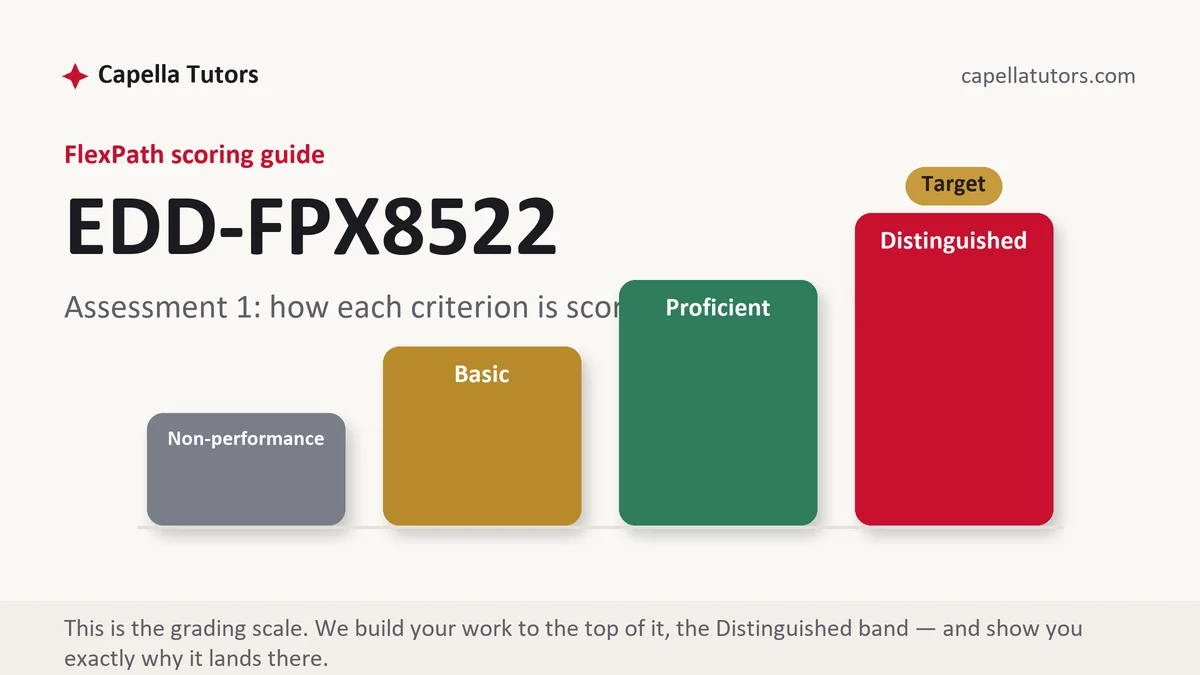
How EDD FPX 8522 Assessment 1 is scored
No percentages and no letter grades are involved. Every criterion resolves to one of four levels, and those level descriptions are the specification for the writing:
| Level | What it means on a culture and conditions analysis |
|---|---|
| Distinguished | Every source is named with its instrument and its denominator, culture and climate are kept apart, and the analysis says which layer it reaches and which it cannot. |
| Proficient | Conditions described accurately with real evidence behind them. Complete, and one move short wherever the evidence type goes unlabeled or the spread behind an average is unreported. |
| Basic | Impressions about morale with a framework name attached. The word culture doing work the evidence cannot support is the standard first-submission problem here. |
| Non-performance | A required element is missing, most often the evidence itself, or the framework the criterion asked you to interpret through. |
The distinction the criteria keep testing is between conditions and character. Conditions can be counted, described and altered; character cannot be designed against. Every graded row gets easier once the writing stops describing adults and starts describing what the building does to them.
The EDD FPX 8522 Assessment 1 method, step by step
-
Say which layer your evidence can reach
Climate is what people perceive now and it moves inside a year. Underneath sits the set of assumptions nobody in the building argues about, and the usual route into that layer is Schein's three levels, artifacts, espoused values and underlying assumptions, taken from his own text rather than from a training slide. Decide in your opening paragraph which layer your evidence actually reaches.
-
Inventory what the building already produces
Before collecting anything new, list the traces already sitting on the server: meeting agendas, optional-session sign-in sheets, the master schedule, internal transfer requests by grade band, exit interview notes. Each is an indirect indicator, each can be read across a year rather than at a single moment, and three triangulated carry a criterion further than one questionnaire.
-
Count something an adult would recognize
Turn a trace into a figure with a denominator. Minutes of a staff meeting given to student work against minutes given to logistics. Sessions attended voluntarily against sessions offered. Initiatives announced against initiatives still running in February. Name the window each figure covers, because a culture claim with no period behind it is an impression with a number attached.
-
Handle any new data collection honestly
If the deliverable asks you to collect something from colleagues, keep it minimal and anonymous, suppress any cell small enough to identify a person, and say in the text what you did. Work produced for a course assignment is not the same activity as research, so if you intend to reuse the data in a dissertation, check the review requirement before collecting rather than after.
-
Report the spread, not only the middle
An average is the least informative number in an analysis of this kind. A midpoint built from one cluster at the top and one at the bottom describes two schools sharing a parking lot. Break each figure by grade band, by years in the building, by department where the numbers allow, and say how many people are missing from the denominator.
-
Write conditions, then self-score
Follow every negative statement about the adults in the building with the structural cause you intend to address. That is the ethical choice and the effective one, since the staff described may eventually read the document. Then mark each criterion yourself at the honest level and repair anything under the top one before you submit.
A structure that maps to the criteria
The targets below are our planning numbers for an analysis deliverable, not published Capella requirements. Give more room to whichever row your guide describes in the most detail.
| Section | What it must do | Guide |
|---|---|---|
| Setting and the adults in it | Size, staffing pattern, turnover, and the collaboration time the schedule actually protects. | ~200 words |
| Evidence and how it was gathered | Each source named with its instrument, window, denominator, and what it cannot see. | ~300 words |
| What the evidence shows | Figures with spread and missing cases reported, patterns stated before any cause is attached. | ~300 words |
| Interpretation through a framework | Culture or trust theory attributed to its author, applied to one specific local pattern. | ~250 words |
| Conditions behind the pattern | The structural causes the analysis can name, and the ones it cannot separate. | ~200 words |
| Limits, ethics, references | Anonymity handling, what the analysis would overstate if read carelessly, current APA both ways. | ~150 words |
Annotated sample excerpt
An original model paragraph from our writers, showing the register an evidence criterion rewards at doctoral level. Study the moves, then write your own version.
This analysis uses three traces the building produces without being asked.1 Across 14 staff meeting agendas from September to March, 21 percent of scheduled minutes went to examining student work and 63 percent to logistics and announcements; optional after-school learning drew 19 attendances across 7 sessions from a certificated staff of 48; and 4 of the 6 internal transfer requests filed in that period came from the sixth grade team.2 None of this measures what the staff believes, and the transfer count is small enough that one retirement would move it, so the analysis treats the three together as a pattern and no one of them as a finding.3
- 1States the evidence type in the first clause. Labeling traces as traces is what lets a doctoral reader trust everything that follows.
- 2Three figures, three windows, three denominators. The percentages are checkable, and the last is disaggregated by team rather than reported school-wide.
- 3Names what the evidence cannot reach and which figure is fragile, then triangulates instead of overclaiming. This sentence separates the top two rows.
The full premium sample for your exact assessment, written fresh to your scoring guide and issue, is free to request. Study it, revise it into your own voice, and submit work you understand.
The five mistakes that cost Distinguished
- Perception data labeled as culture. A survey taken in March records perception now, and the deeper layer needs different evidence and a longer horizon.
- A single average, no distribution. One midpoint hides the split that is usually the real finding, and it hides how many people never answered at all.
- Staff written as personalities. Resistance described as a trait gives a leader nothing to change and will not survive the ethics row.
- Undated evidence. A figure with no window behind it cannot be compared to anything, which is fatal in a course about change over time.
- A framework named but never used. Attributing a model and then applying it to nothing local satisfies the citation and misses the criterion.
Pre-submission checklist
- The layer your evidence reaches is stated in the opening paragraph
- Each source named with its instrument, its window and its denominator
- Spread and missing cases reported alongside every average
- One framework attributed to its author and applied to a specific local pattern
- Cells too small to protect anonymity suppressed, and the suppression stated in the text
- No adult in the building described as a personality anywhere in the document
Culture analysis due?
Send the prompt, the guide, and anything your building already produces, including agendas, the master schedule or a climate report. Eight people, including a research analyst and two QA reviewers, return a premium original sample inside 24 to 48 hours with denominators reported and evidence types labeled, revised free until the guide is met.