This manual is for EDD FPX 8520 Assessment 1, start to submission. Assessment 1 in a design course is the diagnostic front end. The assessment usually asks you to establish a problem of leadership practice inside a setting you can name, size that problem with local evidence, and turn the standards your guide points to into design criteria the later work has to satisfy. Which of those the guide weights most heavily is a question only your own scoring guide answers. Below is the method our tutors use on it, a structure that maps to the criteria, and an annotated sample excerpt. Prefer to hand it off? Our team returns a premium original sample for this exact deliverable inside 24 to 48 hours, with revisions free until the guide is met. Capella's catalog lists the course as EDD-FPX8520, and some courserooms print EDD8520; both point to this same Assessment 1.
One honesty note before the manual: Capella revises courses and scoring guides over time, so always write to the exact scoring guide attached to your assessment in the courseroom. The course identity above is verified on capella.edu; the method and structure below are our tutors' approach to it, not Capella's official rubric text.
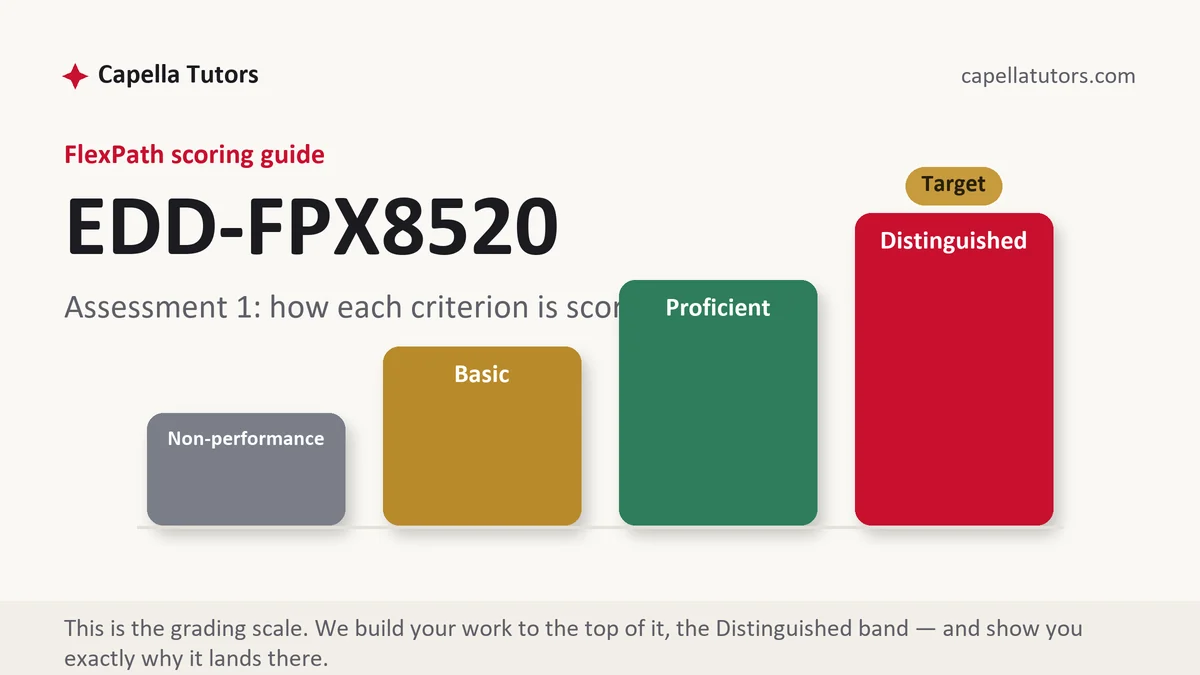
How EDD FPX 8520 Assessment 1 is scored
FlexPath issues no letter grade. Each criterion on your scoring guide lands on one of four levels, and the wording of those levels is the brief you are writing to:
| Level | What it means on a diagnostic leadership analysis |
|---|---|
| Distinguished | The problem is sized with figures a reader could verify, the setting is described including the authority the writer does not hold, and at least one standard visibly changes a decision. |
| Proficient | The problem is identified and the setting described accurately. Complete work, one move short, usually because the standards sit beside the analysis rather than constraining it. |
| Basic | A description of a school with a concern attached, no baseline number, no stated scope. The most frequent landing spot for a first doctoral submission in a design course. |
| Non-performance | A required element is absent, most often the local evidence or the standards alignment. Absent, not thin, is what puts a criterion on the floor. |
Faculty read the diagnostic section as a promise about the rest of the course. A problem stated loosely here produces a design nobody can evaluate later, so the pressure falls on two places: the number attached to the current state, and whether you can act on the ground you claimed.
The EDD FPX 8520 Assessment 1 method, step by step
-
Take the guide apart before you name a problem
Copy each criterion in as a heading, paste its Distinguished wording underneath, then label the row by the proof it will accept: a count, a cited standard, a described condition, or a judgment. The assessments in this course usually mix all four, and a well-written paragraph answering a criterion in the wrong currency earns nothing.
-
Fix the sphere of practice you can act inside
Name the ground you control and hold that boundary through the whole document. Three coaches, twenty-two classroom teachers and one grade band is a sphere. A district is not, unless you run one. A paper written as though the author commands a system they do not reads as assembled from textbooks.
-
Size the problem with something countable
A problem of leadership practice needs a number or nothing later can be measured against it. Pull what your building already produces: minutes logged inside classrooms, days between a visit and a conversation, coaching cycles finished against cycles scheduled. Two or three figures with a source and a date beat a page of description.
-
Convert two standards into tests the design must pass
Standards earn marks as constraints and lose them as citation. Take the standards your guide names, or the national set with a stated reason for choosing it, and pull two obligations that bite. Paraphrase each, cite the issuing body with its year, then write the test it imposes on anything you later propose.
-
Describe the setting, limits included
Give the setting as an outsider would need it: enrollment, staffing pattern, experience profile, and the collaboration time that exists on paper. Then write the limits paragraph most drafts leave out, stating what you decide alone, what a supervisor decides, and what belongs to a bargaining table or a board.
-
Self-score, then check what the next stage inherits
Mark each row of the guide yourself and be honest about the level, then read the document again asking one question: could another person build a design against this diagnosis without asking you anything. Submit early in the week, since faculty hold up to two business days on an attempt.
A structure that maps to the criteria
The word targets below are our own planning numbers for a diagnostic deliverable, not requirements published by Capella. Stretch any row your guide treats as the center of the assessment.
| Section | What it must do | Guide |
|---|---|---|
| Introduction and sphere of practice | Name the setting, the role you occupy inside it, and the boundary of what you can decide. | ~180 words |
| The problem of leadership practice | State the gap as a population, a behavior and a frequency, carried by local figures with dates. | ~300 words |
| Setting evidence | Enrollment, staffing, experience profile, schedule, and the policy or contract language that constrains the work. | ~250 words |
| Standards as design criteria | Two or three obligations paraphrased and attributed, each written as a test the eventual design has to pass. | ~300 words |
| What the diagnosis rules out | The competing readings of the same evidence, and the reason you rejected each one. | ~200 words |
| Handoff and references | The baseline the next deliverable inherits, the questions left open, current APA both ways. | ~150 words |
Annotated sample excerpt
An original model paragraph from our team, at the register that clears the top row of a diagnostic criterion. Take the moves, then write your own.
Coaching at this school is funded, staffed and scheduled, and it does not reach instruction.1 Across the last two trimesters our three instructional coaches logged 61 percent of contracted hours on benchmark administration, substitute coverage and data entry, leaving each coach a median of 4.2 hours a week for classroom work in a building of 22 classroom teachers.2 I set the coaching calendar and the cycle protocol; I do not set the testing window, which the district fixes in August, so this analysis treats that window as a constraint and asks what the remaining hours can do.3
- 1Opens on the contradiction rather than a definition of coaching. The evaluator meets the problem inside the first clause, which is what a diagnostic criterion pays for.
- 2Three figures, each countable in the building. A percentage, a median and a denominator turn a complaint into a baseline the next deliverable can move.
- 3Separates decision rights from wishes in one sentence. Naming the constraint you cannot move is what faculty read as doctoral judgment.
The full premium sample for your exact assessment, written fresh to your scoring guide and issue, is free to request. Study it, revise it into your own voice, and submit work you understand.
The five mistakes that cost Distinguished
- A concern where a problem was required. Coaching is inconsistent describes a feeling; coaches spend six hours a week on testing logistics describes something a design can attack.
- The borrowed setting. A district-scale analysis written by somebody who leads a department reads as reading rather than practice, and the authority row catches it.
- Standards parked in an appendix. A domain that changes no decision has been cited and not used, and the alignment criterion grades the second thing.
- No date on any number. A figure with no collection window cannot be compared to anything later, which disables the evaluation a later deliverable needs.
- APA left to the last hour. The communication row is scored as hard as the analytic rows at doctoral level, and it is the cheapest level anyone loses.
Pre-submission checklist
- Every criterion in the guide has its own labeled section
- The problem states a population, a behavior and a frequency, with a number attached
- Each figure carries its source and the window it was collected in
- Two standards paraphrased, attributed to the issuing body, and written as tests
- One paragraph states what you decide and what a contract or board reserves
- Every row self-scored at the top level, and the file submitted early in the week
Diagnostic due before the design?
Send the prompt, the scoring guide, and whatever your building already counts. A team of eight, including a research analyst and two QA reviewers, returns a premium original sample written to the Distinguished column in 24 to 48 hours, revised free until it lands there. The diagnosis sets the ceiling for every later deliverable in the course.