This manual is for EDD FPX 8520 Assessment 3, start to submission. Assessment 3 usually closes the design work by asking how the practice would be put in place and how you would know whether it worked. That means a sequence carrying dates and owners, decision rights stated accurately, expected objections answered inside the plan, and an evaluation in two layers: whether the design ran at all, and whether it changed anything. The guide attached to your own courseroom decides the deliverable and who it is addressed to. What follows is the sequence our tutors work in, a section plan tied to the criteria, and one annotated excerpt. Want it handed over instead? Send the guide and a premium original sample reaches you within 24 to 48 hours, with unlimited free revisions. Capella's catalog lists the course as EDD-FPX8520, and some courserooms print EDD8520; both point to this same Assessment 3.
One honesty note before the manual: Capella revises courses and scoring guides over time, so always write to the exact scoring guide attached to your assessment in the courseroom. The course identity above is verified on capella.edu; the method and structure below are our tutors' approach to it, not Capella's official rubric text.
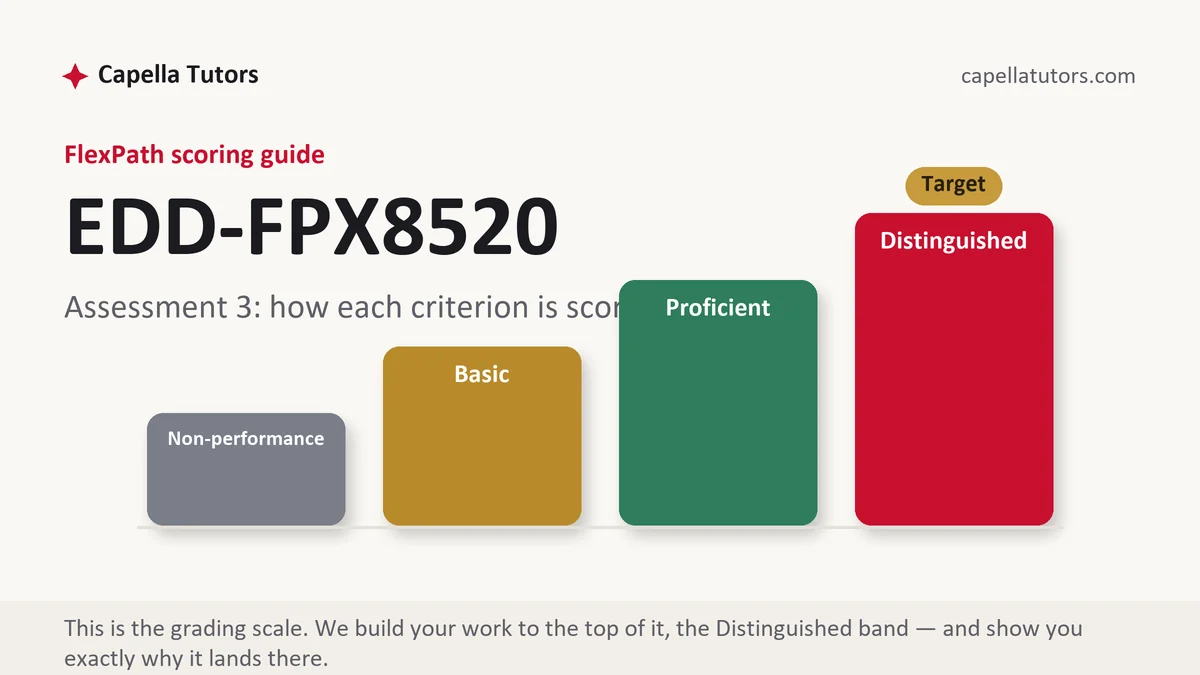
How EDD FPX 8520 Assessment 3 is scored
Nothing here is graded on a curve or a percentage. Each criterion resolves to one of four levels, and reading those levels closely is most of the work:
| Level | What it means on an implementation and evaluation plan |
|---|---|
| Distinguished | The sequence carries dates and owners, the authority behind each step is named accurately, the strongest objection is answered rather than noted, and the plan states what would make the writer stop. |
| Proficient | A workable sequence with measures attached. Complete, and one move short wherever objections are listed instead of met or the measures arrive with no baseline. |
| Basic | A timeline of activities with a promise to monitor progress. No baseline, no denominators, no condition under which the design would be judged a failure. |
| Non-performance | A named element is missing, most often the evaluation baseline or the decision rights the whole plan depends on. |
The row separating this deliverable from an ordinary project plan is the one about evidence. A doctoral evaluation says what would count as the design not working, and says it before any data exists, because a plan that cannot fail is a plan nobody can evaluate.
The EDD FPX 8520 Assessment 3 method, step by step
-
Sequence backward from the first evidence you need
Ask what the first defensible finding is, then work back to the tasks that make it possible. If the first finding is whether every teacher received a visit inside the six-week window, the baseline count has to exist before week one, which fixes the date the tracking sheet is built and the date the calendar is published.
-
Write authority as three lists
Split the plan's decisions into what you decide alone, what a supervisor decides, and what a board vote or bargaining conversation controls. Evaluation instruments, contract time and the calendar usually sit in the third list whatever the building believes. Then say what you would take to whoever holds each one.
-
Collect the baseline before the first cycle
The baseline is the cheapest item in the plan and the one most often skipped. Take the measures you intend to report at the end and collect them once now, with a date and a denominator. Points from earlier years matter more still, since they show what ordinary fluctuation looks like before your design touched anything.
-
Measure the design running before its effect
Split the evaluation in two and report the first layer first. Process measures answer whether the design ran, read within weeks, and need no comparison group: cycles completed against cycles planned, median days to the conversation. A plan reporting outcomes without implementation cannot tell failure from absence.
-
Hire your strongest objector and answer them in the text
Write the objection that would actually be raised in your building, in the voice of the person raising it, then answer it structurally rather than reassuringly. Teachers reading a short visit as evaluation, a colleague noting that the last two initiatives ended in February: each is design input rather than noise.
-
State the abandonment condition, then self-score
Name the result that would make you stop, with a threshold and a date. Fewer than 70 percent of planned cycles completed by the halfway review describes a design that is not running, and saying so in advance reads as intellectual honesty. Then score each row yourself and repair anything under the top level.
A structure that maps to the criteria
These are our planning targets for an implementation and evaluation deliverable, not Capella requirements. Where your guide devotes a whole criterion to measurement, give that section more room.
| Section | What it must do | Guide |
|---|---|---|
| Plan summary and readiness | What is being implemented, in what sphere, and what has to be true before week one. | ~180 words |
| Sequence with dates and owners | Each step, its owner, its date, and the artifact that proves it happened. | ~300 words |
| Decision rights | What you decide, what a supervisor decides, what a board or agreement controls, and what you would ask for. | ~250 words |
| Evaluation: process layer | Measures of whether the design ran, with numerators, denominators and a reading interval. | ~250 words |
| Evaluation: outcome layer | Baseline, window, the outcome tied to the mechanism, and subgroup breakdowns named in advance. | ~250 words |
| Objections, abandonment, references | The objections answered, the condition that stops the design, current APA both ways. | ~200 words |
Annotated sample excerpt
A model paragraph written by our team at the standard an evaluation criterion rewards. Learn the structure, then produce your own with your own figures.
Before the first cycle opens, the tracking sheet records 31 teachers, six six-week cycles in the school year, and last year's median lag of 11 school days between a classroom visit and any recorded conversation.1 Three process measures read every two weeks: cycles completed against cycles planned, median days from visit to conversation, and the share of visit records naming the term's instructional priority in writing.2 At the halfway review on the second Wednesday of February, the assistant principal and I compare those figures against thresholds fixed now, and completion below 70 percent sends the design back for revision.3
- 1A baseline with a denominator and a prior-year comparison, all before implementation. The last figure lets a reader judge whether later movement exceeds ordinary variation.
- 2Three measures that read inside a fortnight and need no comparison group. Each tests whether the design happened, which a first-year evaluation can honestly answer.
- 3A named date, named participants and a numeric threshold set in advance. Writing the stopping rule before results exist separates a plan from an intention to monitor.
The full premium sample for your exact assessment, written fresh to your scoring guide and issue, is free to request. Study it, revise it into your own voice, and submit work you understand.
The five mistakes that cost Distinguished
- A timeline with no owner. Steps written in the passive voice leave every task unassigned, and the implementation criterion is grading who does what by when.
- Authority taken for granted. Proposing changes to evaluation instruments, contract time or the calendar as though they were yours is the fastest way to lose a doctoral reader.
- Outcomes with no implementation measure. Without the process layer, a flat result cannot be told apart from a design that never ran.
- Objections acknowledged rather than answered. A sentence conceding that some staff may resist adds nothing; the structural counter is what the criterion pays for.
- Nothing that counts as failure. A plan with no condition for abandonment cannot fail, and a design that cannot fail has not been evaluated.
Pre-submission checklist
- Every step in the sequence carries an owner, a date and an artifact
- Decision rights split into what you hold, a supervisor holds, and a board or contract holds
- Baseline collected before week one, with denominators and a prior year where available
- Process measures kept separate from outcome measures, each with a reading interval
- The strongest local objection answered structurally inside the plan
- An abandonment threshold and a review date written before any data exists
Implementation and evaluation plan due?
Send the prompt, the guide, and the design you have already specified, plus whatever your building counts today. Eight people, including a research analyst and two QA reviewers, return a premium original sample inside 24 to 48 hours with baselines, thresholds and decision rights written in, revised free until every criterion is satisfied.