This manual is for EDD FPX 8520 Assessment 2, start to submission. Assessment 2 is where the design has to exist on the page. The assessment usually asks you to specify the leadership practice itself: the roles carrying it, the routines those roles perform on a stated cadence, the artifacts the routines run on, the hours each consumes, and the route by which any of it reaches a student. Your scoring guide decides the format and how much justification has to be cited. What follows is our tutors' method, a structure built against the criteria, and an annotated sample excerpt. Rather hand it over? A premium original sample lands with you inside 24 to 48 hours, revised at no charge until every row is satisfied. Capella's catalog lists the course as EDD-FPX8520, and some courserooms print EDD8520; both point to this same Assessment 2.
One honesty note before the manual: Capella revises courses and scoring guides over time, so always write to the exact scoring guide attached to your assessment in the courseroom. The course identity above is verified on capella.edu; the method and structure below are our tutors' approach to it, not Capella's official rubric text.
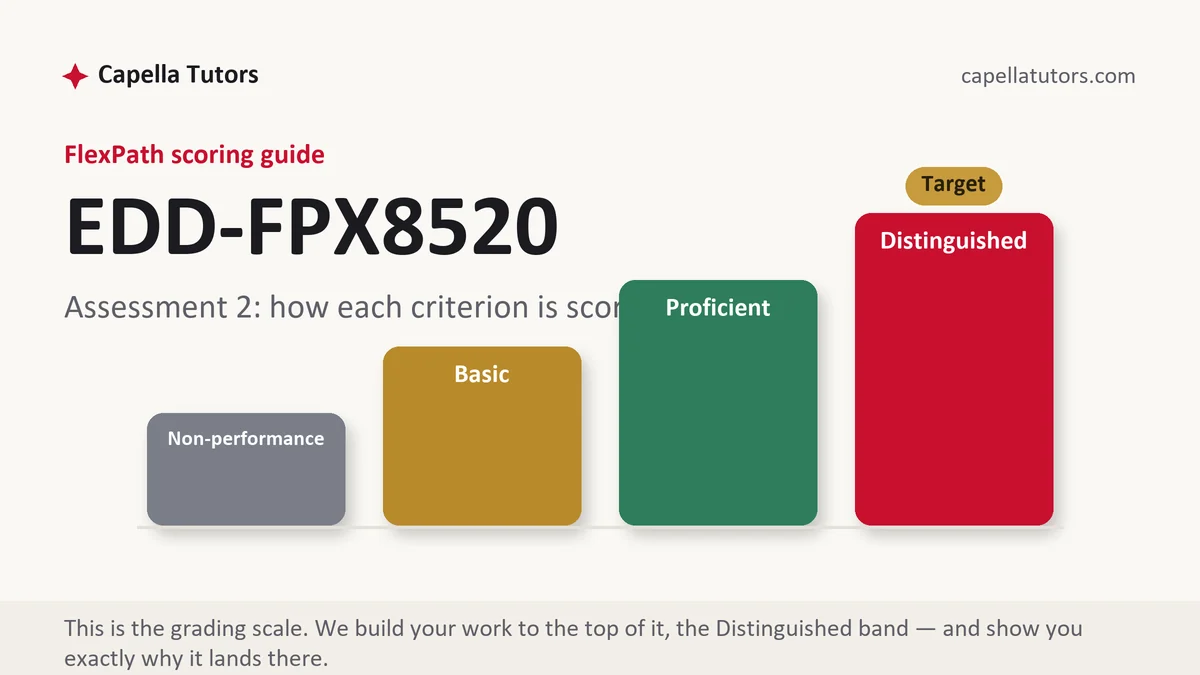
How EDD FPX 8520 Assessment 2 is scored
There are no letter grades here. Every criterion resolves to one of four levels, and the level language tells you what the writing has to do:
| Level | What it means on a specified leadership design |
|---|---|
| Distinguished | Roles, cadence, artifacts and time costs are all present, the route from a leader's action to a student's work is named link by link, and the weakest link is identified by the writer. |
| Proficient | A complete design with owners and a cadence. Solid, and short of the row above wherever the hours go unbudgeted or the mechanism is asserted instead of traced. |
| Basic | A proposal nobody could run: intentions where routines belong, more collaboration and better communication in place of who meets whom, when, over what. |
| Non-performance | An element the criterion names is missing outright, commonly the artifact a routine runs on or the evidence the design would produce. |
The practical test faculty apply here is whether another leader could execute the design on Monday without asking you a question. Everything the criteria reward follows from that: a named owner, a fixed cadence, a document the routine produces, and an hour count somebody has to absorb.
The EDD FPX 8520 Assessment 2 method, step by step
-
Write the mechanism before you write the routine
Draw the chain from your action to a student's task one link at a time, with a source behind each link. A chair reviews a common assessment, the review changes what the team asks students to produce, the changed task reaches sixth period on Tuesday. A design jumping straight to outcomes gives the mechanism criterion nothing to grade.
-
Specify each role by what it stops doing
A role redefined by addition is a role nobody performs. If a department chair is to lead instruction, write the duties leaving the job description as precisely as the ones entering it: textbook inventory, the duty roster, the supply requisition. Then say where that work goes, because it does not evaporate.
-
Put a cadence and an artifact on every routine
Four attributes make a routine specified: who convenes it, how often, what document it produces, and where that document lives. Weekly, monthly and as needed are three different commitments, and a routine with no artifact leaves no trace to inspect. Name the artifact as a one-page form rather than as documentation.
-
Count the hours, then say who pays them
Arithmetic is where designs at this level fail quietly. Nine chairs meeting twice a month for fifty minutes is fifteen hours of adult time before anybody prepares. Add preparation and the follow-up conversation, then name the release: a duty period reassigned, a faculty meeting shortened, a report retired.
-
Design the protection the routine needs to survive
Any routine that looks evaluative will be treated as evaluative, and it dies in week three unless separated from the summative process in writing. Say what gets recorded, who may see it, what can never travel into an evaluation file, and who enforces that boundary. Do the same for student data.
-
Read the design back as the person who runs it
Hand the document to the imagined colleague who has to execute it and read for questions they would be forced to ask. Every question marks an unspecified detail, and unspecified details are where a criterion drops a level. Submit when the design is complete rather than when the week ends.
A structure that maps to the criteria
These targets are our planning numbers for a specification deliverable rather than anything Capella publishes. Move the weight toward whichever row your guide describes in most detail.
| Section | What it must do | Guide |
|---|---|---|
| Purpose and design brief | Restate the problem in one sentence and the criteria the design must satisfy, carried from your earlier analysis. | ~150 words |
| Roles and decision rights | Each role in the design, what it gains, what it gives up, and what it may decide alone. | ~300 words |
| Routines and artifacts | Every routine with a convener, a cadence, the document it produces, and where that document lives. | ~350 words |
| Mechanism | The chain from leader action to teacher practice to student work, a source per link, the weakest one named. | ~250 words |
| Resource arithmetic | The hours the design consumes, the release that funds them, and what stops so this can start. | ~200 words |
| Protections and references | The boundary between the routine and formal evaluation, data handling, current APA both ways. | ~150 words |
Annotated sample excerpt
One original paragraph from our writers, at the level of specification the top row of a design criterion pays for. Study the moves, then build your own.
The instructional review is a fifty-minute meeting convened by the department chair on the first and third Tuesday of each month, inside the common planning period the master schedule already protects.1 Teachers bring six pieces of student work from a task they have already scored, the chair brings the single look-for drawn from the department's annual instructional priority, and the meeting produces a one-page decision record naming what the team will change in the next task and who drafts it.2 Nothing said in the meeting enters an evaluation file, the record carries no teacher name beside any piece of work, and the principal receives the decision line only.3
- 1Convener, duration, dates and the place in the existing schedule, all in one sentence. The criterion asking whether this could be implemented is answered before the second clause.
- 2The artifact is named and it carries a decision rather than a summary. A routine producing a document with an owner is one somebody can evaluate later.
- 3The protection is written into the design instead of promised later. Stating what the principal does not receive is what makes participation plausible.
The full premium sample for your exact assessment, written fresh to your scoring guide and issue, is free to request. Study it, revise it into your own voice, and submit work you understand.
The five mistakes that cost Distinguished
- A cadence written as regularly. Twice a month on Tuesday is a commitment a schedule can hold; regular collaboration is a wish, and the implementation row prices it accordingly.
- Additions with no subtraction. A design handing nine adults new work without naming the work that ends has not been costed, and the resource criterion is where that shows.
- The missing artifact. A meeting producing no document leaves nothing to inspect, so the evidence criterion has nothing to attach itself to.
- A mechanism that jumps. Claiming the routine raises achievement without the change in teacher practice between skips the only link your evidence could reach.
- No guard against evaluative drift. Where a design fails to separate a learning routine from the summative process, anyone who has run a building will say so.
Pre-submission checklist
- Every routine names a convener, a cadence, an artifact and a filing location
- Each role states what it gives up as precisely as what it gains
- The mechanism runs link by link from your action to a student task, one source per link
- Total adult hours calculated, and the release that funds them named
- The boundary between the routine and formal evaluation written into the design
- Every row self-scored, and the document read once as the person who must run it
Design deliverable on the calendar?
Send the prompt, the guide, your role, and the constraints you cannot move, including contract language and any observation cycle already running. Eight people take it from the standards pull to the final proofread and return a premium original sample inside 24 to 48 hours, specified down to the cadence, revised free until the guide is met.