This manual is for EDD FPX 8030 Assessment 2, start to submission. Assessment 2 of EDD FPX 8030 asks what is producing the gap you established. The assessment usually wants candidate causes sorted rather than listed, each one tested against evidence you can produce, and the chain pursued until it reaches something a person in your role could change. Below: how our tutors run causes down, the structure the criteria expect, and an annotated chain out of one. Rather hand it over? One premium original analysis lands within 24 to 48 hours, reworked free for as long as the criteria require. Capella's catalog lists the course as EDD-FPX8030, and some courserooms print EDD8030; both point to this same Assessment 2.
One honesty note before the manual: Capella revises courses and scoring guides over time, so always write to the exact scoring guide attached to your assessment in the courseroom. The course identity above is verified on capella.edu; the method and structure below are our tutors' approach to it, not Capella's official rubric text.
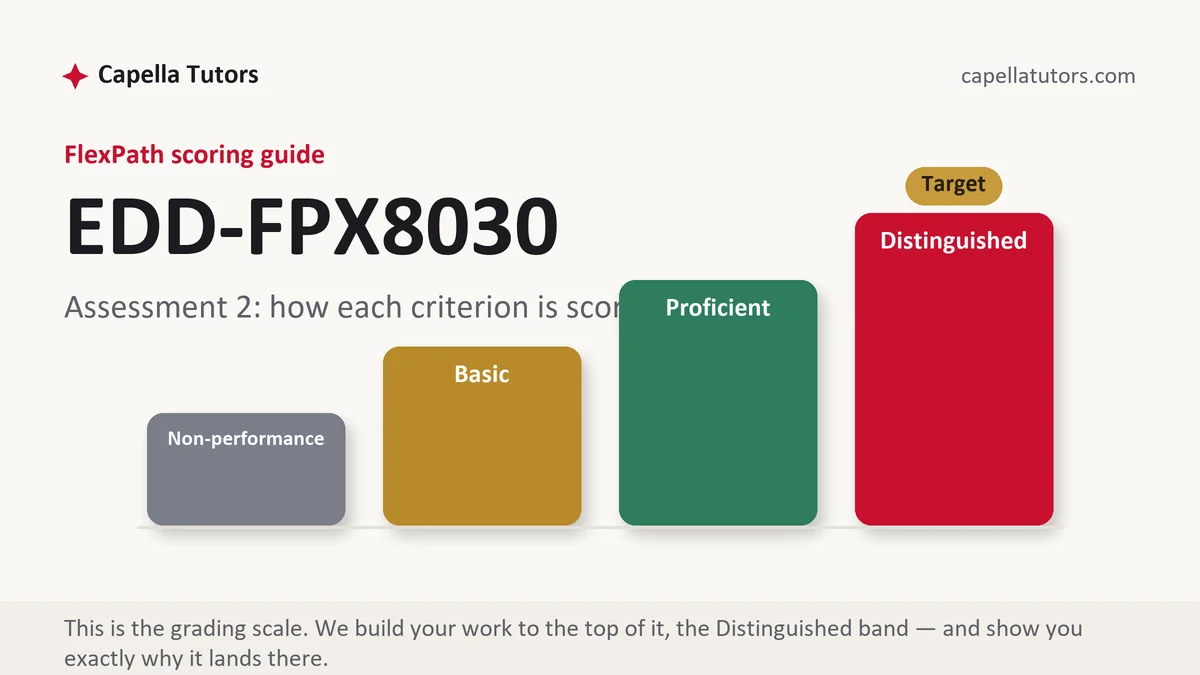
How EDD FPX 8030 Assessment 2 is scored
Four levels, one per criterion, and the descriptors are the assignment. On causal work the levels separate on where the analysis was allowed to stop:
| Level | What it means on a causal analysis |
|---|---|
| Distinguished | Causes are sorted into families, tested against evidence rather than plausibility, and pursued past the first satisfying answer to a routine somebody owns. Causes you cannot reach are named and set aside openly, which reads as judgment rather than retreat. |
| Proficient | Causes are identified and supported, and the reasoning holds. Correct, a level below analysis that ends somewhere actionable. |
| Basic | A list of contributing factors, one of them student motivation. Symptoms renamed as explanations, which is the most common landing spot here. |
| Non-performance | A required element is missing, most often any evidence behind the causes, or any distinction between a symptom and a cause. |
The technique everyone knows stops wherever the person using it loses nerve, and in schools it tends to stop at effort or engagement. One more round of questioning almost always lands on a schedule, a form, a threshold or a handoff that nobody has owned for years, and that is where a doctoral study can actually do something.
The EDD FPX 8030 Assessment 2 method, step by step
-
Sort candidates into families before ranking any of them
A cause and effect diagram in the tradition Kaoru Ishikawa established forces the candidates into groups: people, process, materials, measurement, environment, or whichever families fit your setting. Sorting exposes the empty family, and the empty family is usually the one nobody in your organization is allowed to talk about.
-
Ask why until the answer stops being about the student
Taiichi Ohno's repeated questioning inside the Toyota production system is the tool, and its weakness is that it terminates at the asker's comfort. Ninety-six students have not reclassified is not explained by saying they struggle with English. Ask why they struggle in the domain the assessment actually failed them on, then ask why that domain is not taught.
-
Test every candidate against evidence you could produce
For each candidate write the evidence that would confirm it and the evidence that would kill it, then say which you have. A cause with no available evidence stays on the diagram labelled untested. A cause you assert because it feels right is the reason the analysis criterion exists.
-
Keep going until you reach a routine with an owner
The chain has arrived when the last link is a practice a named role could change inside a term: how a schedule is built, who signs a placement form, what a threshold is set at, which handoff nobody performs. Ending on a policy nobody can touch or a trait nobody can alter means you stopped one question early.
-
Name the causes outside your reach and set them aside in writing
Housing instability, family working hours and state assessment design are real causes and are not yours. Say so, say why the reachable cause still matters, and say what your study is therefore not claiming. Faculty read that paragraph as maturity, and its absence as overreach.
-
Check the diagram has more than one branch
An analysis with a single line from problem to favoured solution was written backwards, and it is visible in seconds. Carry at least two branches far enough that a reader can see you tried to defeat your own preferred explanation.
A structure that maps to the criteria
Our defaults for a causal analysis of ordinary scope; move the weight to wherever your criteria have put it.
| Section | What it must do | Guide |
|---|---|---|
| The gap restated | The measured problem in two sentences, so this document can stand alone in a committee's hands. | ~150 words |
| Candidate causes, sorted | The families, what sits in each, and which family is conspicuously empty. | ~275 words |
| Evidence for and against each | The confirming and disconfirming evidence available, and which candidates remain untested. | ~325 words |
| The chain, followed down | Each link with the question that produced it, ending at a routine a named role could change. | ~300 words |
| Causes out of reach | The real causes you are not addressing, and what that costs your eventual claim. | ~200 words |
| What this licenses, and references | The action the analysis supports, and seventh edition APA throughout. | ~150 words |
Annotated sample excerpt
A model causal passage from our team, written at the register the guide's top column describes.
Of the 318 students carrying the multilingual learner designation in this district, 96 have carried it for six years or longer, and 71 of those 96 met the threshold on every domain of last year's annual assessment except writing.1 Asking why writing, the answer is that these students are scheduled into a second English period that displaces science, so the extended content writing the assessment samples is the one thing their day does not contain.2 Asking why the schedule is built that way, the answer is a 2019 memo setting a minutes floor for language support that no one has revisited, which puts the reachable cause in the hands of the office that builds master schedules rather than in the students.3
- 1Narrows the population from 318 to 96 to 71 on a single measure, so the analysis is aimed at a group the study could actually serve.
- 2Follows the question into the domain the data pointed at instead of restating the problem in more sympathetic language.
- 3Terminates on a document and an office, which is what makes the finding actionable and the recommendation defensible.
The full premium sample for your exact assessment, written fresh to your scoring guide and issue, is free to request. Study it, revise it into your own voice, and submit work you understand.
The five mistakes that cost Distinguished
- Analysis that stops at motivation. Saying students are disengaged renames the problem, and the criteria are written to catch the substitution.
- Causes listed rather than sorted. A list hides the family you never considered; a sorted diagram shows the hole immediately.
- Plausibility accepted as evidence. A cause that sounds right and has no confirming data is a hypothesis, and labelling it as one costs nothing.
- A chain ending where nobody can act. State policy and family circumstance are real and unreachable, and stopping there leaves the study with no lever.
- One branch carried and the rest abandoned. A single line from problem to preferred fix tells a reader the conclusion was chosen before the analysis started.
Pre-submission checklist
- Candidate causes sorted into families, with the empty family named
- Confirming and disconfirming evidence written for each candidate
- The chain followed to a routine a named role could change this term
- Untested causes labelled as untested rather than dropped
- Unreachable causes named, with what their exclusion costs your claim
- At least two branches carried to depth, and seventh edition APA throughout
Root cause work stalling on the third why?
Send the prompt, the criteria, and the gap you have already evidenced. We sort the candidates, attach the evidence each one needs, and return a premium original sample in 24 to 48 hours whose chain ends somewhere a person in your role can act, revised free until the guide is met.