This manual is for EDD FPX 8030 Assessment 1, start to submission. Assessment 1 of EDD FPX 8030, Investigating Problems of Practice, turns a subject into an object a doctoral study can act on. The assessment usually asks you to state a problem inside a setting you can reach, evidence it with local figures rather than assertion, and disaggregate those figures far enough to show which students it actually concerns. What follows is the order our tutors evidence a gap in, the section plan the criteria reward, and a marked-up statement. Prefer to hand it off? A premium original sample is back with you inside 24 to 48 hours and revised at no cost until the guide is answered. Capella's catalog lists the course as EDD-FPX8030, and some courserooms print EDD8030; both point to this same Assessment 1.
One honesty note before the manual: Capella revises courses and scoring guides over time, so always write to the exact scoring guide attached to your assessment in the courseroom. The course identity above is verified on capella.edu; the method and structure below are our tutors' approach to it, not Capella's official rubric text.
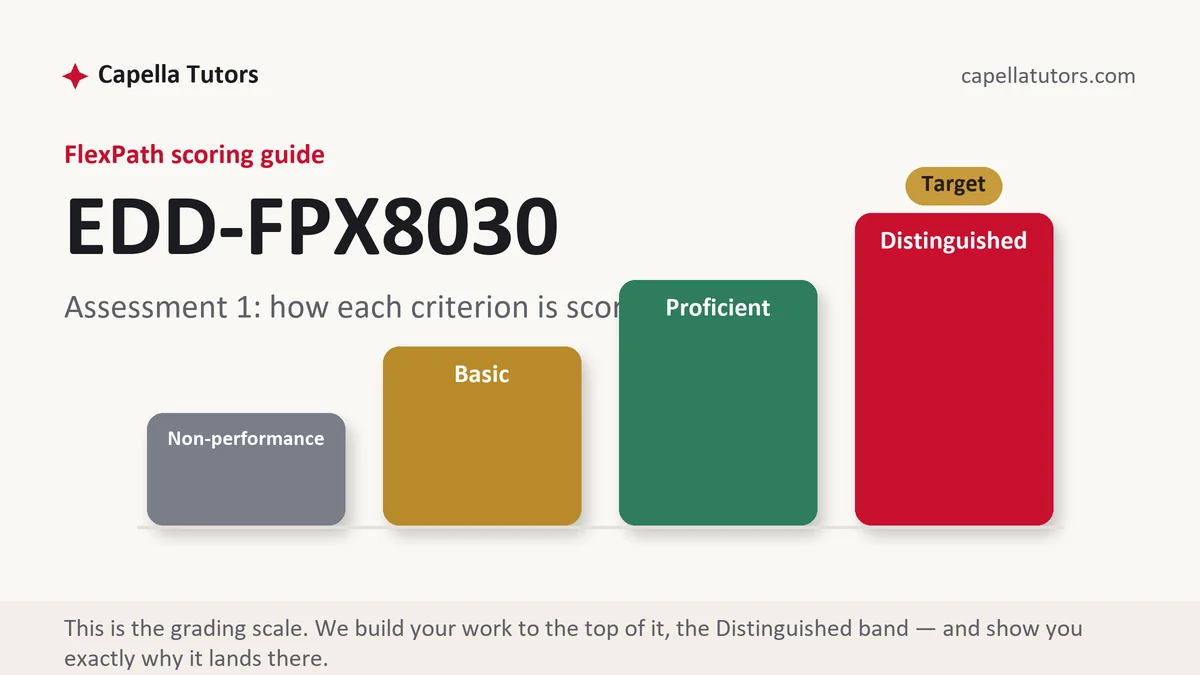
How EDD FPX 8030 Assessment 1 is scored
Criteria, not grades. Each row of the guide lands on one of four levels, and on a problem statement the levels are unusually easy to predict:
| Level | What it means on a problem of practice statement |
|---|---|
| Distinguished | The gap carries its numerator, denominator and window, sits beside a trend and a comparison, and is disaggregated until the group the problem concentrates in is named. Framing the disparity as produced by arrangements, with that framing attributed, is the move at the top. |
| Proficient | The problem is situated in a real setting and evidenced accurately. Sound work, a level under work that says whose problem this is. |
| Basic | A national issue with a local sentence bolted on. It would read the same about any district in the country, and that is what the level means. |
| Non-performance | A required element is absent, most often any figure a reader could verify, or any statement of the setting the problem belongs to. |
A committee is deciding one thing on this deliverable: whether there is an object here that a study could act on. Everything downstream inherits the precision of the statement, so an hour spent fixing a denominator now saves a term of writing around a number nobody can check.
The EDD FPX 8030 Assessment 1 method, step by step
-
Run the four tests before you write a word
A problem of practice is situated in a named organization, evidenced in something a reader can point to, actionable by someone in your role inside a realistic window, and consequential to people you can describe. A topic fails at least three. If yours passes only the fourth, you have a cause rather than a problem.
-
Write every figure with three parts visible
What was counted, out of what, and over what period. Six point four percent means nothing until it reads as 412 of 6,410 students enrolled on the October count date. A rate with no population and no window cannot be verified, and everything resting on it inherits that weakness.
-
Give the number company
One figure has no direction. Add the same measure for two prior years so a reader can see whether this is drift or a spike, then add the district, county or state figure so the explanation that this is normal everywhere can be ruled out or conceded honestly.
-
Disaggregate until the average stops hiding the problem
Building-level means conceal almost every problem worth studying. Skrla, Scheurich, Garcia and Nolly argued in Educational Administration Quarterly in 2004 that an equity audit should read teacher quality, program placement and outcomes together rather than reporting one gap and stopping, and that is the standard your criteria are written against.
-
Say what your figures cannot tell you
Identification, enrollment, participation and completion are four different measures, and districts publish whichever flatters. State which one you have, name the one you wanted, and say what you asked for and were not given. A gap named honestly costs nothing and buys the reader's trust in the rest.
-
Name the arrangement rather than the students
Gloria Ladson-Billings argued in her 2006 presidential address to the American Educational Research Association that gaps of this kind are better understood as an accumulated debt than as a deficit in children, and citing that reframing changes the register of everything after it. Point the sentence at a referral process, a schedule or a screening rule.
A structure that maps to the criteria
Planning targets for a problem statement of ordinary scope rather than Capella rules; follow the weighting in your own guide.
| Section | What it must do | Guide |
|---|---|---|
| The problem of practice | The gap between what is happening and what should be, located in a named setting you can influence. | ~200 words |
| Local evidence | The measure with its numerator, denominator, window, trend and comparison figure. | ~300 words |
| Disaggregation | Results by the groups that matter locally, with counts shown beside every percentage. | ~275 words |
| The arrangement behind the numbers | Access, placement, staffing and outcomes read together rather than one gap reported alone. | ~300 words |
| What the data cannot show | The measure you wanted, the one you have, and what you requested and were refused. | ~175 words |
| Why it warrants study, and references | The consequence of leaving it alone, and seventh edition APA throughout. | ~150 words |
Annotated sample excerpt
An original evidencing passage from our team, at the level the top descriptor asks for.
Of the 6,410 students enrolled in grades three through five on the October count date, 412 are identified for advanced academics, a rate of 6.4 percent.1 Disaggregated, that rate is 11.2 percent for white students, 2.6 percent for Hispanic students, 2.1 percent for Black students and 1.4 percent for students designated as multilingual learners, and it has not moved by more than a point in any group in three years.2 Nineteen of the district's twenty-two elementary schools identify by teacher referral alone, and the three that screen every second grader enroll 14 percent of the district's students while accounting for 38 percent of everyone identified.3
- 1Numerator, denominator and count date together, so the figure can be recomputed and therefore disputed.
- 2Disaggregates and trends in one sentence, which disposes of both the average and the hope that this is one unlucky year.
- 3Moves from outcomes to the mechanism producing them, and that is what turns a reported gap into an equity audit.
The full premium sample for your exact assessment, written fresh to your scoring guide and issue, is free to request. Study it, revise it into your own voice, and submit work you understand.
The five mistakes that cost Distinguished
- A national problem with a local sentence attached. If the paper would read identically about any district, no criterion about a situated problem can be satisfied.
- Percentages without denominators. A rate with no population and no window cannot be checked, and nothing built on it can be either.
- One gap reported and the arrangement left alone. Outcomes without placement, access and staffing beside them is a headline, not an audit.
- Disaggregation stopped at the first category. The group the problem concentrates in is usually two cuts down, and the criteria are written to find out whether you looked.
- A deficit sentence about children. Naming students as the reason for a pattern the district's own referral process produces costs the equity criterion outright.
Pre-submission checklist
- The problem situated in a setting you can actually influence
- Every figure written with its numerator, denominator and window
- Two prior periods and one external comparison included
- Disaggregation carried far enough to name the affected group, counts beside rates
- The placement or referral arrangement examined alongside the outcomes
- One paragraph on what your data cannot show, and seventh edition APA throughout
Problem statement not landing yet?
Send the prompt, the criteria, and whatever figures you can share or point us to publicly. A premium original sample returns in 24 to 48 hours with the gap written as a measured, disaggregated, sourced claim, revised free until the criteria are met.