This manual is for EDD FPX 8030 Assessment 3, start to submission. Assessment 3 of EDD FPX 8030 puts you inside the study. The assessment usually asks who the problem belongs to, what each party stands to lose, and what your own position in the organization does to the credibility of anything you find. Ahead is the order our tutors write disclosure in, a section plan built off the criteria, and an annotated positionality passage. Want it handled? A premium original sample arrives inside 24 to 48 hours and keeps being revised until the guide is met. Capella's catalog lists the course as EDD-FPX8030, and some courserooms print EDD8030; both point to this same Assessment 3.
One honesty note before the manual: Capella revises courses and scoring guides over time, so always write to the exact scoring guide attached to your assessment in the courseroom. The course identity above is verified on capella.edu; the method and structure below are our tutors' approach to it, not Capella's official rubric text.
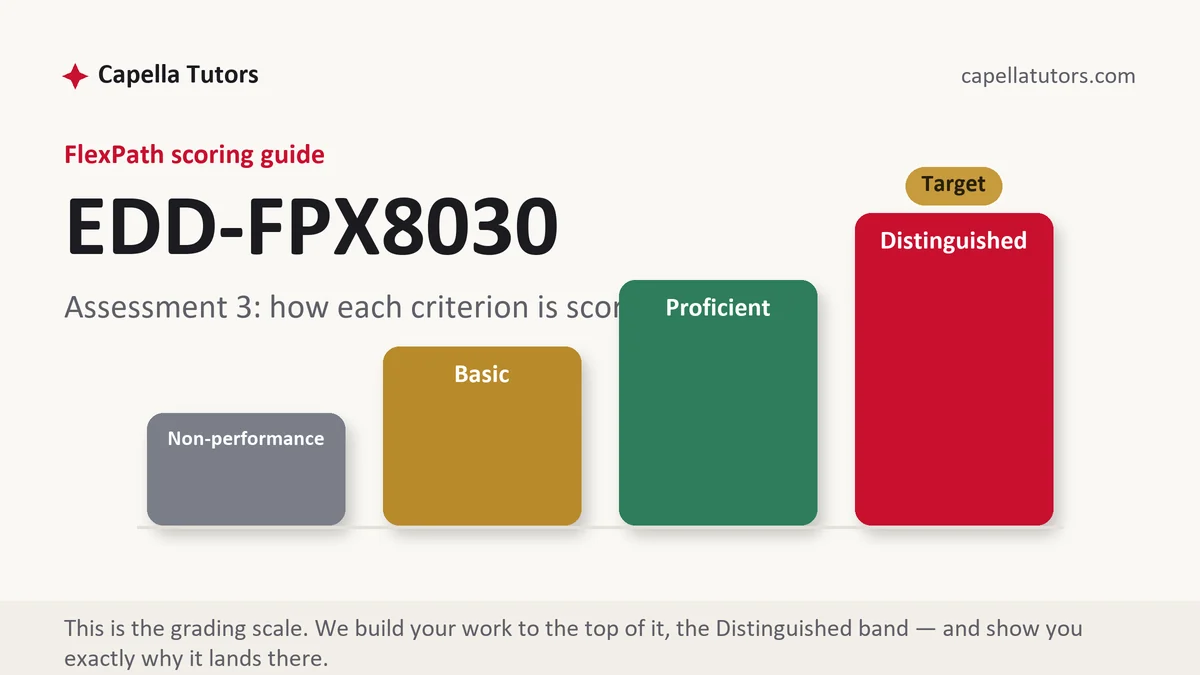
How EDD FPX 8030 Assessment 3 is scored
Each criterion sits at one of four levels. On this deliverable the top column is bought with specificity about yourself, which is why it is the hardest one to fake:
| Level | What it means on a stakeholder and positionality deliverable |
|---|---|
| Distinguished | Every risk your position creates has a named safeguard attached and a stated cost, the party with the least power gets described as concretely as the decision maker, and the determinations that belong to a review board are left to it. Specific safeguards are what the top column pays for. |
| Proficient | Stakeholders are identified and the writer's position is disclosed. Complete, and a level under work that has priced its own safeguards. |
| Basic | A list of stakeholders and a paragraph promising objectivity. Reassurance offered where a procedure was wanted. |
| Non-performance | A required element is absent, most often any disclosure of authority over participants, or any account of who loses if the problem is solved your way. |
Two approvals sit behind work like this and neither is yours to grant. A university review board decides whether the planned activity counts as human subjects research and whether your protections hold, and your district almost certainly runs its own research review with separate forms and its own calendar. Write that both determinations are pending rather than predicting either, and build their timelines into the plan.
The EDD FPX 8030 Assessment 3 method, step by step
-
Map stakeholders by what each one stands to lose
Anyone can list the people affected. The criterion is looking for the loss column: whose time, whose autonomy, whose budget, whose reputation, whose sense of having been right. A change that costs nobody anything is not a change, and a stakeholder map with no losses in it has not been done.
-
Describe the least powerful party as concretely as the superintendent
The person with the least authority in your account is usually the student or the family, and they are usually rendered as a category. Give them the same specificity you give the cabinet: what they experience, when, and what they have already tried. Vagueness about the powerless is a pattern evaluators are trained to notice.
-
Write positionality as authority, access and stake
Three sentences, in that order. What is your role and who reports to you. What can you see or obtain because of that role. What do you gain if the study reaches a particular conclusion. H. Richard Milner's 2007 argument in Educational Researcher for working through the seen, unseen and unforeseen dangers of one's own position is the citation, and the three-sentence form is how you satisfy it without a confession.
-
Attach a safeguard to each risk, and price it
Data collected by someone outside your supervisory line. Direct reports excluded from the sample. An audit trail a reader could inspect. A colleague invited to argue with your interpretation. Then say what each safeguard costs you in participants or time, because a safeguard with no cost is usually a sentence rather than a procedure.
-
Separate the access your job gives you from the access a participant grants
Kathryn Herr and Gary Anderson treat insider standing as a continuum rather than a category in The Action Research Dissertation, which is the useful framing when you supervise some of the people you plan to study. A file you can open because of your title is not the same as a file someone agreed to show you, and the criteria expect you to know the difference.
-
State the warrant for a doctoral study, not for a project
Say what would still be unresolved after an ordinary improvement effort, and what a systematic study adds that a good administrator working hard would not produce. That paragraph is the difference between a problem worth solving and a problem worth studying, and only one of those earns the criterion.
A structure that maps to the criteria
Our planning split for a deliverable of ordinary scope; your own guide decides the emphasis.
| Section | What it must do | Guide |
|---|---|---|
| Stakeholders and their stakes | Who is affected, who decides, who must act, and what each party loses. | ~275 words |
| The least powerful party | Their experience described with the specificity usually reserved for decision makers. | ~200 words |
| Positionality | Your role, the access it grants, and what you gain if the answer goes one way. | ~250 words |
| Safeguards and their cost | One concrete procedure per risk, with what each procedure costs the study. | ~275 words |
| Approvals pending | Which determinations belong to a review board and a district office, and their timelines. | ~200 words |
| Warrant and references | Why this needs a study rather than an effort, and seventh edition APA throughout. | ~175 words |
Annotated sample excerpt
An original disclosure passage from our team at the level the top column describes.
I am the director of teaching and learning, which means the eleven instructional coaches whose practice this study examines are evaluated by me, and the coaching model whose collapse I am investigating is one I designed in 2022.1 I therefore stand to gain from any finding that locates the failure in scheduling rather than in the model itself, and a reader should hold that against every interpretation I offer.2 Two safeguards follow: interviews will be administered by a colleague outside my supervisory line, and no coach who reports to me directly will be included, which costs this study four of eleven possible participants and is the price of the finding being believable.3
- 1States the authority and the authorship of the thing under study in one sentence, since both change how a reader should weigh the account.
- 2Names the direction of the bias instead of promising objectivity, which is the disclosure the criterion is actually asking for.
- 3Attaches a concrete procedure to the named risk and prices it, so a reader sees the trade rather than receiving a reassurance.
The full premium sample for your exact assessment, written fresh to your scoring guide and issue, is free to request. Study it, revise it into your own voice, and submit work you understand.
The five mistakes that cost Distinguished
- Positionality written as reassurance. Declaring yourself objective is not a safeguard, and the missing procedure is what loses the level.
- Stakeholders listed with no losses. A map where nobody gives anything up describes a wish rather than a change.
- The family rendered as a category. Precision about the cabinet and vagueness about the people with the least power is a pattern, and it is scored.
- Review determinations made by the author. Deciding for yourself that this is not human subjects research takes a judgment that belongs to a board.
- A warrant that argues for effort instead of study. If a competent administrator working hard would produce the same answer, the criterion about doctoral warrant has nothing to award.
Pre-submission checklist
- Every stakeholder paired with what they specifically stand to lose
- The least powerful party described as concretely as the decision maker
- Role, access and stake stated in three plain sentences
- One concrete safeguard per risk, each with its cost to the study
- Board and district determinations described as pending, with timelines in the plan
- The warrant for a study rather than a project, and seventh edition APA throughout
Positionality section harder to write than the whole paper?
Send the prompt, the criteria, your role and who reports to you. A premium original sample returns in 24 to 48 hours with the stakes mapped, the disclosure written as authority, access and stake, and a priced safeguard against every risk, revised free until the criteria are met.