This manual is for EDD FPX 8010 Assessment 3, start to submission. Assessment 3 of EDD FPX 8010 is the synthesis, and it usually asks you to turn everything the course has drilled into one warranted position on a decision your organization faces, then say where the doctoral sequence takes it next. Analysis and appraisal were the earlier moves; this one is judgment under a committee's eye. Ahead you will find the order our tutors draft in, a section plan drawn off the criteria, and a closing passage with its moves annotated. Want it handled? One premium original sample is with you within 24 to 48 hours and keeps coming back until the guide is clear. Capella's catalog lists the course as EDD-FPX8010, and some courserooms print EDD8010; both point to this same Assessment 3.
One honesty note before the manual: Capella revises courses and scoring guides over time, so always write to the exact scoring guide attached to your assessment in the courseroom. The course identity above is verified on capella.edu; the method and structure below are our tutors' approach to it, not Capella's official rubric text.
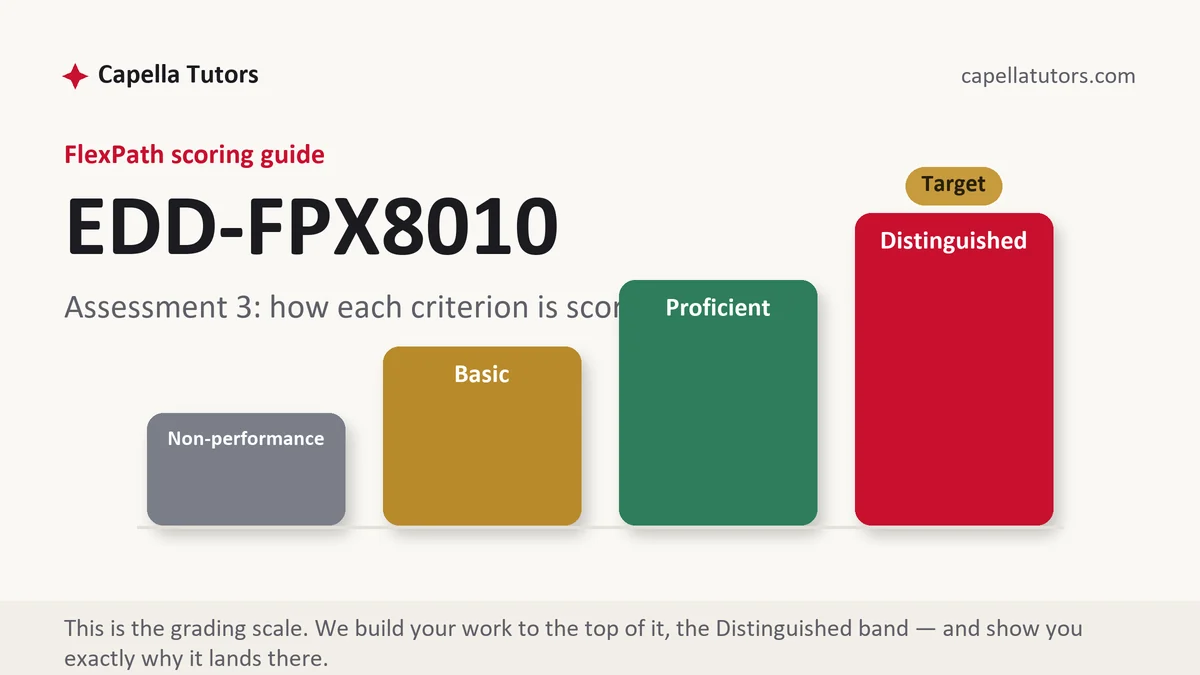
How EDD FPX 8010 Assessment 3 is scored
Four levels per criterion, no letter grades, and the descriptors do the teaching. What separates the top two columns on a synthesis is almost never effort:
| Level | What it means on a synthesis and forward-plan deliverable |
|---|---|
| Distinguished | A position taken on the evidence, the strongest competing reading answered, the cost of being wrong named, and a next step tied to the required sequence rather than to enthusiasm. The extra move is usually the sentence about what you would accept as disconfirmation. |
| Proficient | The evidence is integrated and the position is clear and supported. Sound, and a level below work that has argued with itself in public. |
| Basic | A competent recital of what the course covered, with the decision left implicit. Reads as coursework completed rather than judgment exercised. |
| Non-performance | A required element is simply not there, most often the forward plan, or any statement of what the position costs if it turns out to be wrong. |
This is also where committees start reading you as a future candidate rather than a student, so the plan matters. A route expressed as courses and milestones is checkable; a route expressed as a date is a wish, and the criteria can tell the difference.
The EDD FPX 8010 Assessment 3 method, step by step
-
Decide what the document argues before deciding what it contains
Write the position in one sentence at the top of a blank page and leave it visible. Every section either advances that sentence or defends it. A synthesis assembled by topic rather than by argument reads as a folder, and folders sit mid-guide.
-
Put the decision in front of the reader with its numbers attached
A district weighing a four-week summer academy is deciding about money, staffing and a named group of children. Say how many students it reaches, out of how many eligible, at what cost each, against what the same money currently buys. A decision with no arithmetic cannot be argued with.
-
Line the evidence up against the decision, not the topic
Reorganize your reading so each cluster answers one question the decision turns on: does this move the outcome, for whom, under what conditions, at what intensity. Studies stop being list entries once they answer questions somebody is about to act on.
-
Answer the reading that would defeat you
Find the most credible case against your position, state it in its strongest form, and meet it with evidence rather than tone. Then name what being wrong would cost in the currency your organization spends: staff time, forgone alternatives, a cohort of children who got something weaker.
-
Write the forward plan against the sequence, not the calendar
The route from this course to a culminating study runs through required coursework and a committee, so describe it that way. Name the next courses, what each should produce for this problem, and the artifact you intend to carry forward.
-
Read for the communication criterion last, on paper
Doctoral guides score writing separately from thinking, and the losses are ordinary: a claim outrunning its citation, a paragraph carrying two ideas, a heading that does not match the criterion under it. Read a printed copy backwards and mark every sentence you could not defend if asked why.
A structure that maps to the criteria
The planning split our tutors use when a synthesis runs to the usual scope; move weight to wherever your guide has put it.
| Section | What it must do | Guide |
|---|---|---|
| The decision and its stakes | What the organization is about to choose, who it affects, and the money or time riding on it. | ~200 words |
| Position stated | One sentence of claim, then the shape of the defense, so later sections arrive expected. | ~125 words |
| Evidence, organized by question | Clusters answering whether it works, for whom, under what conditions, at what intensity. | ~375 words |
| The competing reading, answered | The strongest case against your position, met with evidence, plus the cost of being wrong. | ~275 words |
| What remains unsettled | The questions this evidence leaves open and the local data that would close them. | ~175 words |
| Forward plan and references | Next courses, what each should produce, the artifact carried forward, seventh edition APA. | ~200 words |
Annotated sample excerpt
A model closing passage from our team at the register the top column describes. Take the structure, not the sentences.
On the evidence available, I argue that this district should fund a four-week summer academy for the 310 rising fourth and fifth graders reading below benchmark, at four hours a day with certificated teachers rather than two hours with aides.1 The strongest case against me is that summer programs here have historically enrolled about half the children invited, which would put the real cost per attending student near twice the figure in the budget memo.2 If I am wrong, the district will have spent a summer of staffing to reach fewer than 160 children when the same money would have extended intervention blocks for all 310 during the school year, and the board should see that comparison beside mine.3
- 1States the position with the parameters that make it a decision rather than a preference: who, how many, how long, staffed by whom.
- 2Gives the opposing case its best numbers instead of a weakened version, which is what the criterion on competing perspectives looks for.
- 3Names the cost of being wrong in the currency the organization spends, and hands the reader the comparison that would defeat the recommendation.
The full premium sample for your exact assessment, written fresh to your scoring guide and issue, is free to request. Study it, revise it into your own voice, and submit work you understand.
The five mistakes that cost Distinguished
- A synthesis organized by topic. Sections named after themes rather than after the questions the decision turns on read as a folder of notes.
- The opposing case built to lose. A weak version of the objection is worse than none, since it shows you found the pressure and stepped around it.
- A recommendation with no parameters. Support summer learning is a sentiment; four hours daily for 310 students with certificated staff is a proposal.
- A forward plan made of dates. Finishing by spring is not a plan, and the criterion about the route to a culminating study has nothing to score.
- Silence about what you would accept as disconfirmation. A position that cannot be wrong has not been argued, and the top column is written for authors who know it.
Pre-submission checklist
- The position stated in one sentence, with parameters a reader could cost out
- The decision quantified against what the same resources currently buy
- Evidence grouped by the questions the decision turns on, not by theme
- The strongest competing reading answered in its own best form
- The cost of being wrong stated in money, staff time or forgone alternatives
- A forward plan built from required coursework and a named artifact, seventh edition APA
Synthesis standing between you and the next course?
Send the prompt, the criteria, and the decision your organization is weighing. A premium original sample comes back in 24 to 48 hours with the position argued, the opposing case answered at full strength, and the forward plan written against the sequence.