This manual is for EDD FPX 8010 Assessment 2, start to submission. Assessment 2 of EDD FPX 8010 moves from stance to evidence. The assessment usually asks you to locate scholarship on a question that matters where you work, judge what each study is entitled to claim, and use it in prose that does not let the source's architecture survive intact. Below: the working order our tutors use, the shape the criteria reward, and a marked-up appraisal paragraph. Rather hand it over? One premium original sample reaches you in 24 to 48 hours, with free revision until every row of the guide is answered. Capella's catalog lists the course as EDD-FPX8010, and some courserooms print EDD8010; both point to this same Assessment 2.
One honesty note before the manual: Capella revises courses and scoring guides over time, so always write to the exact scoring guide attached to your assessment in the courseroom. The course identity above is verified on capella.edu; the method and structure below are our tutors' approach to it, not Capella's official rubric text.
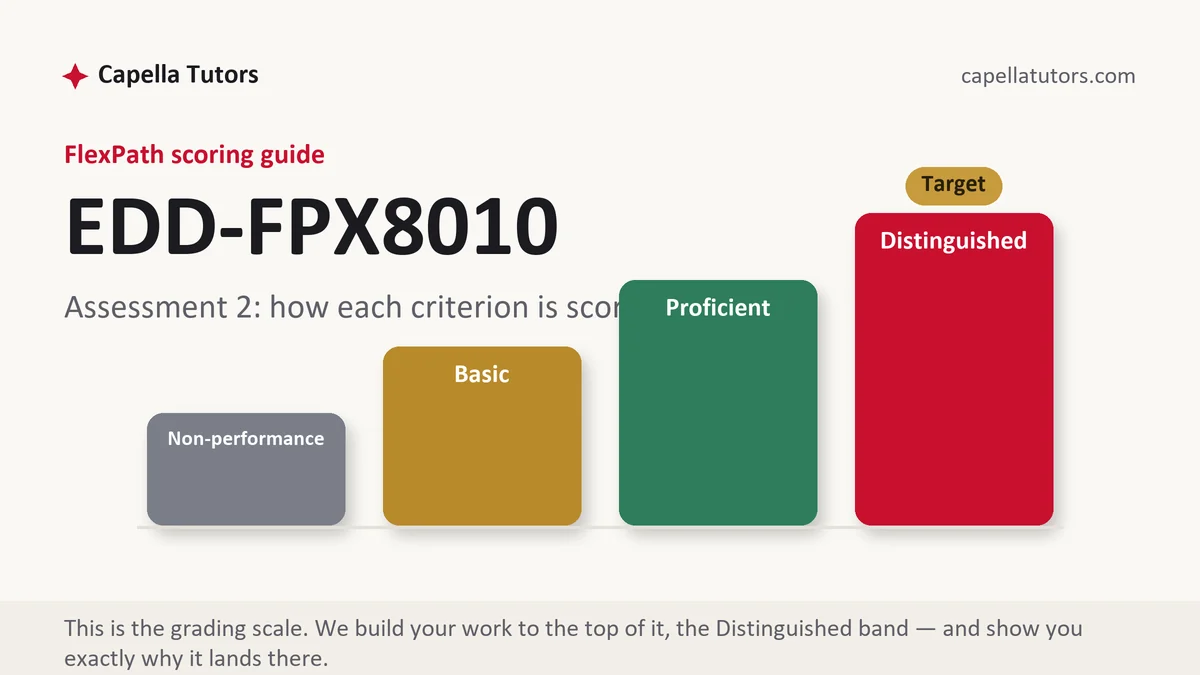
How EDD FPX 8010 Assessment 2 is scored
Nothing here is graded on a curve. Each criterion sits at one of four levels, and reading those levels as instructions is the whole technique:
| Level | What it means on an evidence appraisal deliverable |
|---|---|
| Distinguished | Every study is judged on its design, its sample and its measure, the body of work is characterized as agreements and open disputes, and the author names the claims this evidence cannot carry. That last sentence is usually what the top column pays for. |
| Proficient | Sources are located, reported accurately and applied to the question. Nothing wrong with it, and nothing above it either. |
| Basic | Study-by-study reporting, each paragraph opening with a surname, with the judging left for the reader. The commonest submitted shape in the doctoral core. |
| Non-performance | A required element is missing outright, most often any evaluation of source quality, or attribution complete enough to reach the original. |
Research integrity is scored here more broadly than anywhere earlier in your transcript. Patchwriting, where sentences are reordered and synonyms swapped while the original structure survives, draws the same attention as copying, and citing an abstract as though the study had been read end to end is a claim you cannot support.
The EDD FPX 8010 Assessment 2 method, step by step
-
Search the descriptors an indexer assigned, not the words your district uses
ERIC and Education Source through the Capella library are the primary route in education, and the ERIC thesaurus lets you search controlled vocabulary rather than local phrasing. Grow your own returns a different set from teacher residency. Record the databases, terms and limits you applied, because the criterion on locating evidence wants the route as well as the result.
-
Read each article in the order that makes it usable
Design first, because it caps every conclusion the article can offer. Sample second, its size and who was excluded, since that governs whether anything transfers to your organization. Measure third, because retention counted as returning for a second year and retention counted as staying five years are not the same variable. Limitations last, since they record what the authors declined to claim.
-
Give every source a job before you write about it
One or two establish scale beyond your building, two or more carry the position you intend to take, and at least one is chosen because it cuts against you. Anything with no job is padding, and a list where a third of the entries appear once in a throwaway sentence reads worse than a shorter one that pulls.
-
Rebuild the paraphrase from notes, never from the sentence
Close the article, write what it found in your own architecture, then reopen it only to check facts and numbers. Paraphrase produced by editing the original sentence keeps the original skeleton, and that is the failure faculty at this level are trained to see.
-
Write the body of work as a disagreement, then take a side
A summary paragraph reports three studies in three sentences. An appraisal paragraph opens with the state of the evidence and uses those studies to support a position you have taken about them. Say what the field agrees on, where precisely it splits, and which side your setting gives you reason to expect.
-
Audit attribution both ways before you submit
Every framework traced to the publication that introduced it, every citation present in the reference list, every reference present in the text, every number checked against its source. Then reread the guide and award yourself a level per criterion.
A structure that maps to the criteria
Our planning defaults for an appraisal of ordinary scope rather than requirements; your criteria decide where the weight belongs.
| Section | What it must do | Guide |
|---|---|---|
| Question and setting | The decision your organization faces, stated precisely enough to show which evidence bears on it. | ~150 words |
| Search and selection | Databases, descriptors, limits, and the reason each study was kept or set aside. | ~200 words |
| Appraisal of each source | Design, sample and measure for every study retained, with the claim each one can support. | ~375 words |
| The body of evidence | Where the studies agree, where they conflict, and what explains the conflict. | ~300 words |
| What this evidence cannot settle | The questions your sources leave open, and what would have to be collected locally. | ~225 words |
| Application and references | What the appraisal changes about the decision in front of you, seventh edition APA throughout. | ~200 words |
Annotated sample excerpt
An original appraisal paragraph from our team, at the level the top descriptor asks for.
Across the evaluations of paraprofessional-to-teacher routes I was able to locate, the finding that repeats is that candidates recruited from the community they will teach in remain longer than traditionally prepared peers, while the claim that they arrive equally prepared appears in program descriptions rather than in studies carrying a comparison group.1 Those reporting no retention advantage tend to describe programs that added coursework to a full-time aide schedule without releasing any of it, which makes the disagreement one about design rather than about candidates.2 None of the studies I retained followed a rural cohort of fewer than forty, so this evidence tells a district of nine schools what to expect from a route and little about what to expect from ours.3
- 1Opens on the state of the evidence rather than on an author, and separates what studies established from what program literature merely asserted.
- 2Explains the conflict instead of reporting it, the move that turns a review into an appraisal a committee can use.
- 3Names the limit of the whole body of work against the writer's own setting, before an evaluator has to.
The full premium sample for your exact assessment, written fresh to your scoring guide and issue, is free to request. Study it, revise it into your own voice, and submit work you understand.
The five mistakes that cost Distinguished
- Summary wearing the label of synthesis. Three consecutive sentences each opening with a different surname have organized your reading, not your judgment.
- An abstract cited as a study. The abstract carries the finding and none of the design, so anything you say about quality is unsupported.
- Reworded sentences offered as paraphrase. If the original structure is still visible underneath yours, the integrity criterion is the one at risk.
- A reference list built for its length. Sources that appear once and do no work are visible in a minute, and they weaken the ones that were working.
- Program materials treated as evidence. A brochure reporting its own success is a claim, and citing it as a finding costs the criterion on source quality.
Pre-submission checklist
- Databases, descriptors and limits recorded where a reader can see them
- Design, sample and measure stated for every study retained
- At least one source chosen because it argues against your position
- Each paraphrase written from notes with the article closed
- The disagreement in the literature explained rather than reported
- One paragraph stating what this evidence cannot settle for your setting
Appraisal deliverable due this week?
Send the prompt, the criteria, and the decision your district is weighing. We run the searches, judge each study on design, sample and measure, and return a premium original sample in 24 to 48 hours, with one reader assigned to citations alone.