This manual is for EDD FPX 8010 Assessment 1, start to submission. Assessment 1 of EDD FPX 8010, Foundations of Doctoral Studies in Education, is where you stop writing as an experienced educator with strong opinions and start writing as someone who owes a committee a defended claim. The assessment usually asks you to locate yourself inside a practice doctorate, name the problem in your own organization that sent you here, and argue for it rather than describe it. What follows is the sequence our tutors work through, a structure that mirrors the criteria, and a sample opening with its moves marked. Prefer to hand it off? One premium original sample, written to your own guide, lands within 24 to 48 hours and keeps being revised until the criteria are satisfied. Capella's catalog lists the course as EDD-FPX8010, and some courserooms print EDD8010; both point to this same Assessment 1.
One honesty note before the manual: Capella revises courses and scoring guides over time, so always write to the exact scoring guide attached to your assessment in the courseroom. The course identity above is verified on capella.edu; the method and structure below are our tutors' approach to it, not Capella's official rubric text.
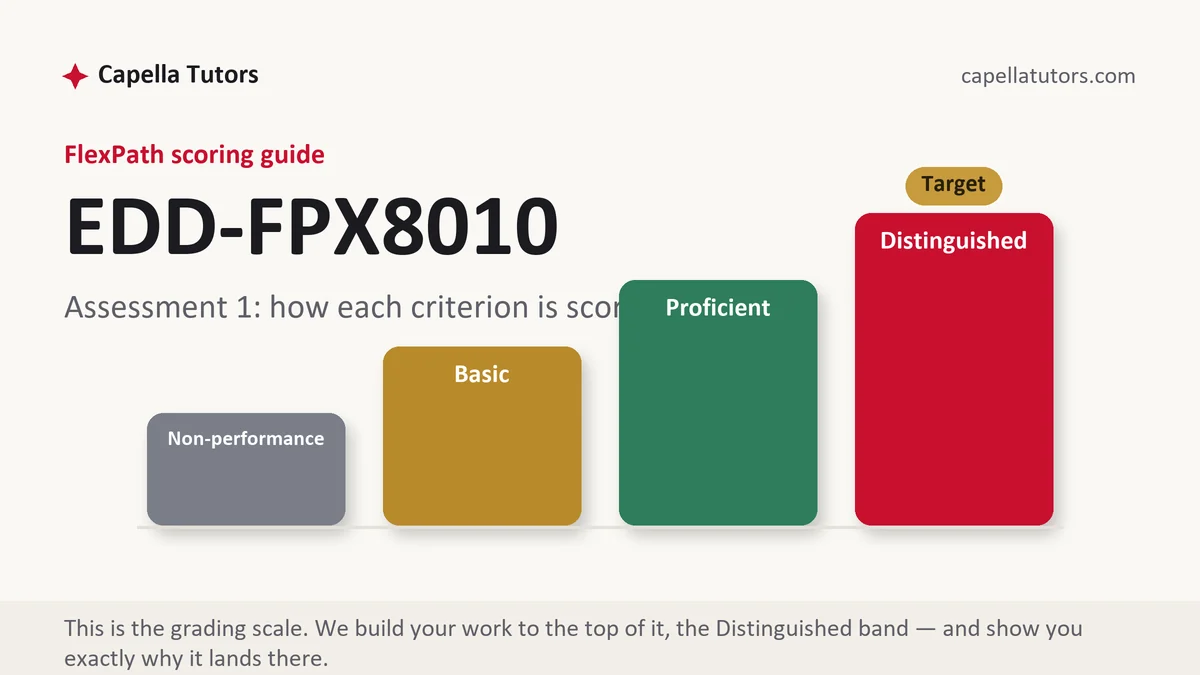
How EDD FPX 8010 Assessment 1 is scored
FlexPath awards no letter grades. Every criterion on your scoring guide lands on one of four levels, and the wording of those levels is the brief you write to:
| Level | What it means on a doctoral positioning deliverable |
|---|---|
| Distinguished | The stance is argued from evidence a reader can check, the line between improving a practice and contributing to a theory is drawn openly, and the author states what the evidence does not yet license. The top column asks one move past completeness; find it in the wording. |
| Proficient | The stance is stated and supported throughout. Complete work, one move short of the level above. |
| Basic | A capable account of a career and an interest, with the doctoral claim implied rather than defended. Most first attempts in the doctoral core land here. |
| Non-performance | Something required is absent rather than thin, most often the practice problem as a countable gap in a named setting. |
Habits formed in the opening course get graded for years afterward, so writing straight at the criterion pays well beyond two program points. Faculty have up to two business days per attempt, which makes an honest early submission cheaper than a late polished one.
The EDD FPX 8010 Assessment 1 method, step by step
-
Build the document out of the guide, not the prompt
Each criterion becomes a heading, its top descriptor pasted underneath while you draft, and any paragraph that cannot be assigned to a heading gets cut. Doctoral guides usually score scholarly communication on its own row, so a sound point made casually still drops a level.
-
State your role and your authority in the first paragraph
A reader needs to know whether the people in your account report to you, because that changes how every later claim is weighed. Give the title, the size of the unit, and the decisions you can genuinely influence. Authority withheld reads as evasion.
-
Convert the meeting sentence into a countable gap
Take what you would say in a cabinet meeting and attach arithmetic to it. We promote from within is a habit rather than a claim. Twelve of the nineteen principals appointed since 2020 were assistant principals in the same buildings the year before is a fact a committee can argue with, and only arguable facts earn anything.
-
Attach all five parts to one claim
Stephen Toulmin's account in The Uses of Argument, published in 1958, names what weak doctoral paragraphs are missing: a claim, its grounds, the warrant licensing the move between them, a qualifier sized to the evidence, and the condition under which the claim would fail. Most drafts hold grounds and a claim with nothing in between, and that absence is what a middle descriptor describes.
-
Separate contribution to practice from contribution to theory
Say what improving this changes for identifiable people in identifiable buildings, then what it would not settle for the field. Shulman, Golde, Bueschel and Garabedian warned in Educational Researcher in 2006 that education had let its research and practice doctorates blur together, and a criterion here is written to catch the blur.
-
Award yourself a level on every criterion, then submit early in the week
Read the draft one criterion at a time, write down the level you would give it, and repair everything short of the top column while it is still yours to repair. An attempt sent on a Thursday can sit through the weekend, so a Monday submission buys an extra cycle inside the session.
A structure that maps to the criteria
Planning targets for a doctoral positioning paper of ordinary length, not Capella rules; stretch whichever section your guide weights more heavily.
| Section | What it must do | Guide |
|---|---|---|
| Opening and position | Name the setting, the authority you hold in it, and the claim this document defends, in that order. | ~175 words |
| The practice problem, counted | The gap with its numerator, denominator and window, beside a prior period and a comparison unit. | ~275 words |
| The claim, warranted | Grounds first, then the warrant from the literature, then a qualifier no larger than the evidence permits. | ~350 words |
| Practice against theory | What improving this changes for people in the building, and what it leaves unresolved for the field. | ~225 words |
| The objection, answered | The reading that would defeat you, put fairly, met with evidence, with the residue named by you. | ~225 words |
| Route forward and references | The next step tied to the required sequence rather than a hopeful date, seventh edition APA throughout. | ~150 words |
Annotated sample excerpt
One original opening from our team, at the register the top column describes. Read it for the moves.
Twelve of the nineteen principals this district has appointed since 2020 were assistant principals in the same buildings the year before, and not one entered the role through a preparation route the district designed.1 I direct leadership development for those nineteen schools, which makes the gap described here one I have been paid to close and have not.2 This paper argues that the district runs a promotion habit rather than a principal pipeline, and that the difference shows in what a first-year principal can do rather than in how long the appointment lasts.3
- 1Opens on a count with its denominator and window, so the problem arrives as evidence instead of an impression. No paragraph on why leadership matters.
- 2Discloses the role and the stake in one sentence. A committee guessing at your authority reads everything after it more suspiciously.
- 3Commits to one disputable claim and names the observable that would test it, so a reader knows what the document owes them.
The full premium sample for your exact assessment, written fresh to your scoring guide and issue, is free to request. Study it, revise it into your own voice, and submit work you understand.
The five mistakes that cost Distinguished
- Preference dressed in doctoral vocabulary. A long word wrapped around an unsupported opinion scores under a plain sentence with a citation behind it.
- A career narrative where a claim belonged. Twenty years of service is context, and there is nowhere on the guide to award context.
- The gap asserted without arithmetic. Calling a pipeline weak, with no count and no period, leaves everything above it standing on air.
- A framework traced no further than last year's article. Citing a 2022 article for an idea published in 1958 says you met the idea secondhand.
- An EdD written as though it were a PhD. Proposing to test a theory instead of improving a practice misreads the degree, and this criterion exists to catch that.
Pre-submission checklist
- Every criterion in your guide has its own labeled section
- The claim reads as one sentence a committee could dispute
- The practice problem carries a count, a denominator and a period
- Your role, your authority and your stake in the answer all stated
- Each framework cited to the publication that introduced it
- Citations reconciled against the reference list both ways, seventh edition APA
First doctoral submission in the queue?
Send the prompt, the scoring guide, and the problem that pushed you into a doctorate. Eight readers, one checking every framework against the publication that introduced it, return a premium original sample written to the top descriptor in 24 to 48 hours, revised free until it gets there.