This manual is for DB FPX 8850 Assessment 2, start to submission. The middle deliverable of a literature review seminar usually asks for synthesis: themes built across the fields you searched, each one carrying the weight of the evidence behind it and none of them a tour of a single literature. The course runs in FlexPath for 3 program points as a seminar in the General Management specialization inside the 45-point Doctor of Business Administration, so the criteria expect claims rather than coverage. What follows is the approach our doctoral tutors take to synthesis, a structure assembled from the criteria, and an annotated sample excerpt. Would you rather hand it off? A premium original doctoral sample for this exact assessment returns in 24 to 48 hours, revised at no cost until the criteria are met. Capella's catalog lists the course as DB-FPX8850, and some courserooms print DB8850; both point to this same Assessment 2.
One honesty note before the manual: Capella revises courses and scoring guides over time, so always write to the exact scoring guide attached to your assessment in the courseroom. The course identity above is verified on capella.edu; the method and structure below are our tutors' approach to it, not Capella's official rubric text.
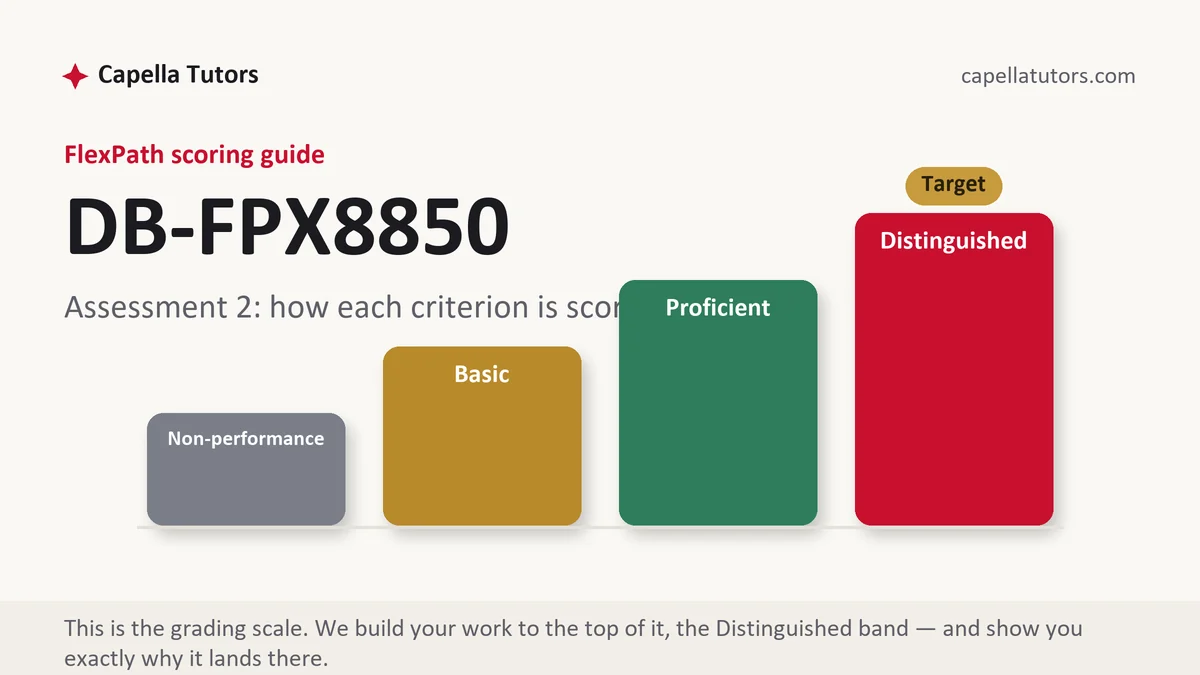
How DB FPX 8850 Assessment 2 is scored
FlexPath scores criteria rather than papers, and each criterion rests at one of four levels. The level language is the only brief that counts:
| Level | What it means on a thematic synthesis |
|---|---|
| Distinguished | Themes are organized by the problem's logic, built from more than one field wherever they claim to be integrative, counted for the independent evidence behind them, and disagreements between fields are reconciled rather than reported. There is one more move in the wording; make it. |
| Proficient | Themes are supported and clearly written, with the evidence summarized field by field inside each one. |
| Basic | A section per literature, a paragraph of connection at the end, and themes that are really topic headings. |
| Non-performance | A required element is missing, most often any account of how strongly each theme is evidenced. |
Two habits carry most of the marks at this stage. The first is counting: write the number of independent studies behind every claim in the margin and let the count decide which themes survive. The second is deciding, because a synthesis concluding that both fields matter and more research is needed is a synthesis whose author has taken no position, and the top column describes an author who has.
The DB FPX 8850 Assessment 2 method, step by step
-
Let the problem, not the fields, set the section order
Write the chain of questions your problem raises and make those the headings. One field may appear in four of them and another in one. If your section order can be predicted only from the reference list, you have written parallel reviews, and integration is what the criteria are grading.
-
Budget depth in pages before you write any of them
Decide what each field is for, allocate space accordingly, and write the allocation into the method with the reasoning attached. Equal coverage of three literatures is the outcome to avoid, since it guarantees shallowness in all of them and a specialist reader will find it in their own.
-
Draft the claims first, then the paragraphs under them
Write each theme as a sentence that asserts something, then assemble the evidence beneath it. Claims written first cannot be satisfied out of one field, so the structure opens itself, while paragraphs written first tend to end in a heading that summarizes whatever you happened to read that week.
-
Count the independent studies behind every claim
Put the number beside each theme in your own draft. Themes resting on two studies get merged into a stronger neighbor or cut with a sentence saying the area is underexamined, which is a finding rather than a loss. Run the count by field as well, because a claim supported entirely from one literature is a claim about that literature.
-
Reconcile the places where the fields appear to disagree
Two literatures measuring the same phenomenon differently often look contradictory until you notice that one reports a rate and the other a count, or one observes individuals and the other units. Explaining the apparent conflict costs a paragraph and is one of the few genuinely new things a review can produce.
-
Self-score, then read only your topic sentences
Mark each criterion yourself and rewrite anything under the top level. Then read your theme sentences in order with nothing else around them and check that they argue rather than announce. If the sequence reads like a table of contents, the synthesis is still coverage wearing better headings.
A structure that maps to the criteria
These lengths are the planning targets our doctoral tutors use for a synthesis submission, not Capella requirements; expand whichever section your criteria weight most.
| Section | What it must do | Guide |
|---|---|---|
| Organizing logic | The chain of questions taken from the problem, used as the section order, with each field's role restated. | ~250 words |
| Depth allocation | How much space each literature receives and why, written as a decision with its reasoning attached. | ~200 words |
| Themes, claim first | Each theme as an assertion, evidenced across fields, with the independent study count stated. | ~500 words |
| Reconciliations | Where the fields appear to disagree, and what explains the appearance rather than the conflict. | ~250 words |
| Thin ground, named | Themes merged or cut, and the areas the combined evidence cannot support yet. | ~200 words |
| References | Current APA both ways, with each field cited to its own leading outlets. | as needed |
Annotated sample excerpt
An original model paragraph from our doctoral team, written the way a reviewer wants a theme delivered. Read the moves, then build a theme of your own the same way.
Dedicated capacity buys predictability at a price the contract cannot fully recover, and the evidence for that claim now runs across two literatures rather than one.1 Operations research on warehouse configuration reports service level gains from dedicated space that are real but concentrated in demand profiles with high variability and low correlation to the rest of the book, which describes roughly a third of anchor accounts in third party logistics portfolios; eleven independent studies support the effect and four of them find it absent where demand is smooth.2 Management accounting research on contract profitability adds the part the operations work does not measure, that a fixed capacity charge is renegotiated at renewal from a weakened bargaining position, an effect documented in six studies of long-term service agreements and never, so far as this search reached, tested in a logistics setting.3
- 1The theme opens as a claim rather than a label, so every sentence beneath it has work to do. A heading reading dedicated versus shared capacity announces a topic and commits the writer to nothing.
- 2Evidence counted out loud, including the studies that do not find the effect. Naming the boundary condition is stronger than asserting the finding, and a reviewer trusts a count they can check.
- 3The second field supplies a mechanism the first cannot see, and the sentence says where the combined claim runs out of evidence. That last clause is the gap the review is being written to find.
The full premium sample for your exact assessment, written fresh to your scoring guide and issue, is free to request. Study it, revise it into your own voice, and submit work you understand.
The five mistakes that cost Distinguished
- Themes that are headings. A label announces a subject; a claim commits you to evidence and gives the criteria something to score.
- Equal space for every literature. Uniform depth is a decision not to decide, and it reads as thin to anybody who works inside one of the fields.
- Single-field themes presented as integrative. Say which literature a claim comes from when it comes from only one, and the honesty costs you nothing at all.
- Apparent contradictions left standing as contradictions. Different units of measurement explain most of them, and explaining one is a contribution in itself.
- A conclusion that both fields matter. That sentence is where a synthesis goes when its author has not decided what the evidence shows.
Pre-submission checklist
- Section order follows the problem's questions rather than the fields
- The depth allocation is stated with its reasoning in the method
- Every theme opens as a claim and carries an independent study count
- Single-field claims are labeled as such rather than presented as integrative
- At least one apparent disagreement between fields is reconciled explicitly
- Self-scored at the top level on every criterion, submitted early in the week
Synthesis due and the themes still thin?
Send the criteria and your matrix in whatever state it is in. A doctoral-register synthesis returns in 24 to 48 hours with themes written claim first, evidence counted per theme and per field, and the thin ground named instead of padded, revised free until the criteria clear.