This manual is for DB FPX 8850 Assessment 1, start to submission. The opening deliverable of a literature review seminar usually asks for the machinery rather than the prose: a review question, the fields you will search, the strings and limiters used in each of them, and an appraisal record that can be sorted. DB FPX 8850 carries 3 program points as a seminar in the General Management specialization, delivered in FlexPath inside the 45-point Doctor of Business Administration, and because a general management question draws on literatures that developed apart, the search is run several times rather than once. Below is the method our doctoral tutors use at this stage, a structure that maps to the criteria, and an annotated sample excerpt. Prefer to hand it over? A premium original doctoral sample for this exact assessment returns in 24 to 48 hours, revised at no cost until the guide is met. Capella's catalog lists the course as DB-FPX8850, and some courserooms print DB8850; both point to this same Assessment 1.
One honesty note before the manual: Capella revises courses and scoring guides over time, so always write to the exact scoring guide attached to your assessment in the courseroom. The course identity above is verified on capella.edu; the method and structure below are our tutors' approach to it, not Capella's official rubric text.
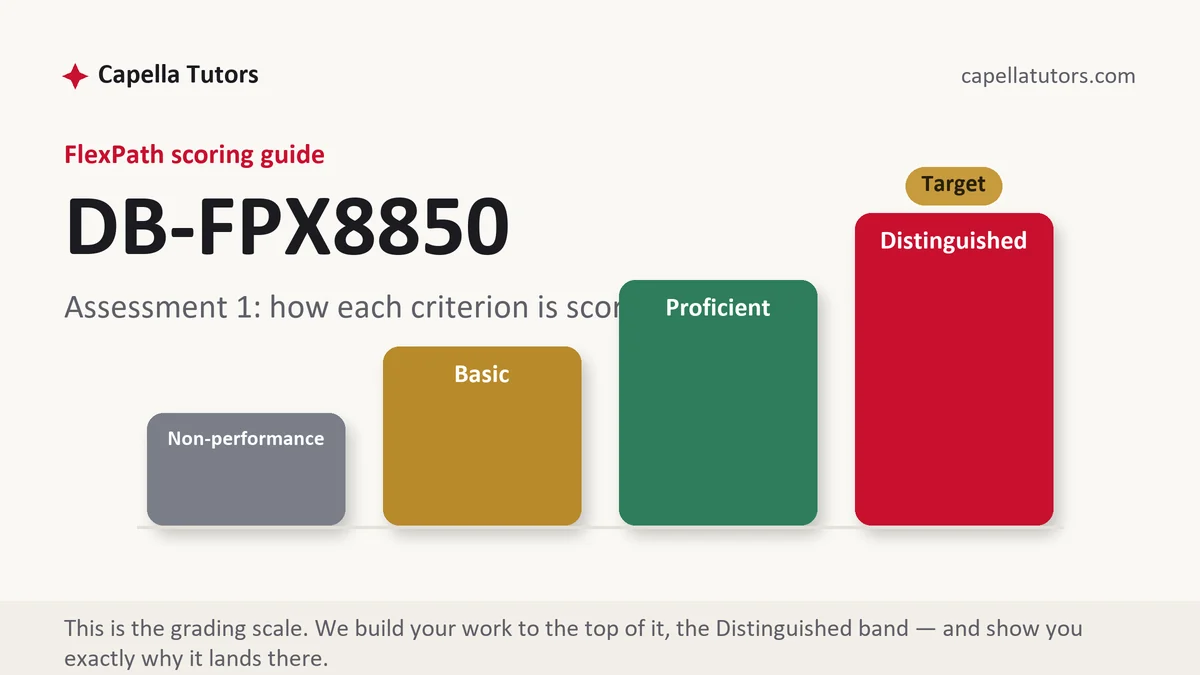
How DB FPX 8850 Assessment 1 is scored
Four levels sit against each criterion on a FlexPath guide, and there is nothing above them. Read the levels as instructions rather than as descriptions:
| Level | What it means on a search and appraisal deliverable |
|---|---|
| Distinguished | The review question is answerable, each field is searched and documented on its own, inclusion decisions could be repeated by somebody else, and the appraisal record can be sorted by field and by design. The top level asks for one move beyond complete, and the wording says which. |
| Proficient | The search is documented and the studies are appraised. A reader could believe it without being able to reproduce it. |
| Basic | A list of sources with a paragraph about how they were found, in which the databases appear and the strings do not. |
| Non-performance | A required element is missing, most often the per-field search record or any appraisal of study quality. |
Everything built here is infrastructure for the stage after it, so build it to be sorted rather than to be read. A matrix that cannot be filtered by field cannot answer the question the synthesis will put to it, which is whether the coverage of any single literature is thin enough to weaken a claim resting on it.
The DB FPX 8850 Assessment 1 method, step by step
-
Write a review question the search can actually serve
A review question names a phenomenon, a context and a relationship. Broad interest is fine as motivation and useless as a search brief, because a string built from a broad question returns thousands of records and produces no decisions. Write the question, then underline the terms a database will have to match, with synonyms and controlled vocabulary beside each one.
-
Decide which fields you are searching, and why
Name each literature and the specific question it is being brought in to answer, before you search anything at all. Fields chosen afterward tend to be the fields whose journals you already read, and a reviewer who works inside an unsearched literature will notice its absence within a page.
-
Run and record one search per field
Databases, exact strings, Boolean operators, limiters, dates run, and counts at each stage, kept separately for every field. Parallel searches merged into a single paragraph cannot be judged, and a reviewer who cannot judge the coverage of a field will ask you to run it again in front of them.
-
Write the inclusion rules before you start excluding
State what makes a study eligible in terms a second person could apply: design, setting, population, measure, publication window. Then apply them and count what falls out at each stage. Rules written after screening always describe the corpus you happened to keep rather than a standard you held.
-
Build the matrix with a field column in it
One row per study, carrying design, setting, sample, measure, finding, appraisal note and source literature. The field column is what lets the matrix answer questions later, and adding it once two hundred rows exist is an afternoon you will resent spending.
-
Self-score, then test the record by repeating one search
Mark each criterion yourself and rewrite anything below the top level. Then take your own documentation for one field, run that search again from it alone, and see whether you land on the same count. If you cannot reproduce your own search, the criterion that pays for reproducibility will not reward it either.
A structure that maps to the criteria
The lengths below are planning targets our doctoral tutors use for a search and appraisal submission, not Capella rules; expand wherever your criteria put the weight.
| Section | What it must do | Guide |
|---|---|---|
| Review question and terms | The question, and the searchable terms inside it, with synonyms and controlled vocabulary listed. | ~200 words |
| Fields and their jobs | Each literature named, with the question it is being brought into this review to answer. | ~250 words |
| Search record | Databases, strings, operators, limiters, dates and counts, recorded separately for each field. | ~350 words |
| Inclusion and exclusion | Eligibility rules a second reader could apply, plus the numbers removed at each screening stage. | ~250 words |
| Appraisal approach | How study quality was judged in each field, using the standards that field applies to itself. | ~300 words |
| Matrix extract and references | A sample of rows showing the columns kept, then current APA matched both ways. | as needed |
Annotated sample excerpt
An original model passage from our doctoral team, written at the standard the top level of a guide sets. Learn the moves here, then run them across your own fields.
The review question asks how integration decisions taken in the first year after a clinic group acquisition affect referral retention inside the acquiring system, which commits the review to three literatures answering different parts of it.1 Post-acquisition integration research in strategy supplies what is known about the pace and depth of integration and its effect on an acquired unit's productivity, and it carries the argument, so it was searched in Business Source Complete and Web of Science with strings combining acquisition, integration speed and autonomy across 2005 to 2026.2 Health services management research supplies the referral behavior evidence and was searched in PubMed and CINAHL with strings combining referral patterns, physician alignment and network leakage, limited to 2015 onward because the payment arrangements shaping referral choice changed materially over that period, while the professional autonomy literature was searched narrowly, in one database, for the single mechanism it contributes.3
- 1The question names the phenomenon, the window and the outcome, and the fields follow from it. Fields chosen before the question is settled produce a reading list rather than a search design.
- 2Each field arrives with a job and its own recorded search. Naming the literature that carries the argument here is what makes an uneven depth budget defensible when the synthesis is written.
- 3A date limit applied in one field and not another, with the reason attached. Unexplained inconsistency between searches reads as carelessness; the same inconsistency with a reason reads as knowledge of the field.
The full premium sample for your exact assessment, written fresh to your scoring guide and issue, is free to request. Study it, revise it into your own voice, and submit work you understand.
The five mistakes that cost Distinguished
- One search covering every field. A single string built to satisfy three literatures satisfies none of them, and the record cannot be judged field by field.
- Databases named without strings. Naming a database says where you looked; only the string says what you asked, and it is reproducibility the criterion is paying for.
- Inclusion rules reverse engineered from the corpus. Written afterward they describe your reading habits rather than an eligibility standard anyone else could apply.
- A matrix with no field column. Without it the synthesis cannot tell whether a theme rests on one literature or three, which is the whole question at this level.
- Your own field appraised strictly and the others loosely. Judge each body of work by the standards its own reviewers use, or the appraisal column measures your training instead of the evidence.
Pre-submission checklist
- The review question names a phenomenon, a context and a relationship
- Each field has a stated job and its own recorded search
- Strings, operators, limiters and dates are written down for every database
- Eligibility rules were fixed before screening, with counts removed at each stage
- The matrix carries a source-literature column beside design and finding
- One search reproduced from your own documentation before submission
Search record due and three literatures to cover?
Send the criteria and your review question, however rough it still is. A doctoral-register draft returns in 24 to 48 hours with a search designed and recorded per field, eligibility rules written so somebody else could apply them, and a matrix built to be sorted, revised free until every criterion clears.