This manual is for DB FPX 8850 Assessment 3, start to submission. The final deliverable of a literature review seminar usually asks for the whole review as one document: the question, the method behind the corpus, the synthesis, and a gap sitting at the intersection of the fields rather than inside any one of them. DB FPX 8850 is a 3-point seminar in the General Management specialization, taught in FlexPath inside the 45-point Doctor of Business Administration, and this chapter is what the design work after it gets built on. Below is the method our doctoral tutors use to assemble it, a structure that maps to the criteria, and an annotated sample excerpt. Rather hand it over? A premium original doctoral sample for this exact assessment comes back in 24 to 48 hours, revised at no charge until every criterion clears. Capella's catalog lists the course as DB-FPX8850, and some courserooms print DB8850; both point to this same Assessment 3.
One honesty note before the manual: Capella revises courses and scoring guides over time, so always write to the exact scoring guide attached to your assessment in the courseroom. The course identity above is verified on capella.edu; the method and structure below are our tutors' approach to it, not Capella's official rubric text.
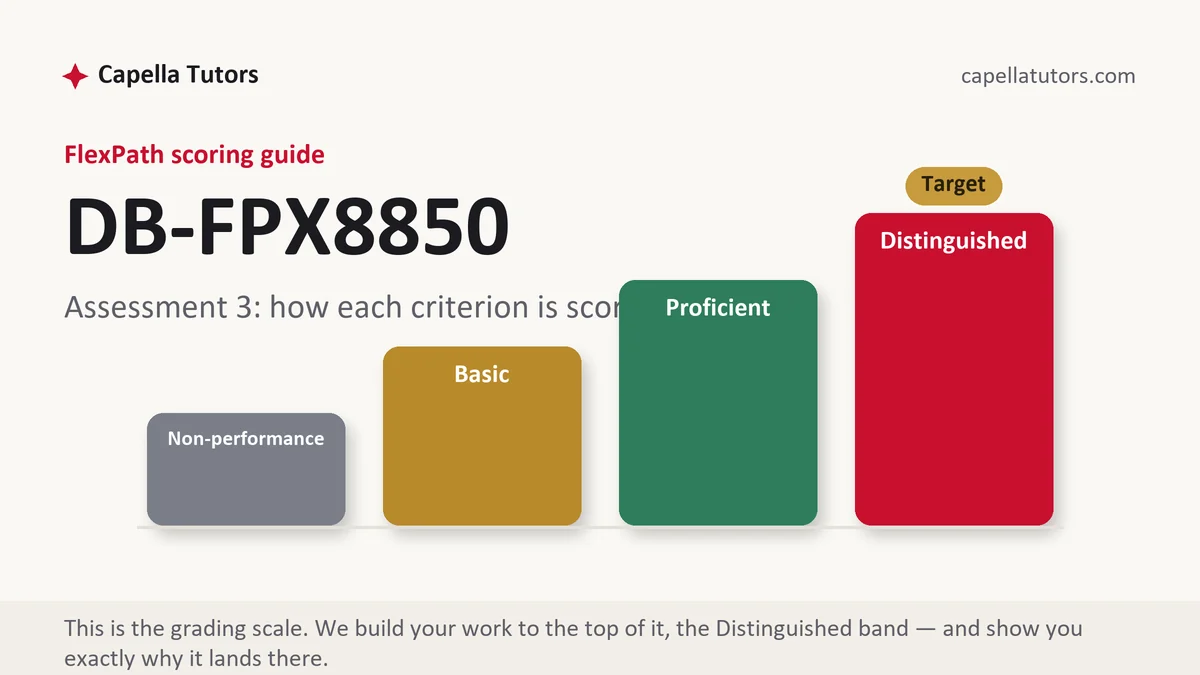
How DB FPX 8850 Assessment 3 is scored
There are four levels on the guide and nothing else on it. The top one is the specification, and the other three describe the ways submissions fall short of it:
| Level | What it means on a complete integrative review |
|---|---|
| Distinguished | The chapter reads as one argument, the method accounts for the corpus it produced, the gap could only have been seen by combining the fields, and the design that follows is implied clearly enough for a reader to name it. One further move is written into each criterion; find it. |
| Proficient | The review is complete, documented and readable, with the gap stated and its connection to the study left implicit. |
| Basic | Three good sections joined by transitions, closing on a gap any one of the literatures would have produced alone. |
| Non-performance | A required part is absent, most often the method behind the corpus or a gap statement that goes past calling for more research. |
This chapter is a handoff twice over. It has to tell a reader what to study next, and it has to leave your own design nothing to argue with, because a gap written loosely becomes a research question that does not follow from it and the mismatch surfaces when the design is already built. Write the closing section so that the next document starts itself.
The DB FPX 8850 Assessment 3 method, step by step
-
Read the whole chapter in one sitting before editing any of it
Sections written across a term hold different vocabularies and different definitions of the same construct. Read it end to end without a pen first, then fix terminology globally, because a local edit to one definition leaves every earlier use of the term standing as it was.
-
Make the method account for the corpus
The method section has to explain the review a reader is holding. If it describes searches in three fields while the synthesis draws on two, one of them is wrong. Reconcile the counts, and state where a field was searched and yielded little, since a documented dry search is evidence about the literature rather than a failure to hide.
-
Write the gap where the fields meet
A gap either literature could have identified alone does not justify an integrative review. The defensible one is a question each field renders unanswerable on its own: one holds the mechanism and not the setting, the other holds the setting and not the mechanism. Say that in plain parallel sentences.
-
Define the contested terms once, in the reader's path
General management topics run into the same word used differently by every field, and performance, capability and quality are the usual offenders. Define each one at the point where the reader first crosses between fields, then hold the definition. Silent shifts of meaning read as confusion about the literature rather than as brevity.
-
Point the chapter at the design without writing the study
Close by naming what the gap requires: a design capable of observing the mechanism in the setting, the data such a design needs, and what stays out of reach. Do not write the study here. Write the constraints the study inherits, and the next document has its opening sentence already.
-
Self-score, then hand it to a reader from each field
Mark every criterion yourself and rewrite anything below the top level. Then ask somebody who works in each literature whether their field is represented fairly, since a specialist finds a shallow patch in their own area in minutes, and a committee member is exactly that reader.
A structure that maps to the criteria
The lengths below are planning targets our doctoral tutors use for a complete review chapter, not Capella rules; adjust to whatever your criteria and your faculty have asked for.
| Section | What it must do | Guide |
|---|---|---|
| Introduction and question | The problem, the review question, and why answering it requires more than one literature. | ~300 words |
| Method behind the corpus | Fields searched, strings, limiters and counts, reconciled with what the synthesis actually uses. | ~350 words |
| Integrated synthesis | Themes as claims across fields, with the evidence counts and reconciliations carried over from earlier drafts. | ~600 words |
| Definitions across fields | Contested constructs defined once, at the point the reader crosses between literatures. | ~200 words |
| The gap at the intersection | The question no single field can answer, and what each one lacks that another holds. | ~250 words |
| What the gap requires, and references | The constraints a design would inherit, then current APA matched both ways. | as needed |
Annotated sample excerpt
An original model paragraph from our doctoral team, set at the register a committee reads for. Take the structure of the argument, not the content, into your own chapter.
Neither literature can answer the question this review has arrived at, and the reason is symmetrical.1 Research on contract form in professional services establishes that fixed-fee arrangements move estimation risk onto the supplier and change which projects get bid, but it observes firms at portfolio level and treats the internal response as a closed box; research on discretionary effort in expert work opens that box and does so almost entirely in settings where the pay of the individual expert changes, which is not what happens in a fixed-fee conversion at an engineering consultancy where salaries hold steady and only the project cost ceiling moves.2 The unexamined question is therefore how technical staff reallocate effort when the constraint changes above them and their own pay does not, and it matters because the eleven-office firm proposed as the study site converted 40 percent of revenue to fixed fee in two years and cannot explain why realization rose in four offices and fell in three.3
- 1One short sentence announcing that the gap is structural rather than accidental. A gap presented as an oversight in the literature invites a reviewer to produce the study you missed.
- 2Each field's contribution and each field's blind spot, in parallel construction. This is the sentence that justifies an integrative review, and it cannot be written from inside one literature.
- 3The gap converted into a question and anchored to a variance the site cannot explain, so the practice problem and the literature gap arrive as the same thing. That coincidence is what a doctoral committee is checking for.
The full premium sample for your exact assessment, written fresh to your scoring guide and issue, is free to request. Study it, revise it into your own voice, and submit work you understand.
The five mistakes that cost Distinguished
- A gap either literature could have found alone. If one field's own review section would have produced it, the integration has not earned its keep.
- A method that describes a different review. Three fields searched and two synthesized is a discrepancy a careful reader finds in the counts.
- Vocabulary that drifts across sections. The same construct named three ways over forty pages reads as three constructs and undoes the synthesis.
- More research is needed as the closing move. Name the research, the design it requires and the data it needs, or the chapter ends without doing its last job.
- A shallow patch in a committee member's own field. Uneven depth is defensible when it is declared and indefensible when it is discovered.
Pre-submission checklist
- The chapter has been read end to end and its terminology unified
- The method accounts for every field the synthesis uses, and every field searched
- The gap is stated as a question neither literature can answer alone
- Contested constructs are defined at the first crossing between fields
- The closing section names the data and design constraints the study inherits
- Self-scored at the top level on every criterion, submitted early in the week
Whole review chapter due?
Send the criteria, the sections you already have and your matrix. A doctoral-register assembly returns in 24 to 48 hours with the method reconciled to the corpus, the vocabulary unified, the gap written at the intersection and the design constraints named, revised free until the criteria clear.