This manual is for DB FPX 8650 Assessment 3, start to submission. Assessment 3 of Seminar: Leadership Literature Review usually asks for the synthesis itself and the gap that follows from it: themes built from several studies at once, disagreements explained rather than smoothed, and a gap a reader can see arriving out of the reading rather than out of your preference. It is where a review either becomes an argument or stays a list. Our doctoral tutors build it in the order below, with a criterion-keyed structure and an annotated sample excerpt. Prefer to delegate it? A premium original sample for this exact assessment returns inside 24 to 48 hours, revised free until the guide is met. Capella's catalog lists the course as DB-FPX8650, and some courserooms print DB8650; both point to this same Assessment 3.
One honesty note before the manual: Capella revises courses and scoring guides over time, so always write to the exact scoring guide attached to your assessment in the courseroom. The course identity above is verified on capella.edu; the method and structure below are our tutors' approach to it, not Capella's official rubric text.
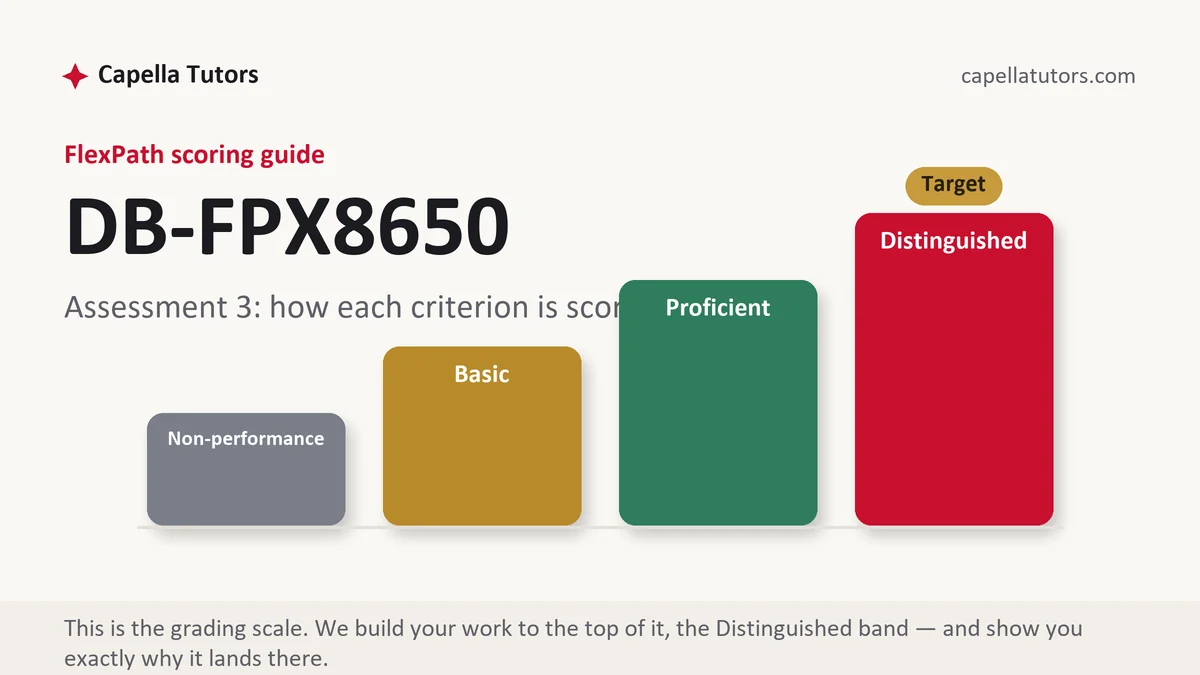
How DB FPX 8650 Assessment 3 is scored
Each criterion sits at one of four levels independently, and the top level is a description of a move rather than a compliment:
| Level | What it means on a synthesis and gap statement |
|---|---|
| Distinguished | Themes are organized by what the literature disagrees about, every paragraph ends in a judgment with its confidence calibrated to the designs behind it, definitional disagreements are separated from empirical ones, and the gap follows visibly from the synthesis. |
| Proficient | A thematic synthesis with conclusions drawn and a stated gap. Well organized work whose confident verbs are not yet matched to the strength of the evidence. |
| Basic | One source per paragraph in an orderly sequence, agreement reported, and a gap announced that the preceding pages did not produce. |
| Non-performance | A required component is absent, most often any synthesis across studies. A summary of each source in turn has not attempted the criterion rather than attempted it weakly. |
What this hands to the proposal is the sentence your study exists to answer, and the tighter the gap, the shorter the proposal argument becomes. One practical note about the review pathway: a synthesis of published work is not ordinarily research with human participants, so this stage usually proceeds without board review, and the moment your next submission proposes collecting anything from anybody, the determination has to be sought rather than presumed. Candidates who ask what their programme requires while writing the synthesis lose no time; candidates who ask afterwards usually lose several weeks.
The DB FPX 8650 Assessment 3 method, step by step
-
Sort the matrix three ways before writing a word
By measure, by design, and by setting. Sorting by measure shows which disagreements are definitional. Sorting by design shows which claims rest only on cross-sectional survey work. Sorting by setting shows the boundary of what the field has actually tested. The three sorts are the synthesis in draft form.
-
Choose the disagreements, not the topics
A theme headed leader communication invites summary. A theme headed whether development programmes change behavior or only self-perception invites argument, and the difference between those two headings is most of the difference between the columns.
-
Write each paragraph in four moves
State the claim. Cite the studies that support it with their designs named. Cite the studies that complicate it and say what differs. Then give your conclusion and how confident it is. Any paragraph that ends without a judgment has stopped short of the criterion.
-
Explain divergence with the fields you recorded
Most apparent contradictions in leadership research dissolve into sample sector, who rated the leader, who rated the outcome, the time lag, or the analytic model. Name which one is doing the work. Where none of them explains it, say so, note which study has the stronger design, and record the question as open.
-
Calibrate the verbs
Reserve shows and demonstrates for claims supported by more than one design. Use is associated with for a single cross-sectional finding and suggests for a case account. A reader who checks three of your verbs against the matrix learns everything about how carefully you read.
-
Derive the gap in the last paragraph of the synthesis
It should read as a consequence rather than as an announcement, and it should point at something observable that you could actually obtain. A gap that requires data nobody holds is a literature observation, not a study.
A structure that maps to the criteria
These targets are our planning defaults for a doctoral synthesis, not Capella rules; expand whichever theme your scoring guide weights most heavily.
| Section | What it must do | Guide |
|---|---|---|
| Organizing logic | Why the synthesis is arranged this way, and what the arrangement makes visible that another would hide. | ~200 words |
| Theme one, contested | The claim, the supporting studies with designs, the complicating studies, and the stated conclusion. | ~350 words |
| Theme two, contested | The same four moves on a second disagreement, with the divergence explained from recorded fields. | ~350 words |
| Definitional versus empirical conflict | Where a disagreement turns out to be about measurement, shown from the matrix rather than asserted. | ~250 words |
| Gap and implication | What remains unresolved, for whom it matters, and the observable a study could obtain. | ~250 words |
| References | Founding statements cited to originals, recent empirical work carrying current claims, APA matched both ways. | as needed |
Annotated sample excerpt
An original model paragraph from our team, written for a review of span of control in a contact-centre outsourcing firm. It shows a divergence explained instead of averaged.
Whether widening a supervisor's span of control degrades coaching quality is reported inconsistently, and the inconsistency is largely a property of what the work being supervised looks like rather than of the span itself.1 Four cross-sectional studies in standardized transactional operations report no association between spans of 12 to 20 and coaching frequency, while three studies in mixed-complexity service work report a clear decline past roughly 15 direct reports, and the two groups differ on a field recorded in the matrix as task standardization, which the transactional studies treat as a control and the mixed-complexity studies treat as an outcome.2 Read together the evidence supports a conditional claim, that span tolerance rises with standardization, rather than the unconditional one the practitioner literature repeats; the two longitudinal studies in the corpus are both set in standardized operations, so the conditional claim itself rests on cross-sectional evidence at the point where it matters most, and this review records that as the open question rather than resolving it.3
- 1States the disagreement and immediately proposes what explains it, which sets up the paragraph as an argument rather than as a report of mixed findings.
- 2Counts on both sides, the ranges involved, and the field that differs between the two groups, drawn from the matrix. Notice that the same variable is a control in one literature and an outcome in the other, which is the kind of observation only a completed matrix produces.
- 3Converts the finding into a conditional claim, then immediately says where that claim is weakest and leaves the question open. Naming the soft spot in your own conclusion is the calibration the top level is describing.
The full premium sample for your exact assessment, written fresh to your scoring guide and issue, is free to request. Study it, revise it into your own voice, and submit work you understand.
The five mistakes that cost Distinguished
- A paragraph per source. One study per paragraph, however well summarised, proves reading and never produces the synthesis the criterion is scoring.
- Contradictions averaged away. Two studies pointing opposite ways are the most useful material in the corpus, and reporting mixed findings and moving on wastes them.
- Studies pooled across incompatible measures. A shared label is not a shared scale, and averaging across instruments manufactures a finding that no study reported.
- Uniform verbs across uneven evidence. When a case account and a longitudinal study both demonstrate something, the prose has erased the difference the appraisal existed to record.
- A gap that arrives from outside. If the gap was chosen before the reading, the synthesis reads as decoration for a conclusion, and reviewers can usually tell within a page.
Pre-submission checklist
- The matrix has been sorted by measure, by design, and by setting
- Themes are named as disagreements rather than as topics
- Every synthesis paragraph ends in a judgment with stated confidence
- Each divergence is explained from a recorded field, or recorded as open
- Verbs match the strength of the designs behind each claim
- The gap follows from the synthesis and points at an obtainable observable
Synthesis or gap statement due?
Send the criteria and your matrix, or your source list if the matrix does not exist yet. We sort the corpus three ways, build the themes as disagreements, explain each divergence from the recorded fields, and write the gap so it arrives as a consequence. First premium sample at no charge.