This manual is for DB FPX 8650 Assessment 2, start to submission. Assessment 2 of Seminar: Leadership Literature Review usually asks for the funnel and the appraisal: counts at every screening stage with grouped reasons for exclusion, and a matrix that records what each retained study actually did rather than what it concluded. It is the deliverable that decides whether your later synthesis will be believed. What follows is the sequence our doctoral tutors work in, a structure keyed to the criteria, and an annotated sample excerpt. Rather hand it across? A premium original sample built for this exact assessment returns in 24 to 48 hours, reworked without charge while any criterion is short. Capella's catalog lists the course as DB-FPX8650, and some courserooms print DB8650; both point to this same Assessment 2.
One honesty note before the manual: Capella revises courses and scoring guides over time, so always write to the exact scoring guide attached to your assessment in the courseroom. The course identity above is verified on capella.edu; the method and structure below are our tutors' approach to it, not Capella's official rubric text.
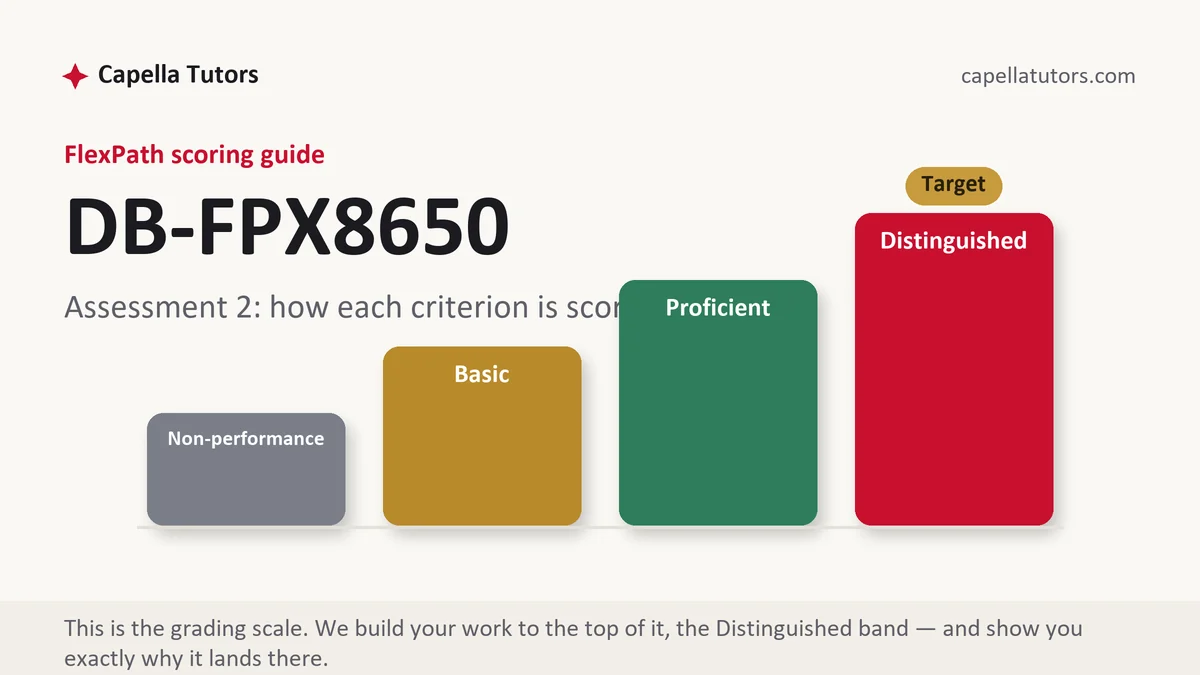
How DB FPX 8650 Assessment 2 is scored
Criterion by criterion, four levels, each placed on the evidence in front of the evaluator rather than on the paper as a whole:
| Level | What it means on screening and appraisal |
|---|---|
| Distinguished | Counts appear at retrieval, deduplication, title and abstract screening, full-text reading, and retention, with exclusions grouped by reason; the matrix records design, sample, setting, measures, who supplied each rating, effect, and the limitation the authors named; and weak studies stay in with their weakness visible. |
| Proficient | A documented funnel and a thorough summary of each study. Careful work in which study quality is described but not used to weight the evidence. |
| Basic | A count of final sources, sources characterised as robust or high quality, and appraisal that records whether the study agreed with the review's direction. |
| Non-performance | A required component is missing, most often the stage counts or the exclusion reasons. Numbers that were never reported cannot be judged as approximate. |
Two things travel from here into the synthesis. The matrix fields are what let you sort the corpus by what was measured rather than by what it was called, which is how definitional disagreements get separated from empirical ones. The counts are what let a reader believe the corpus. Plan the workload honestly as well: ninety full-text appraisals at twenty-five minutes each is thirty-seven and a half hours before a paragraph of synthesis exists, and candidates who schedule that finish the seminar on time.
The DB FPX 8650 Assessment 2 method, step by step
-
Deduplicate before you screen, and count both numbers
Retrieved and unique are different figures and a reader wants both. Export to a reference manager, run the duplicate check, then check the near-duplicates by hand, because the same article indexed twice with different page ranges will survive an automatic pass.
-
Screen on title and abstract against the written rules only
Not on interest, not on how promising the abstract sounds. Where an abstract cannot answer a rule, promote the record to full text rather than guessing, and record how often that happened, because a high rate says something about the abstracts in your field.
-
Group the full-text exclusions by reason and count each group
Wrong population, no comparison, outcome not measured, level of leader mismatched, full text unavailable. Grouped reasons let a reader see the shape of the field, and an unusually large group is often a finding in itself about where research has and has not been done.
-
Record seven fields per retained study
Design, sample and setting, how leadership was measured, how the outcome was measured, whether both came from the same respondent, the effect reported, and the limitation the authors themselves stated. Those seven fields do most of the synthesis work for you later.
-
Rate quality with a named system, cited to its authors
A published appraisal tool applied consistently beats an ad hoc judgment applied confidently. Name the tool, cite it, and record the rating in the matrix beside the study rather than in the prose, so the reader can see the distribution rather than your summary of it.
-
Keep the weak studies and label them
A small single-site study can support feasibility even when it cannot support an effect, and deleting it looks like tidying. A matrix with nothing below the top tier reads as curated, which is the impression the whole exercise exists to avoid.
A structure that maps to the criteria
Word targets are our planning defaults for a doctoral appraisal paper, not Capella rules; the matrix itself is normally an appendix and does not count toward prose.
| Section | What it must do | Guide |
|---|---|---|
| Screening procedure | Who screened, against which rules, how disagreements were handled, and how uncertain abstracts were treated. | ~250 words |
| Yield at every stage | Retrieved, unique, title and abstract screened, read in full, retained, with the reason groups and their counts. | ~300 words |
| Appraisal approach | The named tool, cited, what it rates, and how it was applied consistently across designs. | ~250 words |
| The matrix, described | What the seven fields are, why each is there, and what the completed distribution shows. | ~350 words |
| What the corpus can and cannot carry | Where the evidence is thin, which claims rest on one design, and what that means for the synthesis. | ~300 words |
| References and appendix | The appraisal tool cited to its authors, the matrix reproduced in full, current APA both ways. | as needed |
Annotated sample excerpt
An original model paragraph from our team, written for a review of shift-lead development in food processing plants. It shows appraisal used to weight evidence rather than to describe it.
Of the 34 studies retained, 26 are cross-sectional surveys, five are quasi-experimental evaluations of a training programme with a pre and post measure, two are longitudinal with a twelve-month follow-up, and one is a multi-site case study, and that distribution decides what this review is entitled to claim.1 In 21 of the 26 surveys the leadership measure and the outcome measure were both supplied by the same respondent, which means the association between shift-lead behavior and reported crew engagement in those studies cannot be separated from the tendency of satisfied crews to rate their leads generously, and the matrix records that field precisely so the synthesis can say so rather than averaging across it.2 The two longitudinal studies both report an effect on retention that survives a lagged model, and they were conducted in plants of over 400 employees, so this review can support a claim about direction with two designs and cannot yet support a claim about magnitude in smaller operations, a limit that is a property of the retrieved evidence rather than of the reviewer's confidence.3
- 1Reports the design distribution as counts and then says outright that the distribution governs the claims. Most reviews report the count and then argue as though every study weighed the same.
- 2Names the same-source problem, quantifies how much of the corpus it affects, and points at the matrix field that captured it. This is the sentence that shows the appraisal was performed rather than described.
- 3Separates a claim the evidence supports from one it does not, and attributes the limit to the corpus rather than to the writer. Calibrated confidence stated this way is the clearest marker of doctoral reading in a review.
The full premium sample for your exact assessment, written fresh to your scoring guide and issue, is free to request. Study it, revise it into your own voice, and submit work you understand.
The five mistakes that cost Distinguished
- A single final count with nothing before it. Thirty-eight sources were selected could describe careful screening or the first two pages of results, and the prose cannot tell them apart.
- Exclusions left ungrouped. A total of rejected records hides the shape of the field, and the group that is unexpectedly large is often the most interesting thing you found.
- Quality expressed as adjectives. Rigorous and well designed are impressions. A named tool with a rating per study is a measurement, and only one of those can be checked.
- Same-source ratings left unrecorded. When the leader and the outcome are rated by one person, the association carries a known inflation, and a matrix without that field cannot flag it.
- The thin evidence quietly removed. A corpus with no weak studies in it has been tidied, and tidying is the specific suspicion the counts and the matrix exist to remove.
Pre-submission checklist
- Retrieved and unique counts both reported, with the deduplication method named
- Counts given at title and abstract, full text, and retention stages
- Full-text exclusions grouped by reason, with a count for each group
- Seven fields recorded for every retained study, including who supplied each rating
- A named appraisal tool, cited to its authors, applied across all designs
- Weak studies retained with their rating visible, and their role stated
Screening counts or appraisal matrix due?
Send the criteria and your search output. We deduplicate, screen against your written rules, produce the stage counts with grouped exclusion reasons, and build the matrix field by field so the synthesis has something to be built from. Your first premium sample is free.