This manual is for DB FPX 8650 Assessment 1, start to submission. Assessment 1 of Seminar: Leadership Literature Review usually asks for the review question and the method behind it: a bounded question, inclusion and exclusion rules fixed in advance, and a search another researcher could rerun and land near your set. It is the only part of a review that is graded on reproducibility rather than on argument. The order our doctoral tutors work in is set out below, with a criterion-keyed structure and an annotated sample excerpt. Prefer to hand it over? A premium original sample for this exact assessment arrives within 24 to 48 hours, revised at no charge until the guide is met. Capella's catalog lists the course as DB-FPX8650, and some courserooms print DB8650; both point to this same Assessment 1.
One honesty note before the manual: Capella revises courses and scoring guides over time, so always write to the exact scoring guide attached to your assessment in the courseroom. The course identity above is verified on capella.edu; the method and structure below are our tutors' approach to it, not Capella's official rubric text.
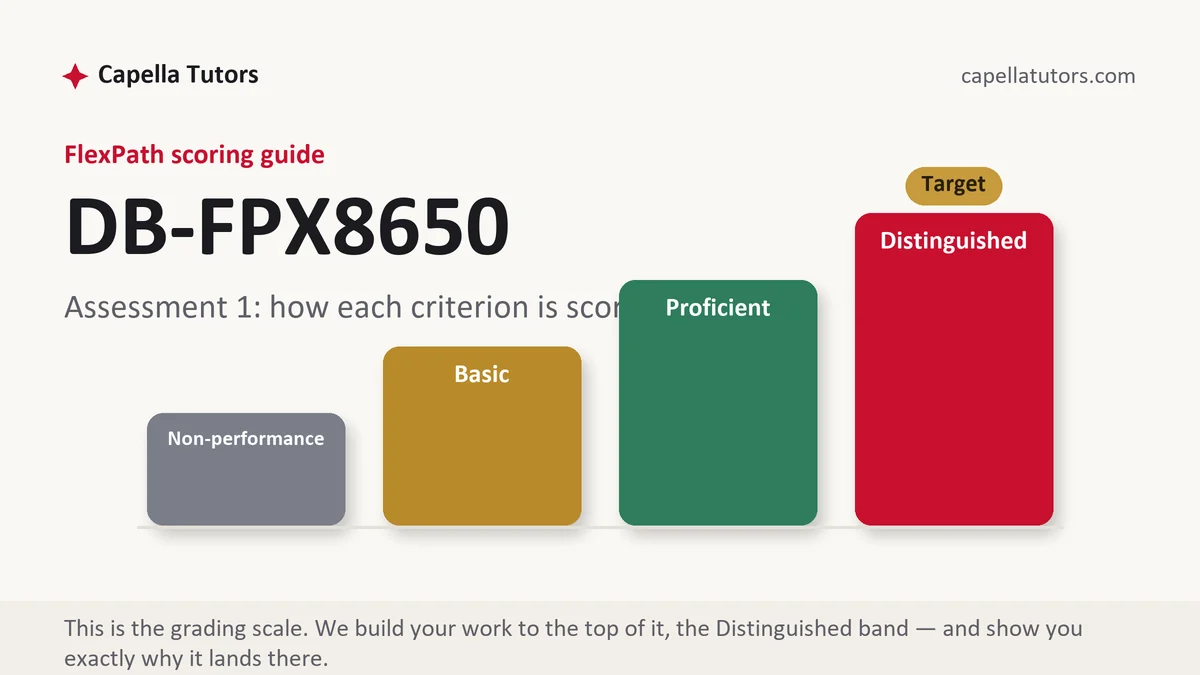
How DB FPX 8650 Assessment 1 is scored
There is no aggregate mark. Each criterion is scored at one of four levels on its own, and the wording of the top level is the specification:
| Level | What it means on a review question and search method |
|---|---|
| Distinguished | The question names population, phenomenon, outcome, and boundary; the rules are written before screening and each one carries the reason it was set; databases, controlled vocabulary, full strings, limiters, and run dates are all reported. Reproducibility is the extra move, and it is the one a reader can verify. |
| Proficient | A clear question with a described search. Sound method whose strings a second researcher could approximate but not reproduce. |
| Basic | Two databases named in a sentence, sources described as recent and relevant, and eligibility rules that read as preferences. |
| Non-performance | A required element is absent, most often the eligibility rules or the run dates. An unreported method cannot be evaluated as a weak one. |
What this hands forward is the audit trail the rest of the review leans on. Screening counts only mean something against rules that existed first, and a synthesis is only defensible if a reader believes the corpus was not curated. There is also a review-pathway point worth settling now: analysis of published literature is not ordinarily human subjects research, so it does not usually require board review, and your programme will still expect that determination to be made rather than assumed, particularly if you intend to fold in organizational documents or internal reports later.
The DB FPX 8650 Assessment 1 method, step by step
-
Write the question with four components and a boundary
Population, phenomenon, outcome, and the limit that keeps it finite. A question about leadership and retention is a topic; a question about first-line supervisors in geographically distributed claims operations and voluntary exit inside eighteen months is a question whose search terms are obvious from reading it.
-
Fix the eligibility rules before you screen anything
Years, languages, publication types, settings, levels of leader, and designs, each with the reason it was set. Rules written afterwards describe the studies you liked, and a pattern of exclusions all pointing one way is visible to any experienced reader.
-
Take the controlled vocabulary from each database separately
The subject headings differ between business and psychology indexes, and a string that works in one returns noise in the other. Build the string per database rather than pasting one across all of them, and keep the version that was actually executed.
-
Book thirty minutes with a librarian before the real run
Library staff build strings professionally, and half an hour usually replaces two evenings of guessing. Bring the question and the four components, ask for vocabulary in each index you intend to use, and keep a record of what was suggested.
-
Log the run as you go
Database, string as executed, limiters, date run, number returned, one row per run. Reconstructing this afterwards produces a method section that is tidy and slightly untrue, and the untidy accurate version is what the criterion pays for.
-
Pilot the strategy on twenty records before committing
Screen the first twenty hits against your written rules and see how many survive. A yield near zero means the vocabulary is wrong; a yield near everything means the rules are not doing any work. Adjust once, record the adjustment, then run properly.
A structure that maps to the criteria
These word targets are our planning defaults for a doctoral method paper rather than Capella requirements; strings, logs, and rule tables normally sit in appendices your guide may not count.
| Section | What it must do | Guide |
|---|---|---|
| Review purpose and question | Why the review is needed now, and the question stated with population, phenomenon, outcome, and boundary. | ~250 words |
| Eligibility rules | Inclusion and exclusion criteria fixed in advance, each with the reason it was set. | ~300 words |
| Databases and vocabulary | Which indexes, why those, and the controlled vocabulary each component maps to in each one. | ~300 words |
| Search strings and run record | Strings as executed with limiters and run dates, reproduced in an appendix and summarised here. | ~300 words |
| Pilot and adjustments | What the pilot screen returned, what was changed, and why the change is defensible. | ~200 words |
| References | Method sources cited to their authors, current APA matched in both directions. | as needed |
Annotated sample excerpt
An original model paragraph from our team, written for a review of hybrid supervision in an insurance claims operation. It shows a search reported rather than described.
Business Source Complete, PsycINFO, and ABI/INFORM Global were searched on 11 and 12 May 2026, limited to peer-reviewed English-language articles published from 2017 onward and to studies of formally appointed supervisors rather than emergent team leaders.1 The Business Source Complete string combined the three components as ( DE "SUPERVISORS" OR supervisor* OR "first-line manager*" OR "team leader*" ) AND ( hybrid N3 work* OR remote N3 work* OR telework* OR "distributed team*" ) AND ( claim* N3 quality OR "work quality" OR error* OR rework ), with the PsycINFO thesaurus terms substituted for the first component and the proximity operators adjusted to that index, and every string is reproduced as executed in Appendix A with its run date and its return count.2 The three indexes returned 612, 388, and 274 records; the pilot screen of the first twenty Business Source Complete hits retained six, which was high enough to proceed without widening but low enough to add rework as a synonym in the outcome component, an adjustment made once, logged, and applied to the two searches run the following day.3
- 1Databases, run dates, and the two limiters that matter, all before any string appears. The second limiter is doing real work: it excludes a whole literature on emergent leadership that shares the keyword and answers a different question.
- 2The string as executed, with field codes, truncation, and proximity operators visible, plus the note that the vocabulary was rebuilt per index rather than pasted across. A reader can now rerun this.
- 3Counts per index and the pilot result, then the single adjustment with its reason and its timing. Reporting that a change was made and when is what keeps the method honest, since an unlogged adjustment is indistinguishable from tuning the search to the answer.
The full premium sample for your exact assessment, written fresh to your scoring guide and issue, is free to request. Study it, revise it into your own voice, and submit work you understand.
The five mistakes that cost Distinguished
- A search described in prose. Two databases named in a sentence tells a reader nothing they could act on, and the criterion is asking for something actionable.
- One string pasted across every index. Subject headings are not shared between business and psychology indexes, and a borrowed string returns the wrong records confidently.
- Eligibility rules with no reasons. A rule without a rationale is a preference, and a reviewer reads a list of preferences as a corpus that was shaped rather than selected.
- Run dates omitted. A search rerun three months later returns a different number, so a method with no date describes an unrepeatable event.
- A question that is really a topic. Leadership and engagement generates thousands of records and no boundary, and the screening burden then decides the review's scope by accident.
Pre-submission checklist
- The question names population, phenomenon, outcome, and boundary
- Eligibility rules are written before screening, each with its reason
- Controlled vocabulary is taken from each index separately
- Every string appears as executed, with limiters, run date, and return count
- The pilot screen is reported, along with any adjustment and when it was made
- Method sources cited to their authors, current APA in both directions
Review question or search method due?
Send the criteria and the question you are working toward. You get the strings as executed, the per-index vocabulary, the eligibility rules written as rules, the run log with dates and counts, and a method section a librarian could follow. First premium sample carries no fee.