This manual is for DB FPX 8640 Assessment 1, start to submission. Assessment 1 of Seminar: Leadership Topic Development usually asks you to convert a leadership interest into a problem of practice: a specific, evidenced, located gap between what an organization is getting and what it needs. It is the sentence every later stage of the sequence inherits, which is why a loose version of it costs you a term rather than a criterion. Our doctoral tutors work it in the order set out below, with a structure keyed to the criteria and an annotated sample excerpt to show the register. Prefer to hand it over? A premium original sample for this exact assessment returns inside 24 to 48 hours, revised without charge until the guide is met. Capella's catalog lists the course as DB-FPX8640, and some courserooms print DB8640; both point to this same Assessment 1.
One honesty note before the manual: Capella revises courses and scoring guides over time, so always write to the exact scoring guide attached to your assessment in the courseroom. The course identity above is verified on capella.edu; the method and structure below are our tutors' approach to it, not Capella's official rubric text.
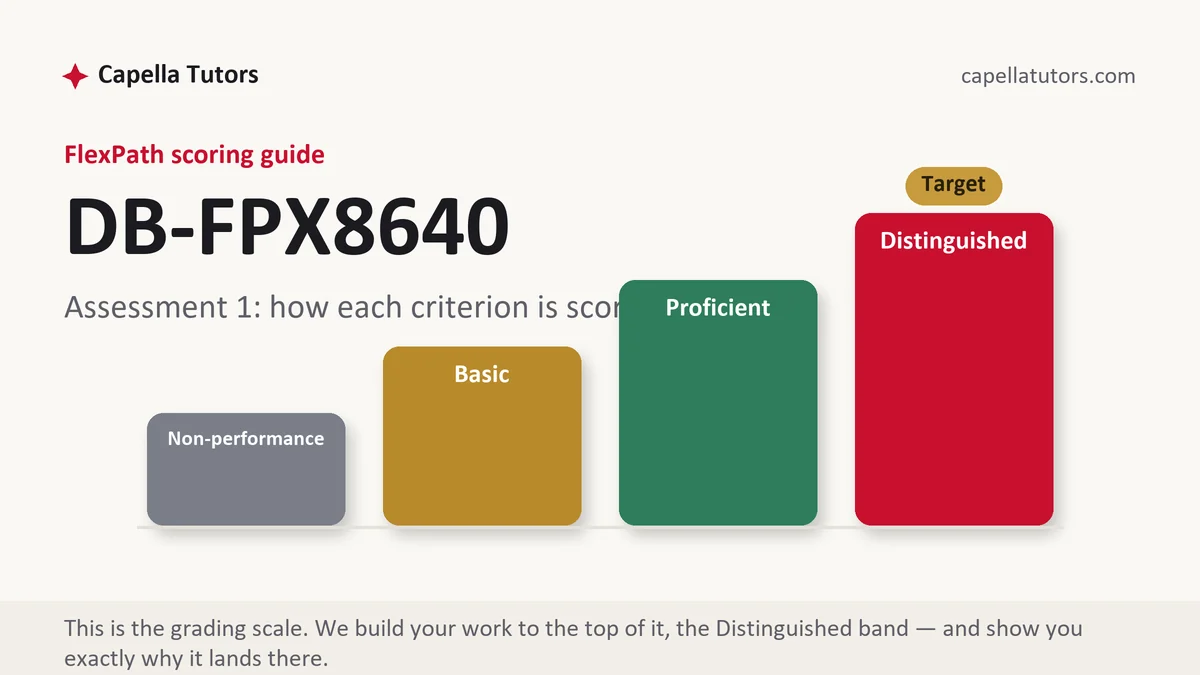
How DB FPX 8640 Assessment 1 is scored
Nothing here is averaged. Each criterion is placed at one of four levels on its own, and the wording of the top level is the brief you write to:
| Level | What it means on a problem of practice |
|---|---|
| Distinguished | The gap is stated at one organizational level, sized with evidence a reader could check, located in a described type of setting, and the statement says what the available evidence does not yet establish. The top level pays for the boundary you draw around your own claim. |
| Proficient | A genuine problem, evidenced and located, that a committee can evaluate. Sound work whose gap is asserted at one point where it could have been measured. |
| Basic | A subject area with an adjective attached. Leadership development in remote teams is a territory, and a territory gives a reader nothing to assess. |
| Non-performance | A required element is missing, most often any evidence at all that the problem exists outside the candidate's experience. One anecdote is not a problem statement. |
This deliverable hands two things forward. The purpose statement and questions you write next may only use constructs that already appear here, so a vague noun in this paragraph becomes an alignment failure two submissions later. The literature review seminar then inherits your search terms from these same constructs, which is the practical reason to keep a search log from the first day you read anything. Write down the databases, the strings, and the dates now, because reconstructing them later is slow and the reconstruction is never quite honest.
The DB FPX 8640 Assessment 1 method, step by step
-
Write the setting before the problem
Two or three sentences on the kind of organization, its size, its operating conditions, and the population of leaders inside it. A problem is only specific relative to a setting, and candidates who skip this end up defending a claim that floats free of anywhere it could be observed.
-
Assemble the evidence before drafting the statement
The statement is a conclusion, not a starting point. Gather what the organization is experiencing, how large it is, what it costs, who has already noticed, and what published work says about the same pattern elsewhere. Drafting the sentence first commits you to defending something you wrote while uninformed.
-
Size the gap with two kinds of evidence
Practice evidence establishes that it happens here: turnover figures, time to competence, internal survey items, exit data. Scholarly evidence establishes that it happens beyond here. Each does a job the other cannot do, and a statement resting on only one of them is half a justification.
-
Fix the level and keep it
Individual leader, work group, business unit, or organization. Choose one deliberately and hold it, because a problem posed at the organizational level by a candidate who can observe one department produces a study that promises more than it can see.
-
Draft in three moves
General situation, the specific gap with numbers attached, then the consequence of leaving it alone. Three sentences, in that order, is usually enough. Add the consequence in operational terms rather than in the language of missed opportunity, because an executive audience discounts the second.
-
Read it to somebody who does not work in your organization
If they can restate the problem, name the population, and say why it matters without asking a question, the statement is ready. If they ask what you mean by any noun in it, that noun is the criterion you are about to lose.
A structure that maps to the criteria
These targets are our planning defaults for a doctoral topic paper, not Capella requirements; your scoring guide decides how much supporting evidence has to be assembled at this stage.
| Section | What it must do | Guide |
|---|---|---|
| Setting and population | The type of organization, its conditions, and the leaders the problem concerns, described rather than named. | ~200 words |
| Practice evidence | Organizational indicators with their measures, dates, and sources, plus the operational cost of the current state. | ~350 words |
| Scholarly evidence | Published work showing the pattern exists beyond one site, cited to peer-reviewed sources. | ~300 words |
| The problem statement | General situation, specific evidenced gap, consequence of inaction, at one stated level of analysis. | ~200 words |
| Significance and limits | Who would act on an answer, and what this evidence does not yet establish. | ~250 words |
| References and search log | Current APA both ways, with databases, strings, and dates recorded for the review seminar that follows. | as needed |
Annotated sample excerpt
An original model paragraph from our team, drawn from a municipal water utility that promotes field crew leads from the trades. It shows a gap sized rather than described.
Mid-sized municipal water utilities promote field supervisors from within the trades, and the promotion is typically made on technical competence with no formal preparation for supervising the crews the candidate previously worked beside.1 At the utility that agreed to host this study, 23 of the 31 crew leads appointed between 2019 and 2025 held no supervisory training before appointment; 9 of those 23 returned to a non-supervisory classification within 24 months, against 1 of the 8 who had completed the county's leadership certificate, and the payroll cost of each reversion averages $18,400 in recruitment, acting pay, and lost crew productivity.2 The problem this study addresses is that first-line supervisory reversion in utility field operations is treated as an individual fit issue rather than as a preparation issue, so the organization absorbs the cost repeatedly without evidence about what preparation would reduce it, and the published work on supervisory transition has been conducted almost entirely in office and clinical settings rather than in field trades.3
- 1Opens on the class of organization rather than on the single site, which is what allows the finding to matter to anybody else. The candidate's own employer arrives in the second sentence, not the first.
- 2Practice evidence with a comparison group, a rate, a window, and a unit cost. The eight trained leads are the sentence that turns an observation into a defensible gap, because without a contrast the reversion rate means nothing.
- 3States the problem as a misattribution the organization is making, gives the operational consequence, then bounds the scholarly gap by setting rather than claiming novelty. A reviewer can check that boundary, which is exactly why it survives.
The full premium sample for your exact assessment, written fresh to your scoring guide and issue, is free to request. Study it, revise it into your own voice, and submit work you understand.
The five mistakes that cost Distinguished
- A subject submitted as a problem. Employee retention and remote team effectiveness are territories. A committee cannot evaluate a territory because there is nothing in it to be right or wrong about.
- One anecdote standing in for evidence. What you have watched happen is the reason you chose the topic, and it is not yet the evidence that it happens.
- Levels mixed inside one paragraph. A gap described in the first sentence as organizational and in the third as individual has already broken the alignment the next stage is graded on.
- Nobody has studied this. An unbounded novelty claim is refutable by one search. Bounding the gap by sector, level, or method cannot be refuted that way.
- A consequence written as lost potential. Untapped opportunity is not a cost. Reversions, overtime, rework, and vacancy days are costs, and they are usually already in a system you can ask about.
Pre-submission checklist
- Every criterion in the guide has its own labelled section, in the guide's order
- The setting is described before the problem appears
- Practice evidence carries a measure, a date, a source, and a comparison
- One level of analysis is named and held throughout the statement
- The gap is bounded by setting, level, or method rather than claimed as novel
- A search log exists with databases, strings, and run dates recorded
Topic paper or problem statement due?
Send the criteria, the setting you have access to, and the leadership issue you care about. A research analyst pulls the empirical base, we size the gap with both kinds of evidence, and a scoring-guide reviewer reads the statement cold to check it holds one level. First premium sample carries no fee.