This manual is for DB FPX 8640 Assessment 3, start to submission. Assessment 3 of Seminar: Leadership Topic Development usually asks whether the study you have designed can actually be run: the sampling arithmetic, the access you would need, the person who controls it, and where the work sits in an existing scholarly conversation. It is the deliverable that saves candidates a term, because everything it catches is cheap to fix now and expensive later. Below is the sequence our doctoral tutors use, a structure keyed to the criteria, and an annotated sample excerpt. Would rather pass it across? A premium original sample for this exact assessment comes back within 24 to 48 hours, revised free until the guide is satisfied. Capella's catalog lists the course as DB-FPX8640, and some courserooms print DB8640; both point to this same Assessment 3.
One honesty note before the manual: Capella revises courses and scoring guides over time, so always write to the exact scoring guide attached to your assessment in the courseroom. The course identity above is verified on capella.edu; the method and structure below are our tutors' approach to it, not Capella's official rubric text.
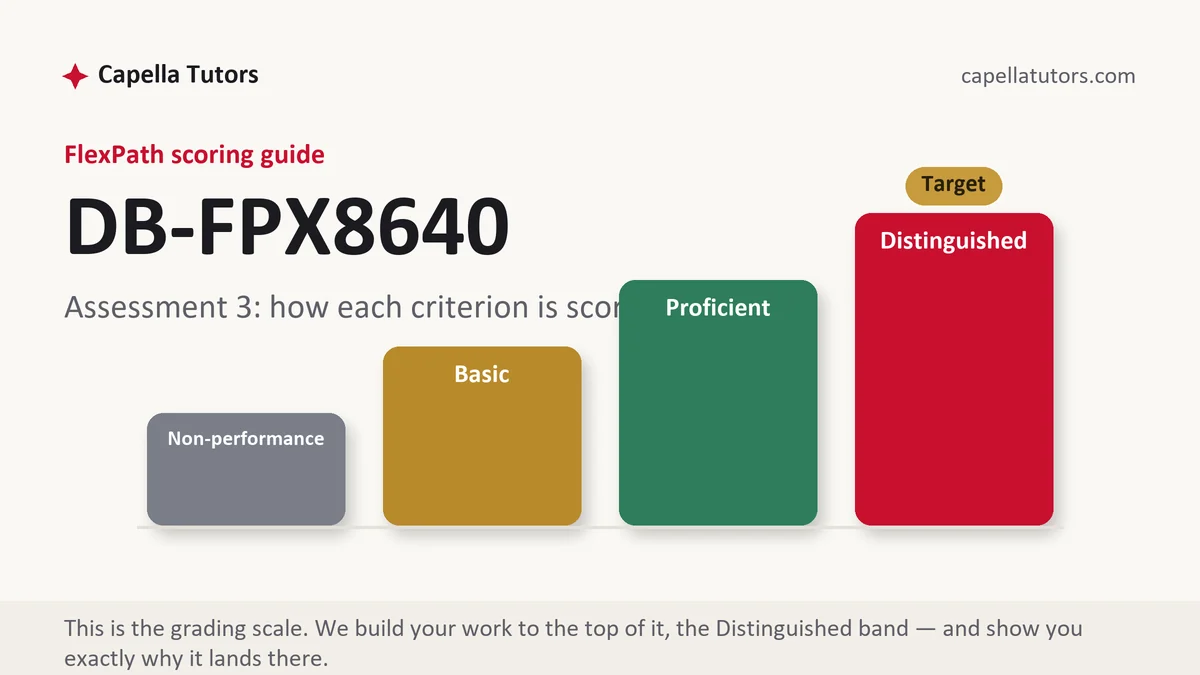
How DB FPX 8640 Assessment 3 is scored
Four levels, applied one criterion at a time, with no overall mark to absorb a weak section:
| Level | What it means on a feasibility and positioning paper |
|---|---|
| Distinguished | Sample size or interview count is worked through numerically against the actual population, the gatekeeper is named by role with evidence that access is obtainable, the analysis hours are counted against the sessions available, and the positioning bounds the gap rather than claiming novelty. |
| Proficient | A feasible design with access considered and the literature located. Credible, and at least one number is an estimate where a count was available. |
| Basic | Feasibility addressed in a paragraph of reassurance, access described as expected to be granted, and the positioning summarised as a general area of interest. |
| Non-performance | A required component is absent, most often the access analysis. A study whose data holder has never been identified has not been shown to be possible. |
Three things travel forward from here. The literature review seminar takes your bounded gap and your search log and turns them into a documented corpus, so the tighter the boundary is now, the less rework that seminar costs. The proposal takes your sampling arithmetic and your access evidence more or less intact. And your review submission takes the consent design, which is why the practical work of this stage is finding out who authorizes research at your site, what they need to see, and how long their process actually takes, since that clock runs independently of yours and nobody can shorten it for you.
The DB FPX 8640 Assessment 3 method, step by step
-
Do the sampling arithmetic against the real population
Work from the response rate you can defend, not the one you hope for. If you need 120 usable survey responses at a 22 percent internal response rate, your frame has to hold roughly 545 people, and if the site employs 380 the design does not fit the site. That is a discovery worth making in a seminar rather than after approval.
-
Count the analysis hours, then count the weeks
Fifteen interviews at an hour each, with five to six hours of transcription, coding, and memoing per interview, is about 90 hours before a theme is written. Divide by the sessions you intend to use. Seven and a half hours a week of analysis on top of everything else is a real number and a committee reads a candidate who has produced it very differently.
-
Name the gatekeeper by role and say what they control
Not the organization, the person. Whoever authorizes research, whoever owns the records, and whoever can require staff participation are frequently three different roles, and the third one creates a consent problem rather than solving an access one.
-
Write the sentence about your own position
If you supervise potential participants, or if what you publish could affect them, say so and describe the separation between your managerial role and your researcher role. Review boards examine this closely and a design that anticipates it moves faster than one that is asked about it.
-
Bound the gap on two axes
Say where the existing work was done and how it was done, then place your study outside one of those boundaries. Studied in large systems and not in mid-sized operators is a boundary; studied by survey and not through practitioners' own accounts is another. Novelty claims are refutable and boundaries are not.
-
Ask what a completed project in your area actually looked like
Read three or four finished doctoral projects in leadership for their scope rather than their findings. Scope is the thing candidates misjudge, and a completed study is the most reliable calibration available for how much a doctoral project actually contains.
A structure that maps to the criteria
These targets are our planning defaults for a doctoral feasibility paper, not Capella rules; the sampling calculation and any access correspondence usually sit in appendices.
| Section | What it must do | Guide |
|---|---|---|
| Design recap | The purpose and questions carried forward, with the design their phrasing implies stated plainly. | ~150 words |
| Population and sampling arithmetic | The frame, its size, the defensible response rate or interview count, and the resulting requirement. | ~300 words |
| Access and gatekeepers | Who authorizes, who holds the data, who could compel participation, and the evidence access is obtainable. | ~300 words |
| Researcher position and consent | Role conflict if any, the separation designed for it, and how consent will work for this population. | ~250 words |
| Workload and schedule | Analysis hours counted, spread across the sessions available, with the constraint that binds. | ~200 words |
| Scholarly positioning and references | The literatures joined, the gap bounded on setting and method, current APA both ways. | ~300 words |
Annotated sample excerpt
An original model paragraph from our team, set in a multi-unit restaurant franchise group. It shows access analysed rather than assumed.
The population for this study is the 40 general managers employed across the franchise group's 40 locations, and access to them is controlled by three different roles that a single permission letter would not cover.1 The director of operations authorizes contact with managers and has confirmed in writing that a study of managerial practice would be permitted; the franchisor's field consultant owns the standardized service audit scores this study would use as context and has no obligation to release them to a franchisee's employee, which is why the design treats those scores as desirable rather than as required; and the individual franchise owners can effectively require their managers to participate, which is the risk this design has to manage rather than exploit.2 Recruitment therefore runs through a direct invitation from the researcher rather than through an owner announcement, participation is described to owners only in aggregate, and no manager's decision to decline is reported to anyone, a structure written now because a review board will ask how voluntary participation can be in an employment relationship of this shape.3
- 1States the population as a count rather than as a category and then makes the point that access is plural. Candidates lose this criterion by treating permission as one conversation.
- 2Three roles, three different kinds of control, and a design decision attached to each. The middle clause is the doctoral move: it downgrades a data source rather than assuming cooperation the researcher cannot compel.
- 3Turns the coercion risk into a recruitment design and names the reviewer who will ask about it. Anticipating the consent question in the seminar is what keeps the review pathway from becoming the critical path later.
The full premium sample for your exact assessment, written fresh to your scoring guide and issue, is free to request. Study it, revise it into your own voice, and submit work you understand.
The five mistakes that cost Distinguished
- Access described as expected. Nobody has agreed to anything until somebody has been asked, and a feasibility criterion is asking what was asked and what was answered.
- A target sample larger than the population. The arithmetic takes ten minutes and the mistake costs a term, which makes it the least forgivable error in the seminar.
- Analysis time left out of the schedule. Coding is the work, not the paperwork after the work, and a plan that budgets only for data collection has budgeted for the easy half.
- Role conflict left unmentioned. Studying people who report to you is manageable and it is never invisible, and raising it yourself is far cheaper than being asked.
- Positioning by topic rather than by boundary. Naming the area your study belongs to locates you in a library; naming what the existing work has not covered locates you in a conversation.
Pre-submission checklist
- The sampling requirement is computed from a defensible rate against the real frame
- Analysis hours are counted and divided across the sessions available
- Each gatekeeper is named by role, with what they control stated
- Evidence of obtainable access is described, not assumed
- Role conflict and consent are addressed for this specific population
- The gap is bounded on setting and on method, with current APA both ways
Feasibility or positioning paper due?
Send the criteria, your purpose and questions, and what you know about the site. We run the sampling arithmetic against the real population, map the gatekeepers, write the consent design a review board will ask for, and bound the gap so the review seminar inherits something usable. First premium sample at no charge.