This manual is for DB FPX 8640 Assessment 2, start to submission. Assessment 2 of Seminar: Leadership Topic Development usually asks for the purpose statement and the research questions, aligned to the problem you already established and to each other. It is the deliverable where drift happens silently, because every sentence looks reasonable on its own. The build order below is the one our doctoral tutors use, followed by a criterion-keyed structure and an annotated sample excerpt. Rather delegate it? A premium original sample written to this exact assessment returns in 24 to 48 hours, reworked at no cost while a criterion is unmet. Capella's catalog lists the course as DB-FPX8640, and some courserooms print DB8640; both point to this same Assessment 2.
One honesty note before the manual: Capella revises courses and scoring guides over time, so always write to the exact scoring guide attached to your assessment in the courseroom. The course identity above is verified on capella.edu; the method and structure below are our tutors' approach to it, not Capella's official rubric text.
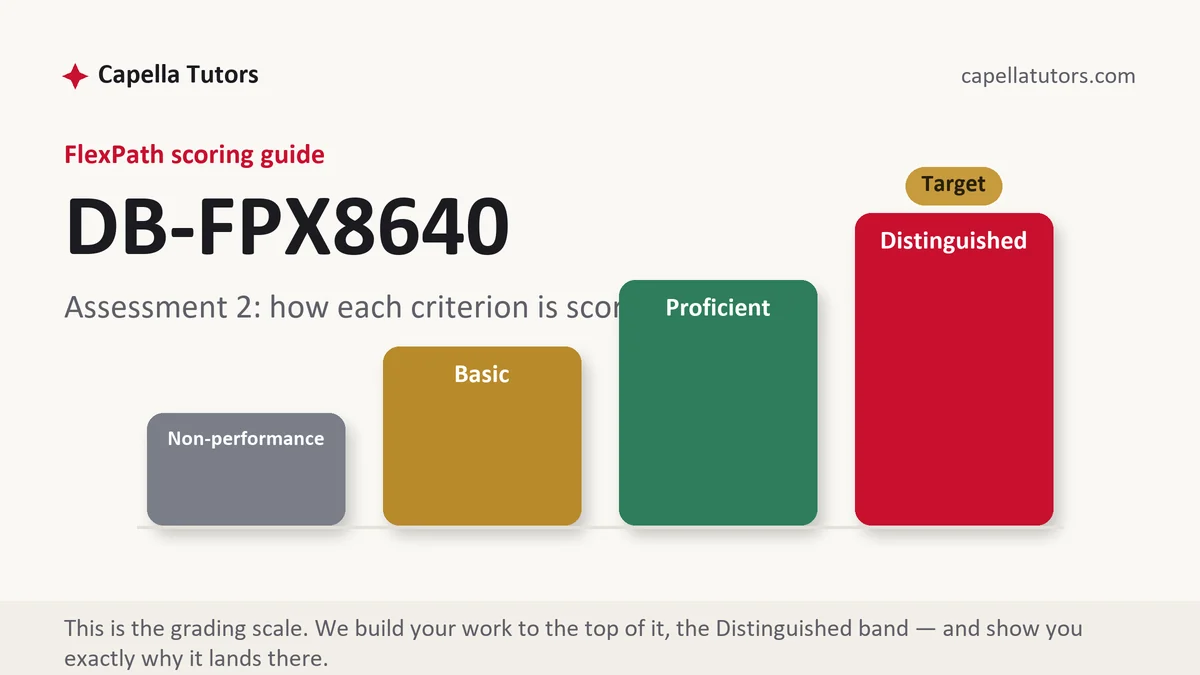
How DB FPX 8640 Assessment 2 is scored
Each criterion is placed independently at one of four levels, and the level wording tells you what to write rather than how well you wrote it:
| Level | What it means on purpose and question alignment |
|---|---|
| Distinguished | Every construct in the questions already appears in the purpose, every construct in the purpose already appears in the problem, the design is implied by the phrasing rather than announced, and the statement concedes what the questions will not answer. |
| Proficient | Purpose and questions that match the problem and each other. Aligned work whose questions could still be answered by two different designs. |
| Basic | A purpose that explores a topic and questions that widen it, so the study grows by one construct per sentence without anyone deciding it should. |
| Non-performance | A required element is missing, most often research questions that the stated data source could answer. Questions no obtainable data can address are a structural absence rather than a weak attempt. |
What this stage hands forward is the design and the review pathway together. A question phrased to compare outcomes across supervisors commits you to matched data and to a permission conversation with whoever owns performance records; a question phrased around how supervisors account for a transition commits you to interviews and to a consent process that has to work for people who may report to you. Both routes are legitimate and they reach an institutional review board in very different states of readiness, so decide which one your wording has selected before the next submission assumes it.
The DB FPX 8640 Assessment 2 method, step by step
-
Lay the three sentences in one row
Problem, purpose, questions, side by side in a table before any prose exists. Underline every construct. Any construct that appears in a later cell without appearing in an earlier one is the drift the criterion is looking for, and it is visible in ten seconds this way.
-
Write the purpose as an action with a population
The purpose says what the study will do, with whom, by what broad approach, to address the stated problem. Explore and examine are acceptable verbs when the object is specific; they fail when the object is a topic area rather than a phenomenon in a population.
-
Let the question phrasing carry the design
How and in what way point at qualitative accounts. To what extent and what is the relationship point at measurement. A reader should be able to name your design from the questions without being told, and a question that cannot be classified is usually two questions.
-
Check every question against an obtainable record
For each one, write the sentence that names the data, the holder of the data, and whether you may have it. A question whose answer sits in a confidential evaluation file is not answerable until somebody agrees, and that sentence belongs in the paper rather than in your assumptions.
-
Cut the question you like most if it does not fit
Three tightly matched questions beat five that survey the territory. The surplus question is usually the interesting one that requires a second data source, and keeping it is how a one-year study becomes a two-year negotiation.
-
Read the three sentences aloud, out of order
Questions first, then purpose, then problem. Reading backwards strips the momentum that hides drift and exposes any construct that arrived from nowhere. This takes four minutes and catches more alignment failures than a full revision of the literature section.
A structure that maps to the criteria
Word targets are our planning defaults for a doctoral alignment paper rather than Capella rules; the alignment table itself usually belongs in an appendix.
| Section | What it must do | Guide |
|---|---|---|
| Problem carried forward | The established problem in two or three sentences, unchanged, with its level of analysis restated. | ~150 words |
| Purpose statement | What the study will do, with whom, by what approach, to address that problem, with no new construct. | ~250 words |
| Research questions | Two to four questions matched to the purpose and to each other, phrased so the design follows. | ~250 words |
| Alignment argument | Construct by construct, how the questions trace to the purpose and the purpose to the problem. | ~350 words |
| Data source and review pathway | What would be collected, who holds it, and what consent or permission the wording now requires. | ~300 words |
| References | Current APA both ways, with methodological claims cited to method sources rather than to topic literature. | as needed |
Annotated sample excerpt
An original model excerpt from our team, written for a credit union whose branch network has just absorbed a merger. It shows alignment argued rather than asserted.
The problem established above concerns branch managers in merged credit unions who are held to service standards written for the acquiring institution while supervising staff trained under the acquired one, and the purpose statement therefore commits to describing how those managers reconcile two sets of expectations in daily practice.1 Three constructs carry across: branch managers as the population, competing service expectations as the phenomenon, and daily reconciliation practice as what will be described, and no fourth construct is introduced, which is why the questions can only ask how managers account for the conflict, what practices they report using, and what conditions they say make reconciliation harder.2 Each question is answerable from interview accounts held by the participants themselves rather than from performance records held by the institution, which is a deliberate design choice: it keeps the study inside data the participants can consent to release, and it means the study cannot say whether those practices improve service outcomes, a limit stated here rather than discovered at the defense.3
- 1Restates the problem compactly and derives the purpose from it in the same sentence, so the reader sees the join rather than being asked to trust it.
- 2Names the three constructs explicitly and then says that nothing else was added. Making the absence of a fourth construct visible is the cheapest way to demonstrate alignment on the page.
- 3Ties the data source to the consent pathway and then concedes the outcome question the design forfeits. Volunteering the limit is what a committee reads as readiness rather than as weakness.
The full premium sample for your exact assessment, written fresh to your scoring guide and issue, is free to request. Study it, revise it into your own voice, and submit work you understand.
The five mistakes that cost Distinguished
- A new construct in the purpose sentence. Organizational culture appearing for the first time after the problem has been fixed is the drift reviewers check for first.
- Questions that outnumber the design. Five questions requiring three data sources describe a research programme, and a committee will read it as scope nobody has costed.
- Explore used as a substitute for a decision. Exploring the impact of leadership on performance names no population, no phenomenon, and no obtainable record.
- Data assumed rather than located. Every question needs a named holder of the data and a sentence about whether they have agreed, because access is discovered late and cannot be compressed.
- Alignment claimed in a sentence. The criterion asks you to show the trace construct by construct; stating that the elements are aligned is an assertion about your own paper.
Pre-submission checklist
- An alignment table exists with problem, purpose, and questions in one row
- No construct appears in the purpose or questions that is absent from the problem
- Each question's phrasing implies one design rather than two
- Every question is matched to a named record and a named holder of that record
- The consent or permission pathway the wording requires is stated
- The limit the design accepts is written down before anyone asks for it
Purpose statement or research questions due?
Send the criteria and whatever your problem statement already established. We build the alignment table first, force every construct to repeat across the row, phrase the questions so the design follows, and write the access and consent sentence your next submission will need. First sample free.