This manual is for DB-FPX8420 Assessment 2, start to submission. The middle deliverable of a doctoral business teaching course usually asks you to build the evidence side of a design: the tasks that produce proof a student can do the thing, the rubric that judges them, and the activities that make the performance likely. The rubric is marked on whether two graders would agree, which means describing the artifact rather than the achievement. Below is the order our doctoral desk builds in, the shape the rubric takes, and an annotated excerpt at the register the top column pays for. Rather delegate it? One premium original sample, keyed to the guide you were issued, lands inside 24 to 48 hours and is revised free until the criteria clear. Your courseroom may print this as DB FPX 8420 Assessment 2 or DB8420 Assessment 2; it is the same deliverable, and DB-FPX8420 Assessment 2 is what this manual walks through.
One honesty note before the manual: Capella revises courses and scoring guides over time, so always write to the exact scoring guide attached to your assessment in the courseroom. The course identity above is verified on capella.edu; the method and structure below are our tutors' approach to it, not Capella's official rubric text.
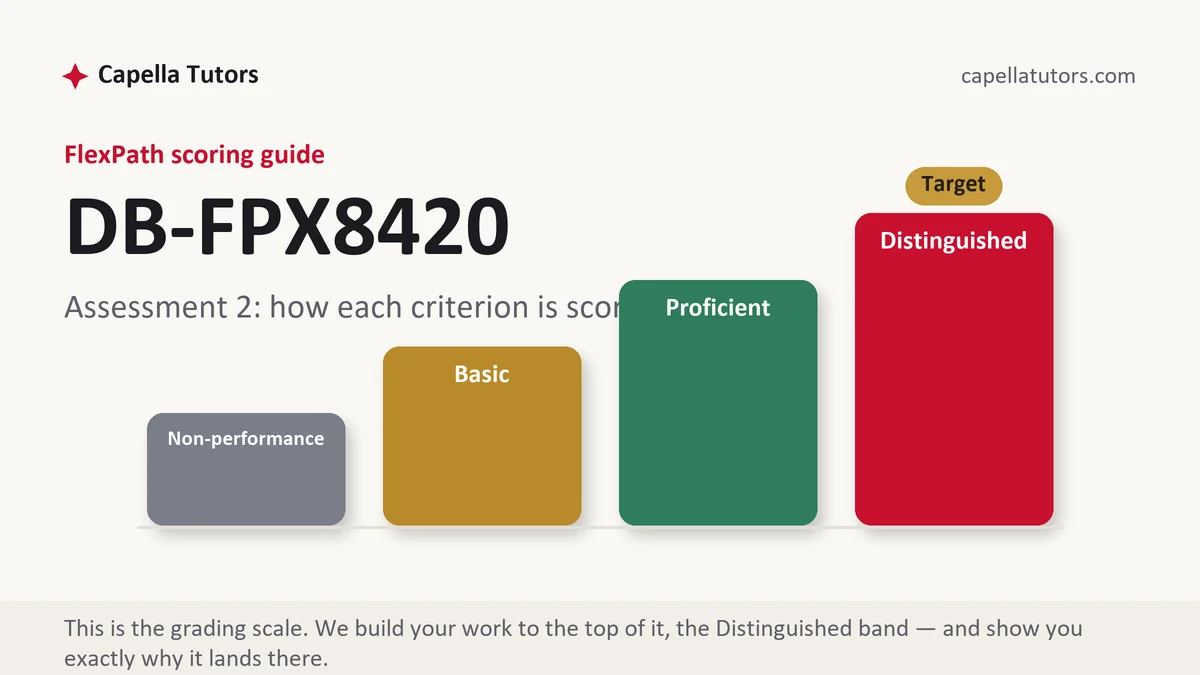
How DB-FPX8420 Assessment 2 is scored
Four levels, one criterion at a time, and the descriptors describe artifacts rather than effort. Read them as your specification:
| Level | What it means on an assessment and rubric design |
|---|---|
| Distinguished | Each task produces evidence of a specific outcome, the rubric levels differ in what the work contains rather than in how well it was done, a second grader could apply them without consulting you, and the activities rehearse the assessed performance with feedback scheduled early enough to be used. Each criterion hides a further requirement; locate it and meet it. |
| Proficient | Tasks matched to outcomes and a workable rubric. Sound design, with one or two levels still separated by degree rather than by substance. |
| Basic | A reasonable assignment, a rubric whose levels run thoroughly, adequately and somewhat, and activities chosen because they are enjoyable. The first attempt most candidates hand in. |
| Non-performance | A required element is absent, most often the mapping from task to outcome. An assessment that cannot be traced to an outcome cannot be credited against an alignment criterion. |
You have a live example of criterion-referenced marking to study, since your own guide is one: four levels where each describes a different artifact rather than a different quantity of merit. Reading it as an instrument, and asking why the top descriptor is worded exactly as it is, is the fastest preparation available for writing one of your own.
The DB-FPX8420 Assessment 2 method, step by step
-
Map every task to one outcome before designing it
Keep a two-column table open, outcomes on the left and the evidence each will produce on the right, and refuse to design a task until both columns are full. Terminology questions cannot produce evidence that a student can construct a position, and an alignment criterion will locate that mismatch inside a minute.
-
Write the top rubric level as a full description
Describe the best realistic submission in concrete terms: what it contains, what it computes, what it acknowledges. Do not write the top level as the absence of faults. A reader should be able to picture the artifact, because everything below it is generated by removing something from this description.
-
Build the lower levels by removing substance
Write the failing level next, then fill the middle by taking out one substantive element at a time rather than by weakening an adverb. Thoroughly, adequately and somewhat describe the grader's mood rather than the work in front of them, and they are where agreement between two markers disappears.
-
Test the rubric like an instrument
Grade three real or constructed samples, hand the rubric and the samples to a colleague without your marks, and compare. Where you disagree, the rubric is at fault, not the colleague, and the sentence you disagreed about is the one to rewrite. Report the exercise in the paper, because a tested rubric is evidence and an untested one is a claim.
-
Design activities that rehearse the assessed task
Students improve at the performance they practice under conditions resembling the assessment, so the case discussion rehearses the memo, the spreadsheet exercise rehearses the model, and the graded presentation follows an ungraded one that carried feedback. Justify the choice from research rather than from preference, and state openly where a finding comes from another discipline.
-
Schedule feedback so it can be used, then self-score
Practice has to precede the graded event by enough time for the feedback to be applied, which is a scheduling decision rather than a pedagogical opinion. Put the dates in the plan. Then mark each criterion against the top descriptor and remember that a design returned over one unaligned task costs most of a week.
A structure that maps to the criteria
These lengths are planning targets our doctoral desk uses for an assessment design of this scope, not Capella requirements; write the sections your own guide names.
| Section | What it must do | Guide |
|---|---|---|
| Outcome to evidence map | Each outcome paired with the task producing evidence of it, with nothing unmatched in either column. | ~200 words |
| The assessment tasks | What students are given, what they produce, under what conditions, and how the task is weighted. | ~300 words |
| The rubric | Criteria and four levels, each level describing the content of the work rather than its quality in the abstract. | ~400 words |
| Inter-rater evidence | The samples graded, the colleague comparison, the disagreements found and the wording changed as a result. | ~200 words |
| Activities and feedback timing | The rehearsal each task gets, the sequence, and the interval that lets feedback reach the next attempt. | ~300 words |
| Integrity, access and references | Integrity built into the task design, materials usable as issued, and current APA cited to primary work. | ~200 words |
Annotated sample excerpt
A model excerpt from our doctoral desk showing two rubric levels written so a second grader could apply them. Learn the moves, then build your own.
The graduate negotiation course runs online across eight-week terms, and its second task requires a post-negotiation analysis of a recorded simulated exchange the student took part in.1 At the top level, the analysis identifies the student's own opening anchor and its effect on the settlement range, quotes two specific moments from the transcript, computes the value claimed against the student's stated reservation point, and names one concession the student would not repeat and why. One level down, the analysis identifies the anchor and quotes the transcript, but the value claimed is described rather than computed, and the concession review is general.2 Neither descriptor contains the words thoroughly or effectively, and both name items a grader can locate in the artifact within a minute of reading it.3
- 1Delivery mode and term length come first, because both constrain what the task can require. The assessment is described before it is judged.
- 2The lower level is the upper level with two substantive elements removed, not the same description with softer adverbs. That is what makes the levels applicable by anyone.
- 3Says out loud what the descriptors avoid and why. Naming the words you excluded is evidence you understood the agreement problem the criterion is about.
The full premium sample for your exact assessment, written fresh to your scoring guide and issue, is free to request. Study it, revise it into your own voice, and submit work you understand.
The five mistakes that cost Distinguished
- Levels separated by adverbs. Thoroughly, adequately and somewhat move the judgment into the grader and out of the artifact, and agreement dies there.
- A task assessing something the course never promised. A criterion marking work the outcomes did not name is unfair whether or not two graders apply it identically.
- The word appropriately doing the specification. Appropriately cited and appropriately structured are the two places a rubric quietly stops being an instrument.
- Activities chosen for engagement. The defensible claim is that students improve at what they practice under conditions like the assessment, not that active work is generically better.
- Feedback scheduled after the graded event. Comments arriving with a final mark cannot be applied to anything, which makes the feedback design decorative.
Pre-submission checklist
- Every task maps to one named outcome and every outcome has a task producing evidence
- The top rubric level is a full description of the artifact rather than an absence of faults
- Lower levels are built by removing substance, with no adverbs carrying the distinction
- The rubric was applied to samples by a second reader and the disagreements are reported
- Each activity rehearses an assessed performance, with feedback dated before the graded event
- Integrity built into the task, materials accessible as issued, APA matched both ways
Want a rubric two graders would actually apply the same way?
Send the guide, the outcomes you wrote and the task you have in mind. A team of eight, including a research analyst and two reviewers who mark the samples cold, returns a premium original sample inside 24 to 48 hours with levels built by removing substance and the disagreements from the test grading reported. Revision is free until each criterion clears.