How to write DB-FPX8420 Assessment 3

The short answer

This manual is for DB-FPX8420 Assessment 3, start to submission. The closing deliverable of a doctoral business teaching course usually asks how you would know the design worked, and most drafts substitute popularity for learning. The better evidence is sitting inside the graded work already: when a specific outcome fails across sections, that is a design finding rather than a cohort finding, and the doctoral response is to establish which of three causes produced it, change one, and compare the next section. Below is how our doctoral desk approaches it, the shape the evaluation takes, and an annotated excerpt. Prefer to hand it across? A premium original sample built against your own scoring guide arrives inside 24 to 48 hours, with revision at no charge until each criterion is satisfied. Your courseroom may print this as DB FPX 8420 Assessment 3 or DB8420 Assessment 3; it is the same deliverable, and DB-FPX8420 Assessment 3 is what this manual walks through.

One honesty note before the manual: Capella revises courses and scoring guides over time, so always write to the exact scoring guide attached to your assessment in the courseroom. The course identity above is verified on capella.edu; the method and structure below are our tutors' approach to it, not Capella's official rubric text.
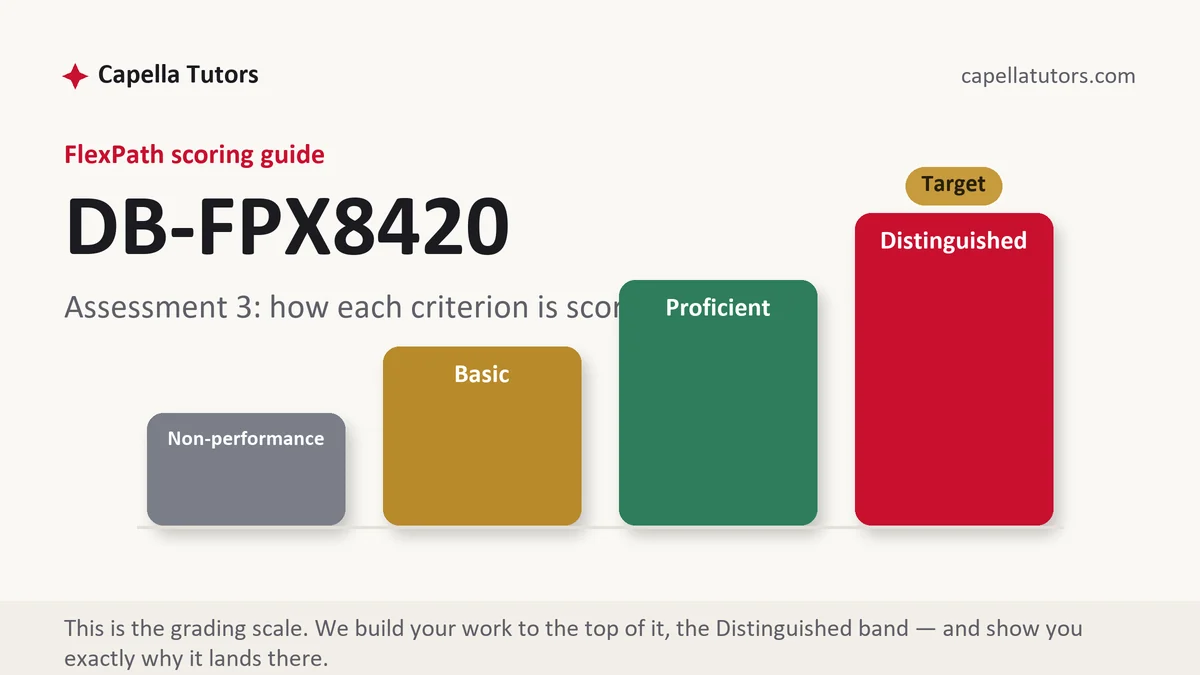
DB-FPX8420 Assessment 3 grading scale at Capella FlexPath, the criterion levels this assessment is scored on, from Capella Tutors
How Capella FlexPath grades DB-FPX8420 Assessment 3, visualized by Capella Tutors.

How DB-FPX8420 Assessment 3 is scored

Marking in FlexPath is a series of criterion decisions rather than a total, and each decision has four possible answers:

LevelWhat it means on an instructional evaluation and improvement plan
DistinguishedLearning evidence is weighted above satisfaction data, the failure is traced to a specific cause rather than to the cohort, exactly one thing changes so the comparison means something, and the plan names how you would know the change had failed. Each criterion carries one step past the obvious; find it and take it.
ProficientMultiple sources of evidence, a sensible diagnosis and a reasonable plan. Sound work, with several changes bundled into one intervention.
BasicStudent ratings reported as the verdict, a conclusion that the cohort was weaker this term, and four improvements proposed at once. Where a first attempt typically lands.
Non-performanceA required element is absent, most often any learning evidence at all. Satisfaction data alone cannot satisfy a criterion asking whether students learned the outcome.

Student ratings measure satisfaction and are influenced by grading leniency, class size, discipline and instructor characteristics having nothing to do with instruction, so they belong in the document as one weak indicator among several. The difference between the scholarship of teaching and an opinion about teaching is a claim somebody else could test, and this deliverable is where you demonstrate you can make one.

The DB-FPX8420 Assessment 3 method, step by step

  1. Read the outcome-level results before anything else

    Break the graded work down by outcome and by section rather than by student, and find where performance is concentrated. A course average conceals the pattern that matters, and the pattern that matters is a single outcome failing in similar proportions across sections taught by different people.

  2. Test three causes before choosing one

    An outcome fails because it was unclear, because the practice was absent, or because the assessment measured something else. Gather evidence on each: reread the task wording, count the rehearsals in the schedule, and check whether the rubric criterion matches the outcome. Naming which of the three you ruled out is a criterion move.

  3. Rank your evidence sources honestly

    Put outcome-level performance first, peer observation against a stated protocol second, and student ratings last with their known limitations named. Where you use ratings at all, quote the response rate and the items, because a mean drawn from nine responses out of fifty-one supports almost nothing.

  4. Change one thing, on purpose

    Alter a single element and hold everything else, because four simultaneous improvements produce a result nobody can attribute. Say which element you chose and why the evidence pointed at it. This is the same discipline the rest of your doctorate runs on, applied to a course rather than to a firm.

  5. Define the comparison and the threshold

    Name the next section, the measure, the baseline proportion and the movement that would count as improvement. Then write the result that would tell you the change failed. A plan with no failure condition reads as an intention rather than as an evaluation, and the criteria treat it that way.

  6. Write one checkable claim about your own teaching, then self-score

    A teaching philosophy asserting a commitment to engagement is this genre's most familiar failure. Replace it with one short specific claim a reader could verify from your own records. Then mark each criterion against the top descriptor, allowing the two business days an evaluator may take with an attempt.

A structure that maps to the criteria

Lengths below are our doctoral desk's planning targets for an evaluation document of this scope rather than Capella rules; your guide decides the sections.

SectionWhat it must doGuide
What was designedThe outcome, the task and the activities in brief, so the reader knows what is being evaluated.~150 words
Evidence and its weightEvery source used, ranked by what it can support, with response rates and protocols stated.~250 words
The findingPerformance by outcome and by section, with proportions and denominators, and the pattern named.~300 words
DiagnosisThe three candidate causes, the evidence on each, and which one the record supports.~300 words
The change and its testThe single element altered, the comparison section, the baseline, the threshold and the failure condition.~300 words
Reflection and referencesOne verifiable claim about your own practice, and current APA cited to primary work.~200 words

Annotated sample excerpt

An original model paragraph from our doctoral desk showing a teaching finding treated as a design problem. Reuse the structure, then write your own.

Sample excerpt: the finding and the diagnosis Original model · Capella Tutors

Across the three sections of the undergraduate business statistics course in the spring term, 61 of 118 students reached the top two rubric levels on the regression interpretation outcome while 104 of 118 reached them on the descriptive statistics outcome, and the shortfall is distributed almost evenly across sections taught by three different instructors.1 That distribution rules out the cohort explanation and points at the design, so three candidate causes were tested: the outcome wording, which names interpretation but the task asks students to report output; the rehearsal count, which is one worked example against four for descriptive work; and the rubric criterion, which awards the top level for correct coefficients without requiring a stated implication.2 The record supports the second and third and not the first, so exactly one change is made this term, adding two graded-for-completion interpretation exercises in weeks four and five, with the rubric left untouched so the comparison isolates the practice effect.3

  • 1Two outcomes compared with a common denominator, then the distribution across instructors. That distribution is what converts a grade pattern into a design finding.
  • 2All three candidate causes are stated with the evidence on each, rather than the favored one being announced. Ruling out is the analytical work the criterion pays for.
  • 3Two causes are supported and one change is made anyway, with the reason given. Holding the rubric constant on purpose is what makes next term's comparison mean anything.

The full premium sample for your exact assessment, written fresh to your scoring guide and issue, is free to request. Study it, revise it into your own voice, and submit work you understand.

Get the full sample free

The five mistakes that cost Distinguished

  • Ratings treated as the verdict. Satisfaction is one weak signal, and the learning evidence is already sitting inside the graded work.
  • A weaker cohort offered as the explanation. When the same shortfall appears under three instructors, the cohort account has already been eliminated.
  • Four improvements introduced together. Simultaneous changes make attribution impossible and waste the comparison the next section would have provided.
  • A mean quoted without a response rate. Nine responses from fifty-one students cannot carry a conclusion about anything, and a doctoral reader will check.
  • A reflection with no claim in it. A commitment to engagement is not verifiable, and the criterion is looking for a statement somebody else could test.

Pre-submission checklist

  • Results are broken down by outcome and by section, with proportions and denominators
  • All three candidate causes are tested and the ones ruled out are named
  • Evidence sources are ranked, with response rates and observation protocols reported
  • Exactly one element changes, and what is deliberately held constant is stated
  • The comparison section, baseline, improvement threshold and failure condition are in numbers
  • One verifiable claim about your own practice, with APA matched both ways and criteria self-scored

Want the evaluation built on learning evidence rather than ratings?

Send the guide, your outcome-level results and whatever observation notes or rating summaries you hold. A team of eight, including a research analyst and two independent reviewers, returns a premium original sample inside 24 to 48 hours with the shortfall broken out by section, the three causes tested, and one change isolated for comparison. Revision is free until every criterion clears.

Keep going

Online now