This manual is for DB-FPX8420 Assessment 1, start to submission. The opening deliverable of a doctoral business teaching course usually asks for the front of a design: who the learners are, what constraints the delivery imposes, and what a graduate of the unit will be able to do, written as observable performances with a criterion of success attached. Practitioners arrive with the content and without the specification, and the gap shows in a plan listing topics a course will cover instead of things a student will produce. Below is the method our doctoral desk uses, the shape the design document takes, and an annotated excerpt at the register the guide rewards. Prefer to hand it across? A premium original sample written to your scoring guide returns inside 24 to 48 hours, with free rewrites until every criterion is met. Your courseroom may print this as DB FPX 8420 Assessment 1 or DB8420 Assessment 1; it is the same deliverable, and DB-FPX8420 Assessment 1 is what this manual walks through.
One honesty note before the manual: Capella revises courses and scoring guides over time, so always write to the exact scoring guide attached to your assessment in the courseroom. The course identity above is verified on capella.edu; the method and structure below are our tutors' approach to it, not Capella's official rubric text.
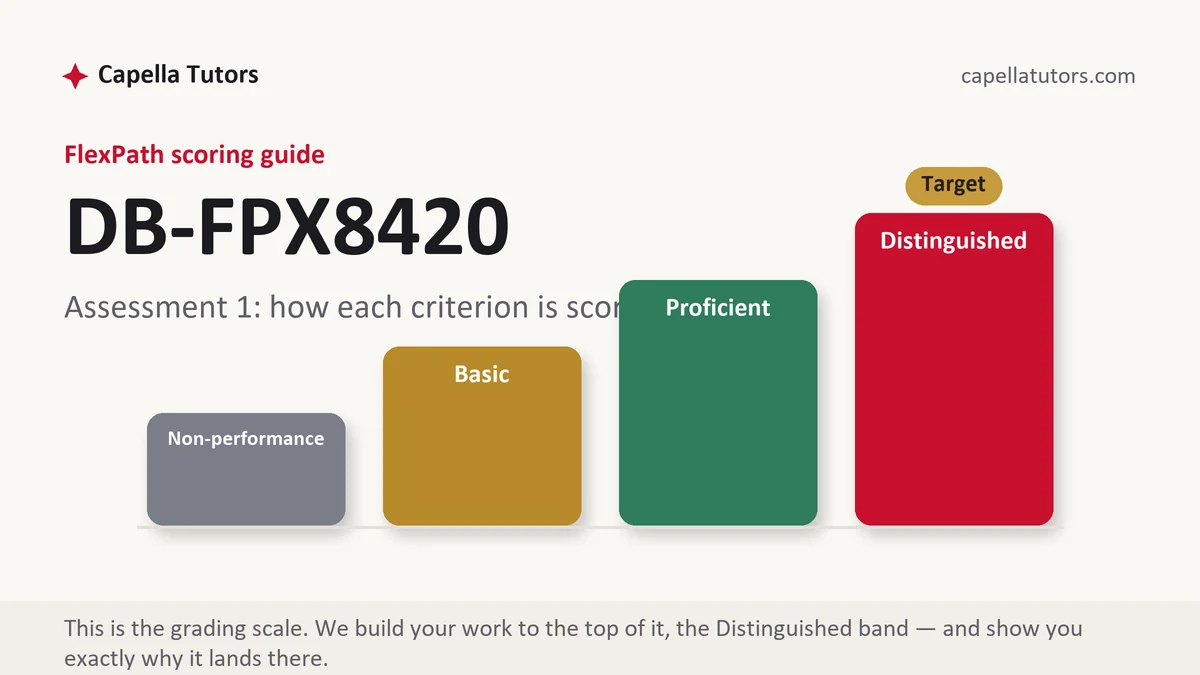
How DB-FPX8420 Assessment 1 is scored
This course grades you the way it teaches you to grade: criterion by criterion, four levels each, no letters anywhere:
| Level | What it means on a learner context and outcomes design |
|---|---|
| Distinguished | The context is described from evidence about these learners rather than assumptions about students in general, every outcome names an observable performance at a stated level of demand with its criterion of success, and an external reader could assess any of them without asking what you meant. Each criterion asks for one move beyond the obvious; find it and make it. |
| Proficient | A specific context and outcomes that could be assessed with a little interpretation. Competent design work, still needing the author present. |
| Basic | A topic list rendered as outcomes, verbs like understand and appreciate, and a learner description that would fit any cohort anywhere. The most common first attempt. |
| Non-performance | A required element is absent, most often the criterion of success on each outcome. An outcome with no standard attached cannot be assessed and cannot be marked upward. |
The doctoral standard here is that teaching claims are empirical claims. That has an uncomfortable consequence, which is that several confident staples of business education do not survive testing: matching instruction to learning styles, generational characterizations of students, and satisfaction treated as evidence of learning. A document built on what replicates, and explicitly declining the rest, is making the argument the criteria reward.
The DB-FPX8420 Assessment 1 method, step by step
-
Describe these learners, not students in general
Name the institution type, the delivery mode, the credit load, the cohort size and what the learners already do for a living, because a first-year section and a part-time cohort of working planners require different decisions. Then say what evidence your description rests on: enrolment data, prior grade distributions, a placement measure, your own intake conversations.
-
Write the constraints down as design inputs
Term length, synchronous hours available, software the institution licenses, accessibility obligations that shape documents and media before anybody requests an accommodation, and the assessment load your students carry elsewhere. Constraints stated early explain later choices; constraints omitted make those choices look arbitrary to a reader.
-
Start at the end and write the performance
Decide what a graduate of the unit must be able to do, then write it as a performance with an object and a standard: given something, the student produces something, judged by something. Backward design is both the content of this course and the fastest route through its criteria, so write the destination before any week of teaching exists.
-
Set the level of cognitive demand deliberately
Decide for each outcome whether the student is recalling, applying, analyzing or evaluating, and cite the taxonomy to its authors rather than to a pyramid graphic. Then check that the verb you used matches the level you chose, because an outcome claiming evaluation and asking for a summary is the misalignment a reader finds first.
-
Attach a criterion of success to every outcome
Say how good is good enough: arithmetic correct, comparison suited to the industry, interpretation defended, sources current. Without a standard, any assessment can be argued to match any outcome, which is exactly the ambiguity the top descriptor is written to eliminate.
-
Test each outcome on a colleague, then self-score
Hand the outcomes to somebody who has not read your plan and ask what task they would set to assess each one. Where two people would set different tasks, the outcome is underspecified. Then mark each criterion against the top descriptor and plan around the two business days an evaluator may take with an attempt.
A structure that maps to the criteria
Lengths are our doctoral desk's planning targets for a design document of this scope rather than Capella rules; the sections your guide names are the ones you write.
| Section | What it must do | Guide |
|---|---|---|
| The course and the institution | What the course is, where it sits in a program, its credit load, delivery mode and term structure. | ~200 words |
| The learners, evidenced | Who they are and what they bring, drawn from data about this cohort rather than from generalities about students. | ~300 words |
| Constraints and obligations | Time, tools, accessibility, workload elsewhere, and any institutional policy that shapes the design. | ~250 words |
| Outcomes | Four to six observable performances, each with an object, a level of demand and a criterion of success. | ~400 words |
| Justification | Why these outcomes for these learners, carried by management education research and cited to primary work. | ~250 words |
| References | Current APA both ways, taxonomies and design frameworks credited to their originators. | as needed |
Annotated sample excerpt
A model excerpt from our doctoral desk showing an outcome rewritten until it can be assessed without the author in the room. Work the moves, then write your own.
The cohort is 28 part-time students in an evening operations course at a regional comprehensive university, 21 of whom hold planning or scheduling roles and 19 of whom last completed a mathematics course more than six years ago, taken from the program's intake questionnaire for the last three cohorts.1 The unit's third outcome therefore reads: given twelve months of demand history for a single stock item, the student selects a forecasting method, justifies the selection against the observed pattern, computes the forecast error against a holdout period, and states what the error implies for safety stock.2 Success requires the method choice to be defended on the data rather than on familiarity, the arithmetic to be correct, and the safety stock implication to be expressed as a quantity rather than as a direction.3
- 1The cohort is described with counts from a named source. Prior knowledge is the strongest predictor available, and this sentence establishes it rather than assuming it.
- 2Given something, the student produces something, in four observable steps at a stated level of demand. Any competent instructor could build the task from this sentence.
- 3The criterion of success names what would fail, including the common failure of a correct calculation with a directional conclusion. This is the standard the top column is written around.
The full premium sample for your exact assessment, written fresh to your scoring guide and issue, is free to request. Study it, revise it into your own voice, and submit work you understand.
The five mistakes that cost Distinguished
- Outcomes describing internal states. Understand, appreciate and be familiar with cannot be observed, so no assessment can produce evidence that one occurred.
- A topic list wearing outcome verbs. Students will explore inventory models names content, and the criterion is asking what the student will be able to produce.
- Learners described as a generation. Cohort labels are marketing categories, and a doctoral reader will treat one as a substitute for the evidence you did not gather.
- Learning styles used as a design input. The matching claim has been tested repeatedly and has not held, and building on it costs the justification criterion outright.
- No criterion of success anywhere. Without a standard, any task can be argued to assess any outcome, and the alignment criteria collapse.
Pre-submission checklist
- The cohort is described with counts and a named source rather than in generalities
- Delivery mode, credit load, term length and accessibility obligations are all stated
- Every outcome names an observable performance with an object and a standard
- The level of cognitive demand matches the verb, with the taxonomy cited to its authors
- A colleague reading the outcomes cold would set the same assessment task you would
- Frameworks credited to originators, current APA matched both ways, criteria self-scored
Want the outcomes written so an external reader could assess them?
Send the guide and the course you teach or intend to teach, with its credit load and delivery mode. A team of eight, including a research analyst and two reviewers who read the draft cold, returns a premium original sample inside 24 to 48 hours with each outcome carrying an object, a level of demand and a criterion of success. Revision is free until every criterion clears.