This manual is for DB-FPX8410 Assessment 3, start to submission. The closing deliverable of a doctoral compliance course usually asks you to build a program rather than issue a policy. A program a doctoral reader will accept has an owner by role, a documented procedure, training aimed at the people whose behavior has to change, a monitoring measure the organization can produce from data it already keeps, a defined consequence when the monitor trips, and a review date. Most drafts thin out exactly here. Below is how our doctoral desk assembles it, the shape the program document takes, and an annotated excerpt. Prefer to hand it across? A premium original sample keyed to your own scoring guide lands inside 24 to 48 hours, with rewrites free until every criterion is satisfied. Your courseroom may print this as DB FPX 8410 Assessment 3 or DB8410 Assessment 3; it is the same deliverable, and DB-FPX8410 Assessment 3 is what this manual walks through.
One honesty note before the manual: Capella revises courses and scoring guides over time, so always write to the exact scoring guide attached to your assessment in the courseroom. The course identity above is verified on capella.edu; the method and structure below are our tutors' approach to it, not Capella's official rubric text.
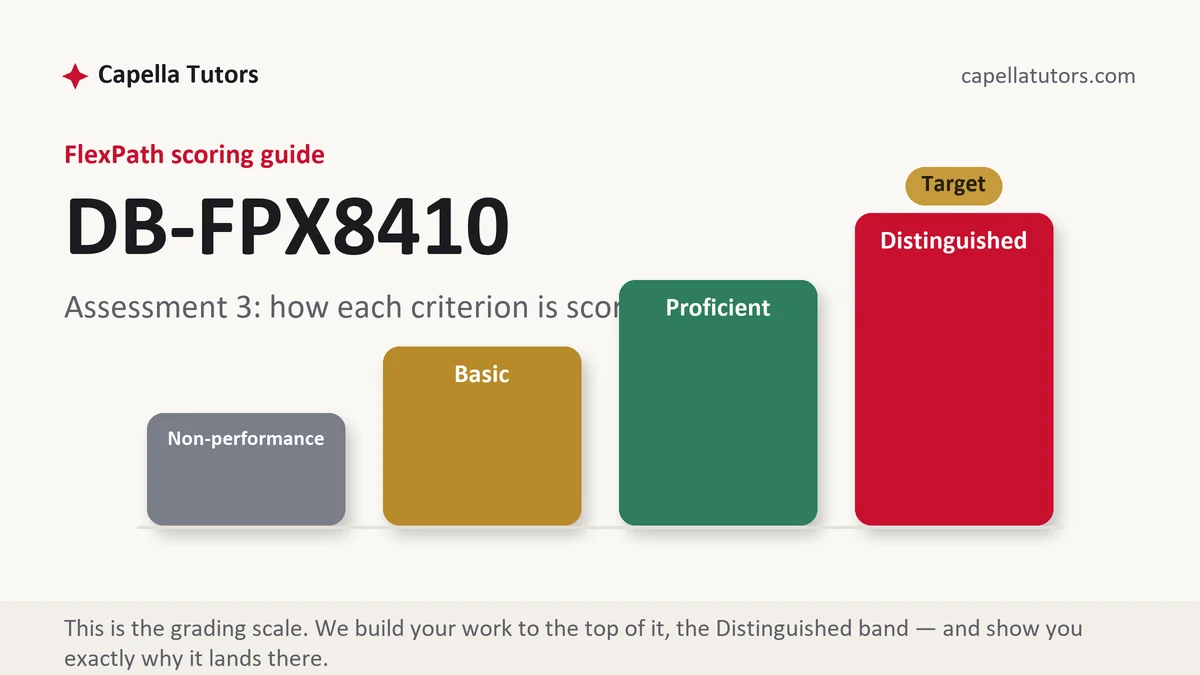
How DB-FPX8410 Assessment 3 is scored
Every criterion on the guide comes to rest on one of four levels, and no letter grade is issued at any point:
| Level | What it means on a compliance program design |
|---|---|
| Distinguished | The monitor is built from data the organization already produces, it has a defined trip point, the consequence of tripping is written down, an owner is named by role rather than by person, and the analysis runs the control before the decision is announced rather than after. Each criterion conceals one more move; find it and make it. |
| Proficient | A complete program with an owner, training and a review date. Implementable work, with the monitor still requiring somebody to build a new report. |
| Basic | A revised policy, a communication plan and a training slide deck, with nothing that would tell the organization the problem had returned. The shape a first attempt almost always takes. |
| Non-performance | A required element is absent, most often the monitoring measure. A program with no detection mechanism is an announcement, and the criterion is written to say so. |
The reason the monitor carries so much weight is that it is the only part of a program that keeps working after attention moves elsewhere. A control depending on a quarterly report nobody owns will lapse inside a year. A control computed from a payroll or applicant tracking extract the organization already runs will survive a change of leadership, which is the standard a committee applies when it asks whether your design is real.
The DB-FPX8410 Assessment 3 method, step by step
-
Fix the control before the communication
Decide what the organization will measure and how often, then design the rest of the program around it. Drafts written in the other order produce polished messaging attached to nothing measurable, and the criteria are arranged so that the measurable part carries the weight the messaging cannot.
-
Run the analysis before the decision is announced
Where a workforce action is planned, model its composition while it is still a draft: the ages, tenures, roles and locations of the people selected against those of the population they were selected from. A pattern found in a spreadsheet is a design problem; the same pattern found after the announcement is a dispute.
-
Name the owner by role and the approver above them
Ownership belongs to a position, not a person, because people move and the control has to survive them. Say who executes, who approves an exception, and what threshold pushes a decision up a level. Programs die when the only person who understood them changes jobs.
-
Choose a monitor from data that already exists
Pick a measure the organization can produce from a system it already runs, and define the trip point in numbers. A quarterly recomputation of a selection ratio at every stage of the funnel is a monitor; a commitment to review the process periodically is a sentence. Say who receives the number and on what day.
-
Write the consequence and the review date
Two sentences most drafts omit: what happens when the monitor trips, and when the whole program is examined again. Both are what convert a document into a control, and both are cheap to write and impossible to fake, which is why the criteria look for them specifically.
-
Handle waivers and releases with restraint, then self-score
Where a program involves agreements with departing employees, cite the provisions that govern them and describe the conditions the statute imposes, then stop and route the drafting to counsel. Say so in the document. Then mark each criterion against the top descriptor and plan for the two business days an evaluator may take.
A structure that maps to the criteria
Lengths below are our doctoral desk's planning targets for a program document of this scope rather than Capella rules; the sections your guide names govern.
| Section | What it must do | Guide |
|---|---|---|
| What the program fixes | The failure and its cost in one paragraph, so the reader knows what the control is for before reading it. | ~150 words |
| Procedure and documents | The change to the form, system or record that produced the problem, with version and effective date. | ~250 words |
| Pre-decision analysis | The composition test run on the proposed action while it is still a draft, with the comparison population defined. | ~300 words |
| Ownership and authority | Owner by role, approver, exception threshold, and the level a decision escalates to. | ~200 words |
| Monitor and consequence | The measure, its source system, its interval, its trip point, who receives it, and what happens when it trips. | ~300 words |
| Review, limits and references | The review date, what the program does not cover, the counsel disclaimer, and current APA cited by provision. | ~200 words |
Annotated sample excerpt
An original model paragraph from our doctoral desk showing what a monitor looks like when it is designed to run without supervision. Study the moves, then write your own.
The proposed reduction eliminates 38 of 210 roles at the print and mailing company, and the composition test is run on the draft selection list rather than on the completed action.1 In the selected group, 26 of 38 are aged 50 or above, a share of 68 percent against 41 percent of the 210-person population, and the concentration sits almost entirely in two departments where selection was delegated to managers using a criterion described in the worksheet only as adaptability.2 The control therefore has two parts: the selection criterion is replaced with the documented skills the retained roles require, and thereafter the human resources director recomputes the age, tenure and location composition of any workforce action affecting ten or more people before the notification date, reporting to the chief financial officer, with any group differing from its comparison population by more than fifteen percentage points held for review rather than released.3
- 1The timing is stated in the first sentence. Running the test before the announcement is the whole difference between a control and a post-mortem.
- 2Two shares with a common denominator, then the location of the concentration and the vague criterion that produced it. The cause is found in a worksheet, not in a person.
- 3Owner by role, recipient, trigger population, a numeric trip point and a defined consequence. Nothing here requires goodwill to keep working.
The full premium sample for your exact assessment, written fresh to your scoring guide and issue, is free to request. Study it, revise it into your own voice, and submit work you understand.
The five mistakes that cost Distinguished
- A policy issued in place of a program. With no owner, no monitor and no review date, the recommendation is a memo wearing a heading.
- A monitor that needs a new report built. Controls depending on work nobody has been assigned lapse within a year and the criterion knows the pattern.
- A trip point described as appropriate. Without a number, the monitor cannot trip, and nothing downstream of it can ever be triggered.
- Composition tested after the announcement. The same arithmetic is a design decision beforehand and an admission afterward.
- Release language drafted in the paper. Describing the statutory conditions is doctoral work; writing the agreement is counsel's, and the criteria reward knowing the boundary.
Pre-submission checklist
- The monitoring measure is chosen before the communication plan is written
- Composition analysis is run on the draft action, with the comparison population defined
- An owner by role, an approver and an exception threshold are all named
- The monitor states its source system, interval, recipient and numeric trip point
- The consequence of tripping and the program review date both appear in writing
- Statutory conditions cited by provision, counsel disclaimer present, APA matched both ways
Want a program a committee cannot call an announcement?
Send the guide, the failure you are correcting and any selection worksheets or policy drafts you can share. A team of eight, including a research analyst and two independent reviewers, returns a premium original sample inside 24 to 48 hours with the monitor built from data the organization already produces and the trip point written in numbers. Revision is free until every criterion clears.