This manual is for DB-FPX8410 Assessment 1, start to submission. The opening deliverable in a doctoral human resources and compliance course usually asks you to take a workforce situation apart: what happened, to whom, over what period, which obligation it engages, and what the employer would have to be able to show. It is not a law review paper and it is not an opinion on how a dispute would end. It is the analysis a senior officer writes in the week before a board committee asks what this could cost. Below is the method our doctoral desk uses, the shape it takes on the page, and an annotated excerpt at the register the guide rewards. Prefer to hand it across? A premium original sample written against the guide in your courseroom arrives inside 24 to 48 hours, with revision free until each criterion clears. Your courseroom may print this as DB FPX 8410 Assessment 1 or DB8410 Assessment 1; it is the same deliverable, and DB-FPX8410 Assessment 1 is what this manual walks through.
One honesty note before the manual: Capella revises courses and scoring guides over time, so always write to the exact scoring guide attached to your assessment in the courseroom. The course identity above is verified on capella.edu; the method and structure below are our tutors' approach to it, not Capella's official rubric text.
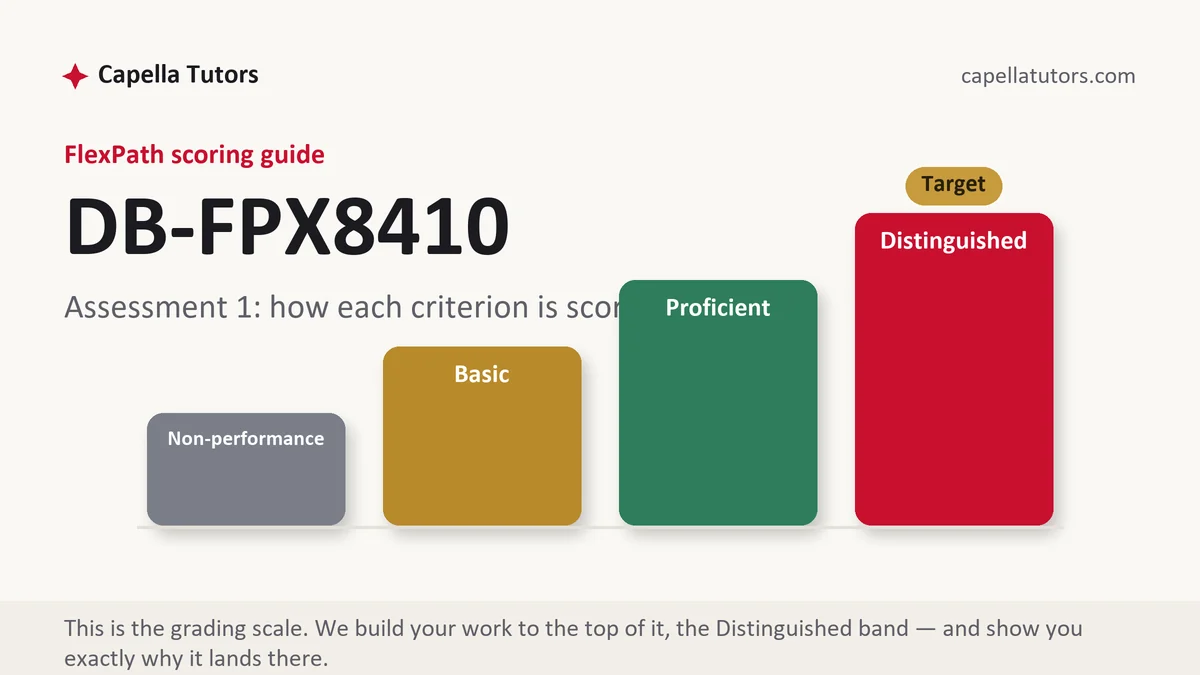
How DB-FPX8410 Assessment 1 is scored
The guide replaces the grade book in FlexPath. Four levels per criterion, and each level describes a different document rather than a different amount of effort:
| Level | What it means on a compliance situation and obligation analysis |
|---|---|
| Distinguished | The facts are separated from the interpretation, the obligation is identified by statute and provision rather than by description, the test the employer would have to satisfy is stated, state-level obligations are addressed alongside the federal floor, and the analysis stops short of predicting an outcome. Each criterion carries one further requirement; find it and satisfy it. |
| Proficient | The right statute is named, the situation is described accurately, and the analysis is coherent. Sound management work with the provision still unquoted. |
| Basic | A narrative of what happened with a general reference to discrimination or leave law, no provision, no test, and the writer's conclusions mixed into the facts. The commonest first attempt in this course. |
| Non-performance | A required element is absent, most often the authority behind the obligation. A description of a rule is not the rule, and a criterion asking for one cannot be met with a paraphrase. |
Doctoral candidates lose this deliverable in two opposite ways. One is writing as if legal training were being assessed, which produces a confident prediction no manager is qualified to make. The other is writing as if the law were background, which produces a paper that dissolves the moment a charge is filed. The competence being marked is a manager's: name the obligation, cite it, describe the test, and say plainly that the organization should take advice from counsel before acting.
The DB-FPX8410 Assessment 1 method, step by step
-
Build a dated chronology from documents
Write the facts as a timeline drawn from records rather than recollection: policy versions with their effective dates, the notices sent, the decisions made and by whom. Keep your interpretation out of it entirely. An evaluator reading a chronology contaminated by conclusions cannot assess either the facts or the reasoning.
-
Identify the obligation, then the theory inside it
Naming a statute is the first half. The second is naming which theory applies and what the employer would have to show under it, because a policy applied uniformly and a policy applied inconsistently engage different arguments even where the same provision is in play. Write the test the employer would have to satisfy in your own words.
-
Cite the provision, not a summary of it
Go to the statute or the regulation, cite it with its section and its current year, and check what the rule says now rather than what a textbook said it said. Where enforcement guidance interprets it, cite that separately and note that how an agency reads an obligation is not identical to how a court does.
-
Add the state layer before you conclude anything
State law frequently imposes more than the federal floor on leave, wage payment, scheduling and accommodation, and an analysis that stops at the federal level is incomplete for any employer with a location inside such a state. Name the states your organization operates in and say which of them adds something material.
-
Locate the root cause in a system, not a person
Ask what document, system or incentive produced the behavior. A supervisor applying an attendance policy exactly as written and configured is not the failure; the policy and its configuration are. Retraining an individual for a defect built into a form fixes nothing, and the criterion is watching for that distinction.
-
Write the scope and the disclaimer, then self-score
State what your analysis covers, what it does not, and that the organization should obtain advice from counsel before acting on it. That sentence costs nothing and demonstrates the judgment being assessed. Then mark each criterion against the top descriptor and plan around the two business days an evaluator may take.
A structure that maps to the criteria
Lengths are planning targets our doctoral desk uses for an analysis of this scope rather than Capella rules; your scoring guide fixes the sections.
| Section | What it must do | Guide |
|---|---|---|
| Situation and chronology | Dates, counts, decisions and policy versions drawn from documents, with the writer's interpretation kept out. | ~250 words |
| Obligations engaged | The statutes and regulations in play, cited by provision and year, with the theory that applies named. | ~300 words |
| The test the employer faces | What the organization would have to be able to show, and which of those things the record currently supports. | ~250 words |
| State and local layer | The jurisdictions involved and any obligation exceeding the federal floor that changes the analysis. | ~200 words |
| Root cause | The document, system or incentive that produced the conduct, evidenced rather than assumed. | ~250 words |
| Scope, limits and references | What the analysis covers, the counsel disclaimer, and current APA with legal sources cited by section and year. | ~150 words |
Annotated sample excerpt
An original model paragraph from our doctoral desk showing how the obligation section reads when it is cited rather than described. Learn the moves and write your own.
The operator employs 1,150 people across six distribution facilities and runs a no-fault attendance system in which each unexcused absence adds one point and eight points within a rolling twelve months ends employment.1 Between January 2025 and April 2026, 47 of the 212 points assessed at the two largest facilities were applied to absences for which certified intermittent leave had already been approved, which engages the Family and Medical Leave Act and specifically the regulatory prohibition on counting protected leave against a no-fault attendance policy, cited here to the provision rather than to a benefits newsletter.2 The question the employer would have to answer is not whether the policy is neutral, since it is, but whether its administration distinguished protected absences from unprotected ones, and on the present record the point ledger contains no field that would allow the distinction to be made.3
- 1The mechanics of the policy come first, in operational detail. A reader who does not understand how points accrue cannot follow anything that comes after.
- 2A count with a denominator, a dated window, the statute named and the provision cited. The refusal to cite a secondary summary is itself part of the criterion.
- 3States the test in plain terms and then points at the record gap, which sets up the root cause without naming a person. This is the doctoral move.
The full premium sample for your exact assessment, written fresh to your scoring guide and issue, is free to request. Study it, revise it into your own voice, and submit work you understand.
The five mistakes that cost Distinguished
- Facts and conclusions written as one paragraph. An evaluator cannot test your reasoning when the record and the interpretation arrive fused together.
- A statute named without its provision. Referring to leave law establishes the topic; citing the section establishes that you read it.
- A prediction about how the dispute would end. That is not a manager's judgment to offer, and offering it costs the criterion that rewarded restraint.
- The federal floor treated as the whole obligation. For a multi-state employer, stopping at federal law leaves the analysis materially incomplete.
- A supervisor blamed for a system defect. Where the policy contains no field to record protected leave, the person applying it is not the cause.
Pre-submission checklist
- The chronology is drawn from dated documents with interpretation kept separate
- Every obligation is cited by statute or regulation, with section and current year
- The test the employer would have to satisfy is written in your own words
- The jurisdictions are named and any obligation above the federal floor is addressed
- Root cause is located in a document, system or incentive with evidence behind it
- Scope stated, counsel disclaimer included, APA matched both ways, criteria self-scored
Want the obligation analysis cited to the provision?
Send the guide and the policy text, notices or point ledger you are working from. A team of eight, including a research analyst and two reviewers who read the draft cold, returns a premium original sample inside 24 to 48 hours with every legal reference pointing at the section rather than at a summary. Revision is free until each criterion clears, and the chronology is built before a word of analysis is written.