This manual is for DB-FPX8410 Assessment 2, start to submission. The middle deliverable of a doctoral compliance course usually asks for arithmetic: turn the exposure into a range with its assumptions declared, then locate the system that produced it. Compliance problems are priced, and the phrase significant risk conceals the fact that nobody performed the calculation. What a board committee wants is a number, the inputs behind it, and the one input that would change the answer most. Below is the sequence our doctoral desk follows, the shape the costing document takes, and an annotated excerpt at the register the top column pays for. Rather delegate it? One premium original sample, built to your scoring guide, comes back inside 24 to 48 hours and is reworked at no charge until the criteria are met. Your courseroom may print this as DB FPX 8410 Assessment 2 or DB8410 Assessment 2; it is the same deliverable, and DB-FPX8410 Assessment 2 is what this manual walks through.
One honesty note before the manual: Capella revises courses and scoring guides over time, so always write to the exact scoring guide attached to your assessment in the courseroom. The course identity above is verified on capella.edu; the method and structure below are our tutors' approach to it, not Capella's official rubric text.
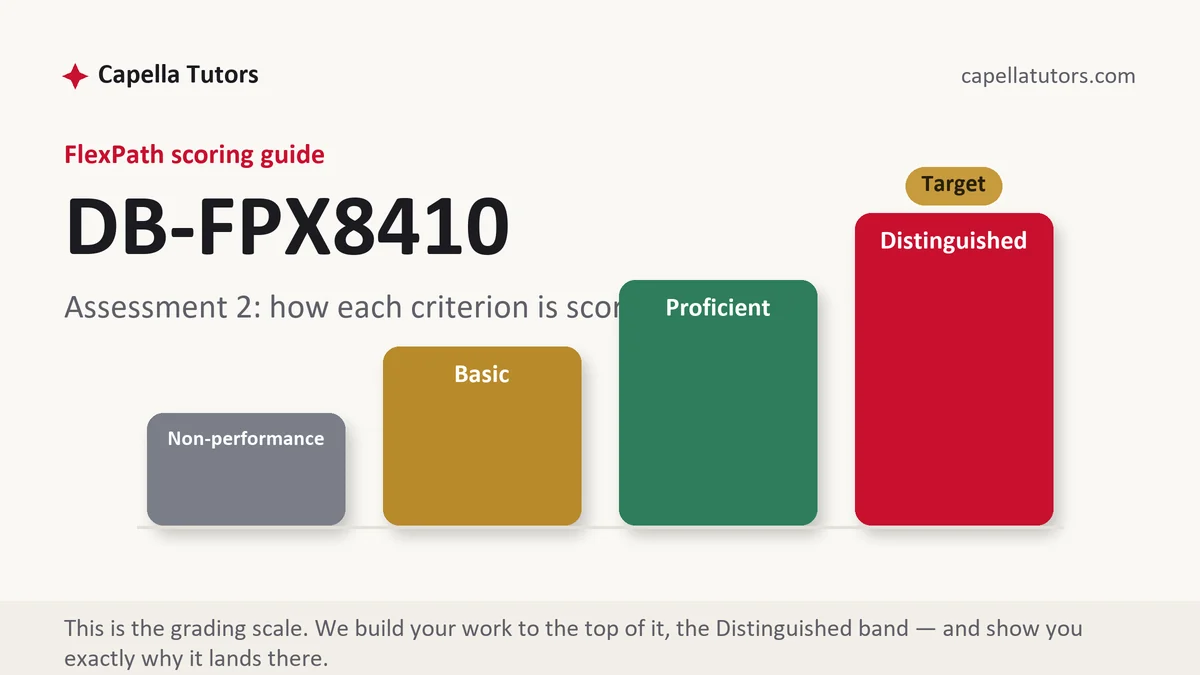
How DB-FPX8410 Assessment 2 is scored
Your score is a set of criterion judgments, not an average. Four levels each, and the level language doubles as a drafting brief:
| Level | What it means on an exposure model and root cause analysis |
|---|---|
| Distinguished | Exposure arrives as a range built from labeled inputs, each with a source and a date, with a sensitivity run on the input most likely to be wrong, and the root cause is located in a record or a process with the individual explanation ruled out by evidence. A further move is folded into each criterion; locate it and make it. |
| Proficient | A defensible cost estimate with visible arithmetic and a plausible account of cause. Competent work with the assumptions still unstressed. |
| Basic | Exposure described in adjectives, one point estimate with no inputs shown, and a cause attributed to whoever was closest to the incident. The standard first submission. |
| Non-performance | A required element is missing, most often the calculation itself. A criterion asking you to model exposure cannot be satisfied by characterizing it. |
The analytical position that earns the top column is that compliance failure and operating loss are one problem looked at from two directions. Written only as legal risk, the analysis reads as caution and executives discount it. Written only as operating cost, it gets overtaken the moment a regulator arrives. The synthesis prices the failure as a loss the business already carries, then shows that the control removing the exposure removes the loss as well.
The DB-FPX8410 Assessment 2 method, step by step
-
Write the exposure as a formula before a number
Decide what multiplies what: population times rate times period, or events times cost per event times probability. Putting the structure on the page first stops the common failure in which four unrelated figures are added together and presented as a total. The formula is also what makes a sensitivity possible later.
-
Source every input and date it
Wage rates from a named occupational series for your metropolitan area, headcount from an organization chart or postings, benefit loads modeled at a stated percentage of base pay, downtime from production records. Put the inputs in a small table with source and date beside each one, so a reader is checking your arithmetic rather than trusting your access.
-
Give the answer as a range, then stress one input
Report low, central and high figures, then take the input you are least sure of and move it, showing the total at two other values. The interesting sentence is the one saying the exposure holds above a threshold across every plausible assumption, or that it collapses if a single estimate is wrong.
-
Handle penalty amounts carefully
Statutory and regulatory monetary amounts are adjusted periodically, so cite the current published figure with its date rather than a number remembered from a course, and say in the text that the amount is subject to adjustment. Where you cannot verify a current figure, model the exposure you can verify and name the omission.
-
Trace the cause back through the records
Follow the failure to the artifact that allowed it: a form field that does not exist, a training record never closed, a job description not revised in a decade, an incentive that pays for throughput and not for the check. Then show what rules out the individual explanation, usually that the same defect appears across people and shifts.
-
Reconcile every figure, then self-score
Confirm each number in the narrative matches the same number in the exhibit, because an inconsistency inside a costing document is read as an error in the costing. Then mark each criterion against the top descriptor, add the counsel disclaimer, and allow the two business days an evaluator may take.
A structure that maps to the criteria
These lengths are our doctoral desk's planning figures for a costing document of this size, not Capella requirements; write to the sections your guide names.
| Section | What it must do | Guide |
|---|---|---|
| The finding in one paragraph | What the exposure is and roughly what it amounts to, on the first page, before any methodology. | ~150 words |
| Inputs and sources | Every figure the model uses, with its source, its date and whether it is measured or estimated. | ~250 words |
| The model | The formula, the arithmetic shown step by step, and the low, central and high results. | ~350 words |
| Sensitivity | The input most likely to be wrong, the total at two other values, and what that does to the decision. | ~200 words |
| Root cause | The record, process or incentive that produced the failure, with the individual explanation ruled out. | ~300 words |
| Limits and references | What the model excludes, the counsel disclaimer, and current APA with legal sources cited by section. | ~150 words |
Annotated sample excerpt
A model paragraph from our team showing exposure written as a model rather than as a warning. Take the structure, then build your own version.
Exposure at the bakery is modeled as three components rather than one figure, because they are verifiable to different degrees.1 The verifiable component is operational: the three guarding incidents on the night shift in the fourteen months ending April 2026 produced 61 hours of line stoppage at a contribution rate the plant states as $2,140 per hour, or about $130,500, plus 412 hours of backfill overtime at a loaded $34.80, near $14,300.2 The second component is the workers compensation reserve, which the carrier has set at $186,000 across the three claims and which is an estimate held by a third party rather than a settled cost. The third is regulatory, and it is modeled as a range rather than a point, because per-violation monetary amounts are adjusted periodically and the current published figures should be confirmed at the date of any decision; the model therefore reports the operational and reserve components as the defensible floor and treats the regulatory component as additive and uncertain.3
- 1Announces the structure before any number appears, and gives the reason for the structure. This is what stops four incompatible figures being summed into a headline.
- 2Rate times hours, both sourced, both dated, arithmetic shown. A plant controller could reproduce this line without asking a question.
- 3Refuses to invent a penalty figure and says why, then defines a defensible floor. Declining to state a number you cannot verify earns the criterion rather than costing it.
The full premium sample for your exact assessment, written fresh to your scoring guide and issue, is free to request. Study it, revise it into your own voice, and submit work you understand.
The five mistakes that cost Distinguished
- An adjective standing in for a calculation. Substantial exposure tells a reader only that the writer never built the model the criterion asked for.
- One point estimate with no range. A single figure implies a precision the inputs do not have and makes any sensitivity impossible to run.
- Incompatible figures added together. A settled cost, a carrier reserve and a hypothetical penalty are three different objects and cannot share a subtotal.
- A remembered penalty amount. Monetary amounts are adjusted periodically, and quoting a stale figure undermines every number around it.
- Cause pinned on the nearest person. Where the same defect appears across three shifts and two supervisors, the individual explanation has already been ruled out.
Pre-submission checklist
- The exposure formula is stated before any figure is reported
- Every input carries a source, a date and a label as measured or estimated
- Results appear as low, central and high, with the arithmetic shown
- The least reliable input is stressed at two other values and the effect stated
- Root cause is tied to a record, process or incentive, with the individual account excluded
- Narrative figures reconcile to the exhibits, counsel disclaimer present, APA matched both ways
Want the exposure modeled rather than described?
Send the guide and whatever incident logs, payroll extracts or training records you can share. A team of eight, a research analyst among them and two reviewers who see the draft cold, returns a premium original sample inside 24 to 48 hours with the inputs tabled, the sensitivity run and every figure reconciled to its exhibit. Revision stays free until the criteria clear.