This manual is for DB FPX 8405 Assessment 3, start to submission. The closing deliverable of a doctoral leadership course usually asks for the change itself, written for people who allocate budget: a development or structural intervention with a named population, a cost, a mechanism the evidence supports, and an evaluation capable of showing that it failed. The sentence a committee looks for is the one saying what result would end the program. Below is the route our doctoral desk takes through it, the shape the proposal ends up in, and an annotated excerpt. Prefer to hand it across? A premium original sample aimed at your own scoring guide arrives inside 24 to 48 hours and is revised at no charge until the criteria are met. Capella's catalog lists the course as DB-FPX8405, and some courserooms print DB8405; both point to this same Assessment 3.
One honesty note before the manual: Capella revises courses and scoring guides over time, so always write to the exact scoring guide attached to your assessment in the courseroom. The course identity above is verified on capella.edu; the method and structure below are our tutors' approach to it, not Capella's official rubric text.
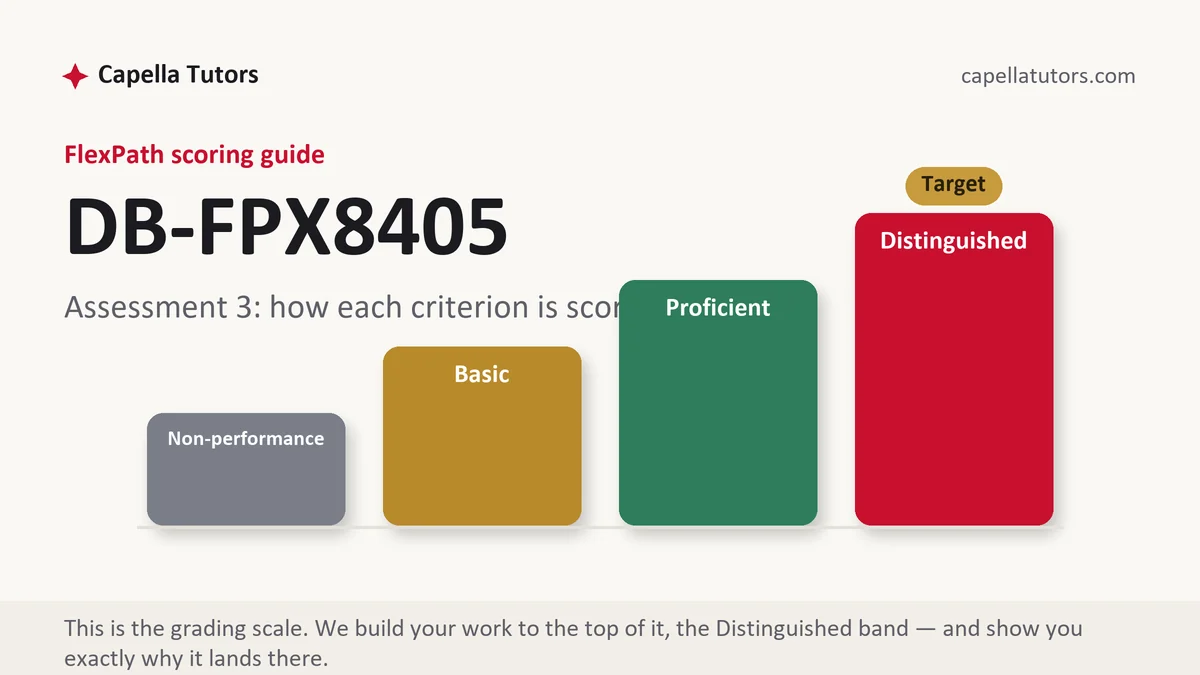
How DB FPX 8405 Assessment 3 is scored
Points do not accumulate in FlexPath; criteria clear or they do not. Four levels each, and the top one names a specific artifact:
| Level | What it means on a leadership intervention and evaluation design |
|---|---|
| Distinguished | The intervention has a population, an annual cost, a mechanism the literature supports, a comparison built into the rollout rather than bolted on afterward, and a stated result that would end it. The reader can see how the organization would learn it had failed. The extra step sits in the criterion wording; locate it and perform it. |
| Proficient | A well-reasoned change with a cost and a measurement plan. Credible doctoral work, and still reportable only as a success. |
| Basic | A development program recommended for everyone at once, measured by attendance and satisfaction, with no way to attribute any later movement to it. The shape most first attempts take here. |
| Non-performance | A required element is absent, most often the evaluation plan or the cost. A proposal without a price is a preference, and the criterion is written to catch that. |
Executives read this structure every week, which is why a doctoral document adopting it is treated as competent before its argument is weighed. The discipline the criteria are testing is willingness to design something that could embarrass you: a staged rollout costs nothing extra, converts an opinion into evidence, and gives the organization a defensible reason to continue or to stop.
The DB FPX 8405 Assessment 3 method, step by step
-
State the mechanism before the intervention
Write the sentence explaining why this change should move that outcome, and cite the evidence behind the mechanism rather than behind the popularity of the program. A workshop chosen because it is available is not a mechanism, and the criterion asking why this intervention is looking for a causal story you can defend.
-
Define the population by name and count
Say exactly who receives the intervention, how many of them there are, and who is deliberately excluded. Everyone in leadership is not a population. A count is what makes the cost calculable and the comparison possible, and both criteria downstream depend on it.
-
Price it, including the hours it consumes
Build the annual cost from visible inputs: facilitation or license fees, participant hours valued at loaded rates, coverage for the shifts left uncovered, and the internal time to administer it. Show the arithmetic in a small table with each input sourced or labeled as an estimate, then name the input most likely to be wrong.
-
Stage the rollout so a comparison exists
Sequence the sites or teams so that those receiving the intervention later serve as the comparison for those receiving it first, and match the groups on the things that would otherwise explain a difference. If everyone starts on the same day, no result the program produces can be attributed to it, and you have spent the budget to learn nothing.
-
Write the measurement plan with a stopping rule
Name the measure, its source, the baseline, the interval, and the movement that would justify continuing. Then write the result that would end the program, in numbers. Criteria at this level reward the stopping rule specifically, because a proposal that can only ever be reported as a success tells a reader the evaluation is decorative.
-
Write the executive page, then self-score
Compress the whole thing into one page in the order a board reads it: what you propose, what it costs, what must be true, what would reverse it, and when the decision is needed. Everything else becomes an appendix. Then mark each criterion against the top descriptor and allow the two business days an evaluator may take.
A structure that maps to the criteria
These are our doctoral desk's planning lengths for a proposal of this kind rather than Capella requirements; the sections your scoring guide names govern.
| Section | What it must do | Guide |
|---|---|---|
| The problem, priced | The pattern already diagnosed, expressed as an annual cost in turnover, coverage or rework, with the arithmetic visible. | ~200 words |
| Mechanism and evidence | Why this change should move that outcome, carried by studies whose designs are named, at the magnitude they reported. | ~300 words |
| The intervention | Population and count, content, duration, who delivers it, who is excluded and why. | ~250 words |
| Cost | Annual cost built from labeled inputs, with the input most likely to be wrong tested at two other values. | ~200 words |
| Evaluation design | The staged sequence, the matching rule, the measure, the baseline, the interval and the stopping rule. | ~350 words |
| Governance and references | Who owns it, who approves continuation, the review date, and current APA matched both ways. | ~200 words |
Annotated sample excerpt
A model paragraph from our doctoral desk showing an evaluation design written so it could return bad news. Copy the structure, not the content, and write your own.
The coaching program reaches all 41 branch managers, but not on one day: the 14 branches in the Central region begin in October, the 13 in the Southeast begin in February, and the 14 in the Mountain region begin in June, with regions paired on branch revenue and fleet size so that each wave has a comparable group not yet trained.1 The measure is voluntary separations among branch staff per 100 employees per quarter, taken from payroll rather than from exit interviews, with the four quarters before October as baseline.2 Continuation past the second wave requires the trained branches to run at least 1.5 separations per 100 below their matched comparison across two consecutive quarters; a gap under 0.5, or a gap in the wrong direction, ends the program and the $186,000 remaining in the budget returns to the operating line.3
- 1The comparison is created by the sequence rather than by a separate control group, and the matching rule is stated. This costs nothing and makes attribution possible.
- 2One measure, from a system nobody can flatter, with a defined baseline period. Payroll data cannot be talked up in a steering meeting.
- 3Both a continuation threshold and a stopping rule, in numbers, with the money named. This is the sentence the top column is written around.
The full premium sample for your exact assessment, written fresh to your scoring guide and issue, is free to request. Study it, revise it into your own voice, and submit work you understand.
The five mistakes that cost Distinguished
- Everyone trained at once. A simultaneous rollout destroys the only comparison available to you, and no later movement can be credited to the program.
- Attendance reported as outcome. Completion rates and satisfaction scores measure delivery, and the criterion is asking whether anything changed.
- A cost with no hours in it. Omitting participant time and shift coverage understates the price of a leadership program by more than the fee ever amounts to.
- A mechanism borrowed from the vendor. Why this works should come from research with a design, not from the brochure of the firm being paid to deliver it.
- No condition that would end it. A proposal with no stopping rule cannot be governed, only defended, and doctoral readers treat that as an unfinished design.
Pre-submission checklist
- The mechanism is stated and cited before the intervention is described
- The population is named with a count, and exclusions are justified
- Annual cost includes participant hours and coverage, with inputs labeled and sourced
- The rollout is staged and the matching rule for comparison groups is stated
- The measure, baseline, interval, continuation threshold and stopping rule are all in numbers
- An owner, an approver and a review date are named, with APA matched both ways
Want the proposal built so it could fail honestly?
Send the guide, the pattern you diagnosed and whatever cost or turnover figures you can share. A team of eight, including a research analyst and two independent reviewers, returns a premium original sample inside 24 to 48 hours with the staged comparison and the stopping rule already written. Revision is free until the criteria clear, and the arithmetic is reconciled before the narrative goes near it.