This manual is for DB FPX 8405 Assessment 1, start to submission. The opening deliverable in a doctoral leadership course is normally a diagnosis rather than an argument about leadership: name the level you are studying, name the construct, attach a measure or an observable trace to it, and report what the pattern appears to be producing at one organization. The document that fails is rarely mistaken; it is usually a fluent set of beliefs with three models bolted on. What follows is how our doctoral desk builds the diagnosis, the shape it takes on the page, and a marked-up excerpt showing the register. Prefer to hand it across? A premium original sample built against your own scoring guide lands inside 24 to 48 hours, rewritten free until every criterion clears. Capella's catalog lists the course as DB-FPX8405, and some courserooms print DB8405; both point to this same Assessment 1.
One honesty note before the manual: Capella revises courses and scoring guides over time, so always write to the exact scoring guide attached to your assessment in the courseroom. The course identity above is verified on capella.edu; the method and structure below are our tutors' approach to it, not Capella's official rubric text.
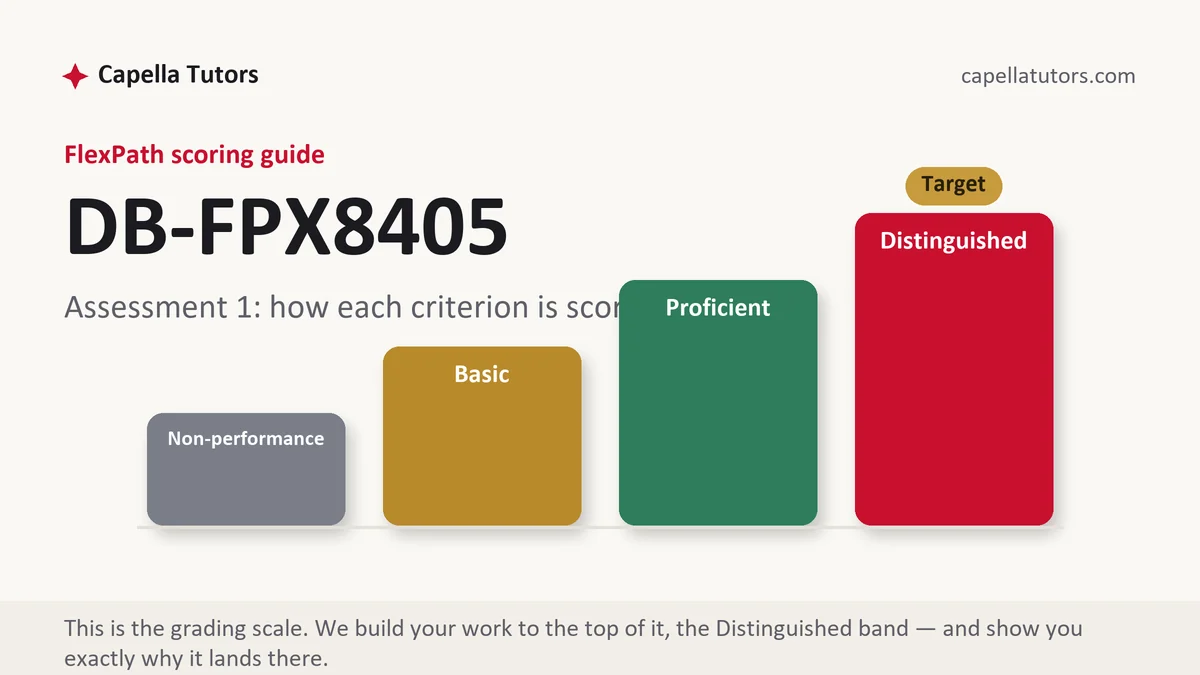
How DB FPX 8405 Assessment 1 is scored
Nothing here is graded on a curve. Each criterion on your guide resolves to one of four levels, and the descriptors tell you what to build:
| Level | What it means on a leadership diagnosis |
|---|---|
| Distinguished | The level of analysis is fixed in the opening paragraph and never drifts, the construct arrives with a definition and a measure whose weaknesses are conceded before a reader raises them, and the local pattern is quantified with the rival explanations the data cannot rule out named individually. Every criterion hides one additional move; locate it and perform it. |
| Proficient | A defensible construct, a reasonable measure and an accurate account of the pattern. Competent doctoral diagnosis, still short of the top descriptor. |
| Basic | A leadership style named and nothing measuring it, with the writer's own philosophy standing in for evidence. Where most first attempts in this course come to rest. |
| Non-performance | A required element is missing, most often any measure at all. A label is not a measurement, and a criterion asking for one cannot be met by a stronger adjective. |
An executive audience will tolerate uncertainty and will not tolerate vagueness, and the criteria are written the same way. The reason to submit a diagnosis with its limits already stated is that the alternative, borrowing the certainty of your local figures for a claim your design cannot carry, is precisely what a faculty reader at this level is scanning for.
The DB FPX 8405 Assessment 1 method, step by step
-
Fix the level of analysis, in writing, first
Decide whether you are studying a supervisor and a direct report, a manager and a team, or an executive group and a firm, then write that decision into your first paragraph and defend it. Findings do not travel between those levels, and sliding from one to another mid-document is the structural fault a doctoral reader spots fastest.
-
Choose the construct, then define it narrowly
Pick one construct and say what it is and is not. The established leadership constructs overlap in content and there is a long argument about whether some are distinct at all, so a document naming three of them interchangeably has already conceded the measurement criterion. One construct, defined tightly, outscores three used loosely.
-
Attach a measure or a behavioral trace
Name the instrument and cite its validation study, or name the observable behavior standing in for it. Where you use an employer survey built for another purpose, report the items you are leaning on and the response rate. Where no survey exists, behavioral traces already recorded somewhere will usually do more work than a questionnaire would.
-
Quantify the local pattern with a denominator
Convert the impression into a rate across a stated population and period, then compute the difference between the groups you are comparing. A number an operations director can verify buys the credibility that carries the rest of the document, and it takes the argument out of the territory of opinion in a single sentence.
-
Name the rival explanations one at a time
List the differences between your comparison groups that could produce the same result: market, wage competition, volume, tenure, seasonality. Write each as a specific alternative rather than as a general caution. A limitations paragraph confesses; a named confound with a reason attached demonstrates that you understood the design.
-
Say what the diagnosis licenses, then self-score
Close by separating what your data can carry from what only a different design could establish, and stop before recommending anything the evidence does not reach. Then read each criterion against the top descriptor, mark yourself honestly, and set your submission date knowing an evaluator may hold an attempt for two business days.
A structure that maps to the criteria
These lengths are our doctoral desk's planning targets for a diagnosis of this size rather than Capella requirements; the sections your guide names are the ones you write.
| Section | What it must do | Guide |
|---|---|---|
| Organization and level | The organization, the unit the data describes, and the level of leadership under study, stated and defended in the opening. | ~200 words |
| Construct and definition | One construct, defined against its neighbors, with the reason this construct suits the behavior you observed. | ~250 words |
| Measure and its limits | The instrument or the observable trace, its source, and the properties that weaken it, raised before a reader raises them. | ~250 words |
| The pattern, quantified | Rates across a stated population and period, the difference between comparison groups, and the arithmetic shown. | ~300 words |
| Rival explanations | Each alternative account named specifically, with what would be needed to rule it out. | ~250 words |
| Position, access and references | Your role and the access it gives, individuals described by role only, and current APA matched both ways. | ~200 words |
Annotated sample excerpt
A model paragraph from our doctoral desk showing what a diagnosis sounds like when the measure is doing the work. Borrow the moves, then write your own.
This analysis stays at the level of the first-line supervisor and the operator, and uses two behavioral traces recorded by the authority's own systems rather than a leadership questionnaire: discretionary overtime approvals per operator and the share of shift-swap requests granted.1 Across the nine depots in the twelve months ending May 2026, overtime approvals ranged from 0.9 to 4.6 hours per operator per month, and the three depots in the top third granted 71 percent of swap requests against 38 percent in the bottom third, a spread wide enough that operators at two depots in the same city work under materially different rules.2 Neither trace measures the construct directly, since both are shaped by depot staffing headroom and by route volatility, which is why the comparison below is drawn only between depots matched on scheduled headcount and route count.3
- 1The level is declared in the first clause and the measurement decision is justified in the second. A reader knows what is being studied and how before any finding appears.
- 2Ranges rather than a single figure, two traces rather than one, and a consequence stated in operational terms. The spread is the finding, and it is checkable.
- 3Concedes what the traces cannot measure and answers it with a matching rule rather than a disclaimer. This is the sentence that separates the top column from a competent account.
The full premium sample for your exact assessment, written fresh to your scoring guide and issue, is free to request. Study it, revise it into your own voice, and submit work you understand.
The five mistakes that cost Distinguished
- The leadership memoir. The criteria are assessing a leadership system at one organization, not the writer's accumulated convictions about leading people.
- Two levels in one document. A finding about a supervisor and a direct report cannot be used to explain what an executive group produced at firm level.
- A style with nothing measuring it. Describing a manager as transformational without an instrument or an observable behavior is a label wearing the clothes of a diagnosis.
- An impression with no denominator. Three managers left is a fact; three of eleven left in one year against one of nine the year before is a finding.
- Confounds waved at rather than named. Other factors may also contribute earns nothing, and each specific alternative you can name earns the criterion instead.
Pre-submission checklist
- The level of analysis is stated in the opening paragraph and held throughout
- One construct is defined, distinguished from its neighbors, and cited to its originator
- The measure or trace is named with its source and its weaknesses conceded
- Every local figure carries a population, a period and a denominator
- Each rival explanation is named specifically with what would rule it out
- Your role and access are disclosed, individuals are described by role, APA matched both ways
Want the diagnosis built on figures rather than impressions?
Send the guide and whatever survey, turnover or scheduling data you can share. A team of eight, a research analyst among them and two reviewers who read the draft cold, returns a premium original sample inside 24 to 48 hours with the arithmetic reconciled before the narrative is written. Revision stays free until each criterion clears, and it will state plainly what your data can and cannot support.