This manual is for DB FPX 8405 Assessment 2, start to submission. The middle deliverable of a doctoral leadership course usually asks you to establish how much the leadership evidence can actually bear, then apply that judgment to one organization: which claims the literature supports at what magnitude, which of them your own data reaches, and which one nothing you currently hold can carry. Separating those three is the graded move. Below is the method our doctoral desk uses, the shape the document takes on the page, and an annotated excerpt at the register the top column pays for. Rather delegate it? One premium original sample, written to the guide in your courseroom, returns inside 24 to 48 hours with unlimited free revision. Capella's catalog lists the course as DB-FPX8405, and some courserooms print DB8405; both point to this same Assessment 2.
One honesty note before the manual: Capella revises courses and scoring guides over time, so always write to the exact scoring guide attached to your assessment in the courseroom. The course identity above is verified on capella.edu; the method and structure below are our tutors' approach to it, not Capella's official rubric text.
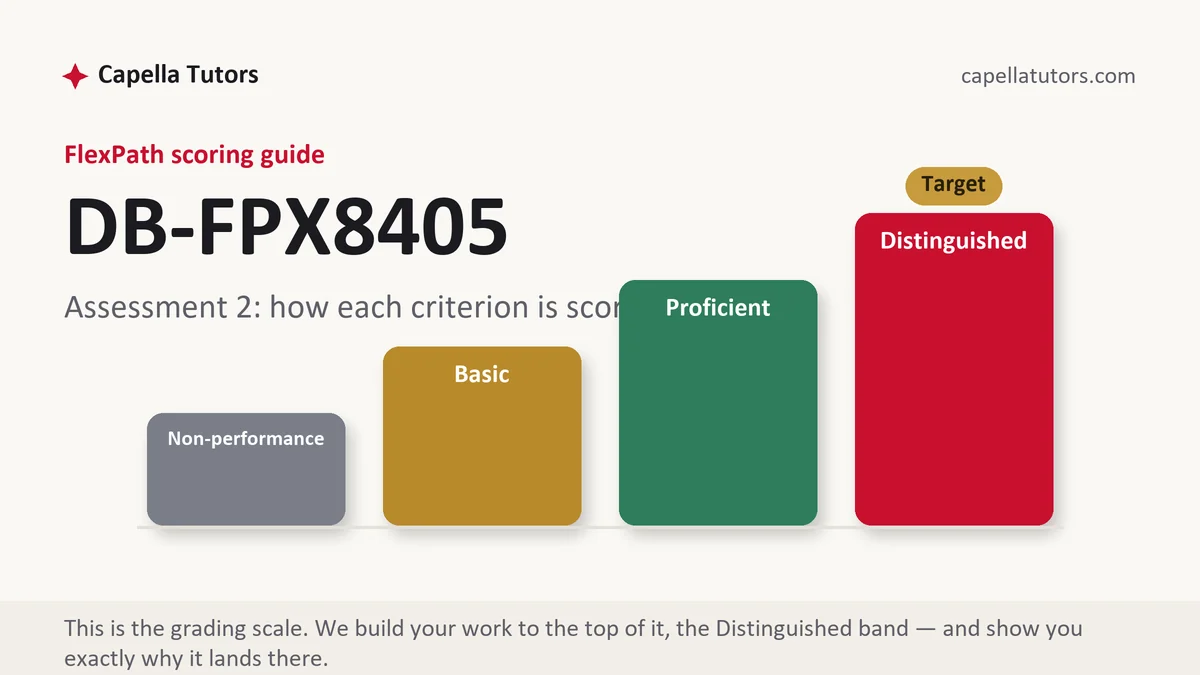
How DB FPX 8405 Assessment 2 is scored
A FlexPath evaluator marks criteria, not papers. Four levels per criterion, and the wording of each level is a set of instructions:
| Level | What it means on an evidence appraisal and measurement deliverable |
|---|---|
| Distinguished | Findings are used at the size they were reported, the design behind each one is stated, the same-source problem in much of the leadership literature is addressed rather than mentioned, and three claims of different strength are supported separately. One additional move is written into the criterion; find it and take it. |
| Proficient | Relevant studies located, reported accurately, and connected to the organization under discussion. Sound work with the claims still bundled together. |
| Basic | Correlations quoted without designs, effect sizes described as strong or significant, and the association carried straight into a recommendation. The usual first submission. |
| Non-performance | A required element is absent, most often any account of measurement quality. An evaluator cannot credit an appraisal you did not write. |
The honest summary of this field is that leader behavior is reliably associated with attitudes and intention to leave, that its association with hard performance outcomes is smaller and noisier, and that a large share of published correlations came from one respondent rating both the leader and the outcome on one instrument. That does not make the evidence useless. It makes it evidence of a particular size, and saying so is the criterion.
The DB FPX 8405 Assessment 2 method, step by step
-
Write the three claims out separately
Draft the claim your local data can carry, the claim the literature can carry, and the claim nothing you hold can carry, as three numbered sentences on one page. Most drafts in this course contain all three fused into a paragraph, and unfusing them is the single highest-value hour you will spend on the deliverable.
-
Search for designs, not for agreement
Run Business Source Complete and ABI/INFORM Global for the construct and the outcome together, and screen on design before relevance. Prefer meta-analyses and longitudinal or experimental work where the claim concerns effect, and record what you excluded and why. A search filtered by conclusion produces a paper nobody needs to read.
-
Report effects at their reported magnitude
Quote the coefficient or the meta-analytic estimate as it stands, with the number of studies and the combined sample behind it, and resist converting a modest association into a strong relationship in your own prose. Doctoral readers check the source on exactly this move, and an inflated adjective costs a criterion that arithmetic would have secured.
-
Address the same-source problem directly
Where a study captured the leader rating and the outcome from one respondent in one sitting, say so and say what it does to the estimate. Then note which studies in your set avoided it. Handling this in the body rather than in a limitations paragraph is what tells a reader you can read a method section.
-
Audit your own instrument before you rely on it
If you use a published measure, cite the validation study and check licensing, because several of the best known leadership instruments are commercial products that cannot simply be reproduced in an appendix. If you use an employer survey, report what it was designed to measure and what you are asking it to measure instead.
-
Land the appraisal on a measurable local question
Close by naming what the literature leaves undetermined for an organization like yours, expressed as something you could count. Then self-score each criterion against the top descriptor, correct anything short, and book your submission with the two business days an evaluator may take already in the plan.
A structure that maps to the criteria
Lengths below are planning figures our doctoral desk works to for an appraisal of this scope, not Capella rules; write to the sections your own guide specifies.
| Section | What it must do | Guide |
|---|---|---|
| The situation in brief | The organization, the level, and the leadership pattern already established, restated with its figure so the appraisal has a target. | ~150 words |
| Search and selection | Databases, strings, design screens and the count surviving each stage, with exclusions explained. | ~200 words |
| What the evidence supports | Findings at their reported magnitude, each with design, sample and setting, grouped by the mechanism they assume. | ~400 words |
| Measurement quality | Instruments, their validation, the same-source problem, and what your own proxy can and cannot register. | ~300 words |
| Three claims, supported separately | The local claim, the literature claim and the causal claim, each carried only by evidence that reaches it. | ~250 words |
| References | Current APA both ways, framework sources cited to their originators, instrument sources cited to validation work. | as needed |
Annotated sample excerpt
An original model paragraph from our team, written to show appraisal doing work rather than reporting reading. Study the moves, then build your own.
Three claims are in play at this grocery co-operative and they are not equally supported. The first, that store directors hold margin accountability without pricing authority, rests on the co-operative's own delegation schedule and on 31 of 44 directors reporting in the March survey that they cannot adjust a shelf price without regional approval, and the internal record carries it.1 The second, that mismatched accountability and authority is associated with lower engagement and higher intention to leave, is carried by the empowerment literature at a modest magnitude, with the larger estimates coming from cross-sectional designs in which one respondent supplied both the authority rating and the outcome.2 The third, that restoring pricing discretion at this co-operative would reduce director turnover, is carried by nothing currently available, which is why the proposal that follows is built to find out rather than to assert.3
- 1The local claim is tied to a document and a count from a named month. An evaluator can see which evidence supports which claim without reconstructing the logic.
- 2Reports the association at the size the field actually found and names the design flaw inflating the upper end. No adjective does the work a number should do.
- 3States plainly that the causal claim is unsupported and converts that into a reason for the design. Borrowing strength from the first claim here is the exact error the criteria hunt.
The full premium sample for your exact assessment, written fresh to your scoring guide and issue, is free to request. Study it, revise it into your own voice, and submit work you understand.
The five mistakes that cost Distinguished
- An association promoted to a cause. Cross-sectional survey data support a statement about pattern, and a recommendation built on one has to say which it is.
- Effect sizes described rather than reported. Strong, robust and significant are the words a paper uses when it did not open the results table.
- Constructs used interchangeably. Treating four overlapping leadership measures as one thing concedes the measurement criterion before the analysis begins.
- An instrument named without its validation study. Naming a published measure and skipping the citation is the most reliably lost criterion in this deliverable.
- The same-source problem parked in limitations. It changes the size of the estimate you are relying on, so it belongs where the estimate is used.
Pre-submission checklist
- The local, literature and causal claims appear as three separately supported statements
- Every effect is quoted at its reported magnitude with study count and combined sample
- Each study arrives with its design, its sample and its setting attached
- Same-source measurement is addressed where the estimates are used, not in a footnote
- Instruments are cited to validation work and licensing checked before you rely on one
- Current APA both ways, frameworks cited to originators, self-scored against the top level
Want the evidence weighed at its real size?
Send the guide, the construct you are working with and any survey or delegation records you can share. A team of eight, including a research analyst and two reviewers who see the draft cold, returns a premium original sample inside 24 to 48 hours with every effect quoted at its reported magnitude. Free revision until the criteria clear, and faculty comments re-enter the same pipeline at no cost.