How to write BUS-FPX4802 Assessment 1

The short answer

This manual is for BUS-FPX4802 Assessment 1, start to submission. Assessment 1 in BUS-FPX4802, Change Management, usually asks you to define a change in terms of what people will do differently and then establish whether the organization is in any state to absorb it, using evidence rather than optimism. Your scoring guide decides whether that arrives as a diagnostic report, a readiness assessment or a briefing for a sponsor. FlexPath scores it against your own guide one criterion at a time, four levels, no letters. The rest of this page is the method, a structure that lines up with the criteria, and one annotated excerpt. Rather hand it over? Send the prompt and a premium original sample is back inside 24 to 48 hours, revised free until the guide is satisfied. Your courseroom may print this as BUS FPX 4802 Assessment 1 or BUS4802 Assessment 1; it is the same deliverable, and BUS-FPX4802 Assessment 1 is what this manual walks through.

One honesty note before the manual: Capella revises courses and scoring guides over time, so always write to the exact scoring guide attached to your assessment in the courseroom. The course identity above is verified on capella.edu; the method and structure below are our tutors' approach to it, not Capella's official rubric text.
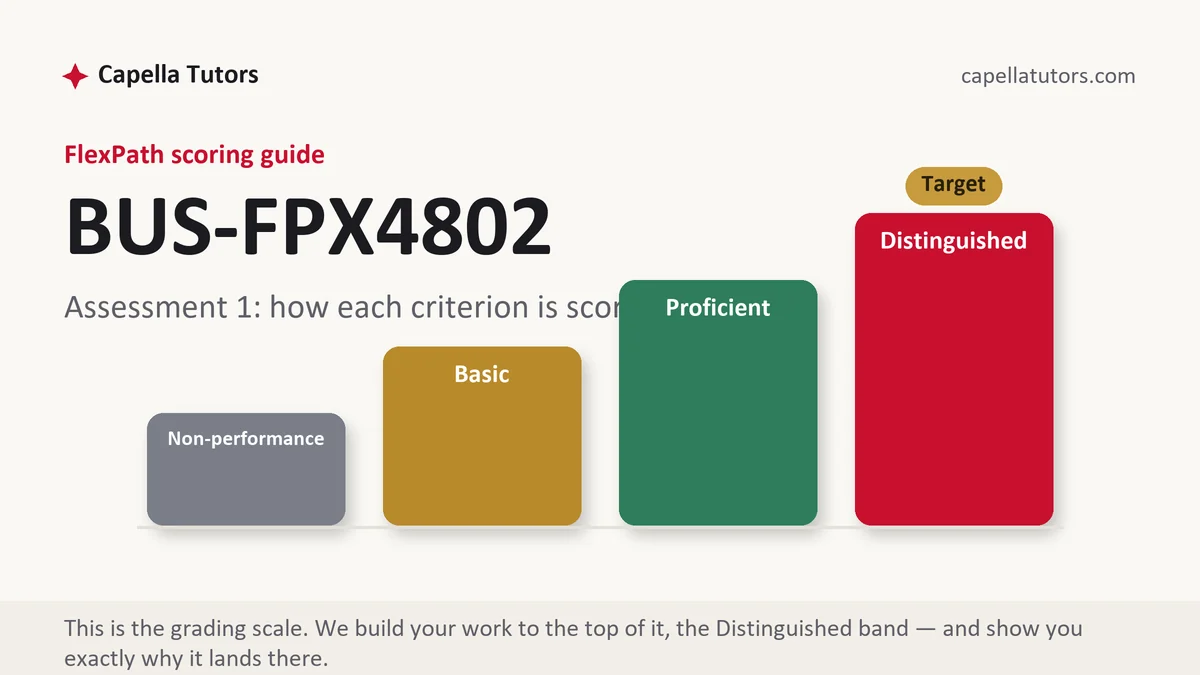
BUS-FPX4802 Assessment 1 grading scale at Capella FlexPath, the criterion levels this assessment is scored on, from Capella Tutors
How Capella FlexPath grades BUS-FPX4802 Assessment 1, visualized by Capella Tutors.

How BUS-FPX4802 Assessment 1 is scored

No letter grades exist in FlexPath. Each criterion returns at one of four levels, and that wording is the assignment:

LevelWhat it means on a readiness assessment
DistinguishedThe change is described as observable behavior, readiness is measured against named factors with evidence for each, prior initiatives are named including the abandoned ones, and the assessment reaches a verdict specific enough to change the plan.
ProficientThe change is defined clearly and readiness is assessed across several factors with support. Solid work sitting one row below the top.
BasicA description of the new system, a paragraph saying that people resist change, and a conclusion that the organization is somewhat ready. Easily the most common first submission.
Non-performanceReadiness asserted with no evidence, or the change never defined in terms of what anybody does differently. An absent element floors the criterion.

The verdict is what most drafts get wrong. Somewhat ready tells a sponsor nothing and cannot be acted on. Ready in the warehouse and not at the counter, or ready on capability and short on capacity until the winter season ends, gives them something to schedule around, and that specificity is what the top level of the criterion is describing.

The BUS-FPX4802 Assessment 1 method, step by step

  1. Convert the criteria into headings before you write a word of background

    Each criterion becomes a section, and its top-level wording sits underneath as your brief. Background about the company earns nothing on its own, so keep it to what the reader needs in order to follow the diagnosis.

  2. Define the change as behavior, not as a purchase

    Write the sentence that says who will do what differently. Not a new system, but the nine staff from the acquired site will ring sales on the surviving till, stock counts will be entered nightly on a handheld, and the paper count sheet will stop existing. Anything you cannot phrase that way cannot be measured later.

  3. Pick readiness factors you can actually observe

    Choose four to six and name them: the record with past initiatives, how much change is already running, trust that leadership follows through, capability in the affected group, and slack in the calendar. Observable evidence beats a survey you cannot run, and it is what a practitioner looks at first anyway.

  4. Score the factors and show the arithmetic

    Put each factor on a simple scale, total it, and express the total as a percentage of the maximum. A readiness score of 13 out of 25 is a finding; a paragraph saying readiness is mixed is not. State that the scale is your own construction and say what it cannot capture.

  5. Count the history, including what was quietly dropped

    List the initiatives launched in the last three years and mark each finished or abandoned. One completion in four is the single most useful number in the whole assessment, because it tells you what the workforce already believes will happen to this one.

  6. Write a verdict a sponsor could schedule around, then self-score

    Say where the organization is ready, where it is not, what would have to be true before starting, and what you would do first. Then mark each criterion D, P, B or N yourself and lift anything below D before you submit early in the week.

A structure that maps to the criteria

The targets below are how our tutors plan an assessment of this size, not a Capella requirement; expand whichever section your guide weights hardest.

SectionWhat it must doGuide
The change in behavior termsWho does what differently, from when, and what stops being done at all.~200 words
Why nowThe trigger, the cost of leaving things as they are, and the deadline if one exists.~150 words
Readiness factors and evidenceEach factor named, the observable evidence behind it, and the score you assigned.~400 words
History with changeInitiatives counted, outcomes stated, and what the pattern implies about belief in this one.~250 words
Method and limitsHow you gathered the evidence, over what period, and two sentences on what it cannot show.~150 words
Verdict and referencesWhere it is ready, where it is not, the first action, and APA reconciled in both directions.~250 words

Annotated sample excerpt

An original model excerpt from our team, showing what a readiness section looks like once it carries numbers. Take the moves and rebuild the passage from your own evidence.

Sample excerpt: readiness, scored Original model · Capella Tutors

Thornbury Garden & Home bought the nursery next door in February and now runs two till systems, two stock files and two ways of pricing the same shrub. The change is narrow to state: 23 counter staff will ring every sale on the surviving till, 9 of whom have never touched it, and the second stock file will be closed rather than reconciled.1 Scored across five observable factors on a one-to-five scale, readiness totals 13 out of 25, or 52 percent, against the 70 percent the implementation calendar quietly assumes: capability 2, capacity 2, leadership credibility 3, urgency understood 4, and prior record 2.2 That prior record is the number to argue from. Four initiatives were launched here in three years and one was finished, so a workforce that expects this to be abandoned is drawing a reasonable conclusion from its own experience rather than being obstructive.3

  • 1The change is stated as behavior, with the number of people who have to learn something new. Nine of 23 is the training population, and it appeared without a survey.
  • 2A total, a percentage and the factor scores that produced it. Showing the components lets a reader disagree with one score without discarding the whole assessment.
  • 3One in four completions, then the interpretation. Reframing expected resistance as a rational forecast is the move the top level of this criterion usually rewards.

The full premium sample for your exact assessment, written fresh to your scoring guide and issue, is free to request. Study it, revise it into your own voice, and submit work you understand.

Get the full sample free

The five mistakes that cost Distinguished

  • The change described as a system. Naming the software says nothing about who has to work differently, and nothing measurable follows from it.
  • Readiness asserted rather than assessed. A criterion asking whether the organization is ready is asking on what evidence, so the factors and the scores belong on the page.
  • Abandoned initiatives left out. The projects nobody mentions are the ones shaping what employees expect, and finding them is the whole point of the history section.
  • Capacity ignored. A workforce already carrying two projects has no room for a third, and a plan that assumes otherwise fails in week two.
  • A verdict nobody can use. Somewhat ready is not a finding, and it leaves the sponsor with the same question they started with.

Pre-submission checklist

  • The change written as who does what differently, and what stops
  • Four to six readiness factors named, each with observable evidence
  • A total score shown with its components and its scale explained
  • Past initiatives counted, completions and abandonments both stated
  • Method and limits stated in a short, honest paragraph
  • A verdict split by area, with a first action and APA both directions

Readiness assessment due?

Send the change you are working on and the criteria. We define it as behavior, score readiness on evidence you can actually get, count the history, and write a verdict a sponsor can schedule around. First premium sample free, delivered within 24 to 48 hours.

Keep going

Online now